





Chronic Absenteeism Focus Group Findings
In August and September 2025, Stand for Children held a series of focus groups with parents of chronically absent high schoolers and a few of those high schoolers themselves – a total of 15 participants. With rates of chronic absenteeism stubbornly high following the pandemic era, the purpose of the focus group effort was to garner insights from families about barriers to attendance and potential solutions. While many of these problems are complex and depend on significant community and systems change, we heard several actionable changes that schools could readily undertake to remove barriers and improve attendance.
Focus Groups Methodology
We recruited for focus groups primarily through Stand for Children’s Illinois email list and invited other organizations to share with individuals who would be interested, securing 15 participants across 4 groups. Almost half of the participants were from Chicago, five from the suburbs, and three from downstate. Participants received a $50 gift card for their active participation in a 90-minute focus group. To ensure participants were Illinois-based, gift cards were only distributed to physical Illinois addresses.
There are pros and cons to the focus group approach, which we decided to undertake as a way to probe questions about chronic absenteeism with affected parents, on a relatively quick turnaround time. However, there are limitations to this approach, most notably that this is not a representative sample or a scientifically validated survey. We have included our focus group script at the end of this document.
Our last focus group was held on September 11, so these conversations happened before the Immigration and Customs Enforcement (ICE) operations in the Chicago area ramped up dramatically soon thereafter. Chicago has reported 9,000 fewer students enrolled than last year, and some schools have seen steep declines in daily attendance amid ICE activity across the region. This was not a major theme in our conversations, but it is clearly a significant barrier to attendance at this moment.
Focus Group Findings
Parents mostly, but not entirely, felt supported by educators in their students’ schools to help mitigate their teenagers’ absenteeism. Most described individual educators or school counselors who they trusted. Even parents who eventually sent their high schoolers to alternative options were generally complimentary of the schools their children left. “Nobody’s dropping the ball,” said one parent. “All of those measures are in place, and it’s up to the individual to take advantage of them.”
However, this was not universal. One mom shared stories of her son with autism facing bullying from students and adults at school. Another said their student could not identify one adult in the building with whom they had a positive relationship. One considered school safety a “huge barrier,” with concerns more about violence from school security guards than from other students, while another considered behavior of other students to be a safety concern. Several were threatened with legal action for their children’s spotty attendance, which no one believed was helpful to a situation where they were already frustrated and striving to get their children motivated to go to class. One was reluctant to reach out for help from the school, seeing the responses as punitive and not supportive.
Nearly everyone, even those who generally perceived the school and staff as helpful, had some critiques that could help or ideas for improvement to systems and policies. Many of these were complex, longer-term issues, extremely important and requiring a larger and sustained effort over time from systems outside of public education. These include fixes to these pervasive societal problems:
- Poverty
- Food insecurity
- Childcare affordability
- Neighborhood violence
- Lack of resources and support for families
- Loss of a sense of community
- Loss of kindness and humanity
But other suggestions were more readily actionable changes that could be achieved in the short-term and rest within the purview of the school or district. Those recommendations include:
- Ensure Every Student Has Positive Adult Relationships in the Building. This is perhaps the most obvious finding: students are more likely to come to school when they know someone in the building cares whether they are there or not. One parent recommended many of the same activities in the Attendance Works protocol: real-time calls home when students are absent, in-home visits, proactive conversations with families, and appointment of a parent advocate or point person with whom families can communicate for attendance issues. He also recommended local meetings with parents for feedback, particularly parents who had succeeded in turning around their children’s attendance problems. But for others, it was less about informing parents – who often knew and struggled daily with students to get them to school – and more about giving students intrinsic motivation to make it to school, including feeling a sense of belonging in their school community and knowing there are caring adults who would miss them if they were absent.
- Don’t Over-Penalize Tardiness. One recurring theme, which came up in nearly every group, was that showing up to school late was often punished more harshly than not coming at all. Participants spoke of in-house detentions issued after some number of tardies and corralling students in a “tardy tank” if they were late then making them wait until the next period to go to class. The most egregious examples we heard from two parents were schools that charge monetary fines for tardiness (a practice that is likely already against state law). Granted, tardiness is also not something to strive for; however, in the words of one student participant: “Some school is better than no school.”
- Minimize Dress Code-Related Barriers. Several participants mentioned issues related to dress code violations as a source of conflict. Some parents spoke of their children being sent home for not having complete uniforms when they have been unable to get to the laundromat. A shared closet at the school could minimize absences for these sorts of infractions. Allowing hats and scarves can minimize absences when some hairstyles may require many hours of work that sometimes remain unfinished at the start of a school day.
- Minimize Cell Phone and Social Media Access. Anxiety, bullying, and peer conflicts were a recurring theme in most groups. This is critically important to address for reasons that stretch beyond absenteeism, and multiple projects are trying to tackle the ongoing challenge of supporting students’ mental health, such as the new mental health screening law, the Childhood Adversity Index, and the Whole Child Task Force. However, one moderately resolvable subtheme was the relationship between social media use and student anxiety. Though much of this occurs outside of school hours, regulating cell phone access – and therefore, social media use – within school buildings is a fast-growing movement that can help minimize this anxiety and encourage students to strengthen in-person social skills with peers.
- Provide Flexible, Meaningful Schedules and Alternative Options. Two parent participants had students who struggled mightily with attendance at their home school and found alternative schools to be a better fit. Another spoke about the career pathway program their student began as a major motivation for her to turnaround her poor attendance. Similarly, several participants talked about the importance of extracurricular activities in motivating students to attend. This echoes a larger theme that students want to see the value of their high school education and believe it is a meaningful steppingstone to the future they want for themselves.
- Improve Reliability and Affordability of Buses. Another recurring theme was the apprehension some students feel walking along dangerous routes to school and the herculean task some parents face having to drive multiple children to multiple schools in different directions. Buses truly are the lifeblood of a school system, connecting home to school for so many students. Cuts in busing and bus driver shortages may be, in part, to blame for a perception that school transportation is less reliable and accessible than it once was.
- Enable Common Sense Medication Management. One participant, a student with chronic pain from an auto-immune condition, shared that one deterrent was trying to deal with pain management during school. Even getting over-the-counter pain relievers in the middle of the day was difficult. Admittedly, we need to do more research to explore the regulatory environment for streamlining systems to support students with chronic health conditions to access medication, but we wanted to include this here as it was a valid suggestion and one that has anecdotally come up in other settings.
Chronic Absenteeism Context
Chronic absenteeism became exacerbated after the pandemic, and Illinois’ rates have remained high, with over a quarter of students chronically absent in 2024. Absenteeism rates were especially low in 2020 (11%) when schools were primarily meeting virtually and attendance was counted differently, and to some extent, that may have carried over into 2021 (21.1%). In the three years since schools returned to in-person learning, the rate jumped to 29.8% and has slowly crept downward to its current 26.3%. This is 50% higher than the pre-pandemic, 2019 rate of 17.5%.
Across grade levels, absenteeism rates vary dramatically. Kindergarten and high school face the most substantial problems, with nearly 30% of kindergarten students and 41% of 12th graders chronically absent. Though the rates vary from place to place, this pattern is the norm: high in kindergarten, decreasing throughout elementary school, increasing in middle grades, and peaking in high school.
Stakeholders broadly agree that absenteeism is a problem, though there are differences of opinion as to how to solve it. Discussions are underway through multiple venues. Vision 2030’s statement on chronic absenteeism recommends the state’s accountability system: “De-emphasize chronic absenteeism as an isolated metric and instead incorporate chronic absenteeism within the context of a set of whole-child student success and readiness indicators.” The conversation about that accountability system revamp is housed with the Illinois Balanced Accountability Measure Committee (IBAM), which held a listening tour about options for modifications to the system throughout the summer. The IBAM committee minutes shared that there was “[h]igh interest in changing the chronic absenteeism weight” reflected at the tour. The committee is expected to release the proposed changes to the system soon, and discussions indicate that “ISBE is exploring an indicator that would be the inverse of chronic absenteeism, which is consistent attendance.”
A new state law creates a Chronic Absenteeism Task Force, charged with reporting by December 15, 2027 on “approaches to help families, educators, principals, superintendents, and the State Board of Education address and mitigate the high rates of chronic absence of students in State-funded early-childhood programs and public-school students in grades kindergarten through 12,” issuing recommendations on a “coherent State strategy for addressing” absenteeism, goals for boosting consistent attendance, policy changes, and evidence-based methods for improving attendance.
Chronic Absenteeism by Year
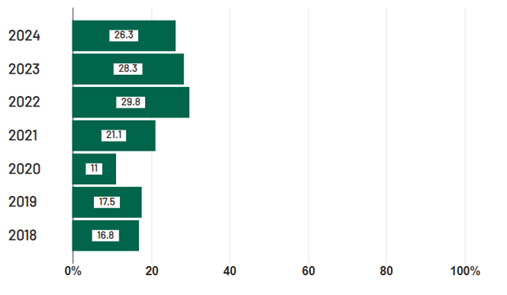
Source: ISBE Report Card.
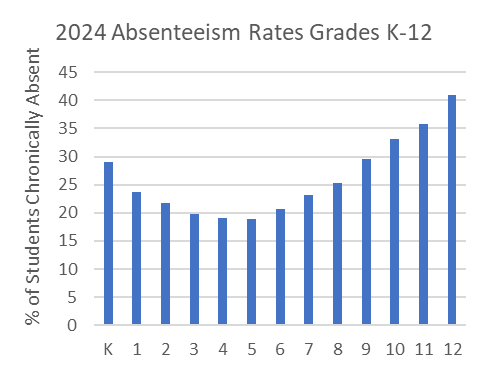
Source: ISBE Report Card., recreated chart
Shortly before the pandemic, ISBE facilitated an Attendance Commission for four years, which issued annual reports. It was during this era that chronic absenteeism became a standardized metric on the report card and a requirement for a minimum 5-hour school day was reinstated in law, and a public awareness campaign “Every Child, Every Day” to promote the importance of regular school attendance was launched. In its final report in 2019, the Commission recommended that schools use a multi-tiered system of support to provide tiered interventions to students struggling with attendance and provide real time information to parents about attendance through calls and texts and appoint a point person for their communication.
One area of discussion in the 2019 report was an ISBE proposal to remove chronic absenteeism as a factor in the accountability system following a listening tour where the agency heard criticism of the metric: “While chronic absenteeism is a strong predictor of student success, in that we know that students cannot receive instruction if they are not at school, it nonetheless represents an inequity in the accountability system. The accountability system is meant to provide a single summative designation that is an indication of school quality. Conversely, chronic absenteeism can be understood to measure the behaviors and practices of parents and caregivers which are outside the scope of what the school can control. For instance, commenters noted how many of the factors that drive chronic absenteeism, including illness and family mobility, are entirely outside the control of schools.
Common perception persists that student attendance is primarily their parents’ fault and that schools have little ability to influence whether students make it to class. What we heard in the focus groups deeply challenged that picture. Over and over, parents expressed their own frustration about the difficulty getting their students to school, the ongoing battles every morning, and the perpetual source of conflict this presented in their families.
In August 2024, the Overdeck Foundation awarded funding to five pilot programs and research partners to study attendance interventions, including one studying attendance of 95,000 Chicago middle schoolers with results being analyzed by the Consortium for Chicago School Research. The research is still in process, but initial findings suggest that “post-pandemic absenteeism varies widely between schools with similar pre-pandemic attendance rates. What appear to be key predictors are student-reported measures of climate, such as safety, connectedness, and trust between teachers and parents. These are stronger predictors of attendance than neighborhood poverty or family education levels, suggesting that strong relationships are a critical factor driving students’ engagement in learning.” This also demonstrates that the influence school-level actions can have on supporting students to get to school is significant.
The Overdeck Foundation also recently undertook polling around chronic absence to reveal what resonated most with families in trying to boost attendance. They found that effective communication post-COVID has shifted. Their research suggests the most powerful and compelling shifts in messaging their research suggests are:
- Focusing on the whole child, rather than just the importance of academics.
- Emphasizing the value of attendance, rather than the harm of absence.
- Acknowledging parents’ concerns, along with re-iterating the value of consistent attendance.
In partnership with Attendance Works last year, sixteen states have signed onto the “50% Challenge,” a commitment to cutting their rates of chronic absenteeism over five years. Illinois is not among them. Those states are supported with an Attendance Works toolkit to systematically plan goals and interventions to conquer their attendance issues.
A Word About the Chronic Absenteeism Accountability Indicator
As described above, there has been some back and forth over the last several years about how to handle chronic absenteeism in the State’s accountability system. We were concerned that with the revamped accountability plan, chronic absenteeism might have been a casualty; however, it appears based on discussions at IBAM that the indicator (or at least, its inverse: consistent attendance) will be maintained. The question remains how that will be weighed. One suggestion we offer is that holding schools accountable to a one-size-fits-all chronic absenteeism (or consistent attendance) barometer fails to appropriately consider unique school circumstances or incentivize schools that are far under or over the chosen rate to prioritize attendance improvement. Instead of asking whether each school met an arbitrary consistent attendance rate, schools would be better incentivized to focus on minimizing chronic absenteeism by asking whether the school improved its own consistent attendance rate over the last year by a certain percentage.
Focus Group Interview Script
Thank you for joining us at the chronic absenteeism focus group. Our main reason for coming together today is to hear from you and learn about your experiences with high school, either with yourself or your children, with a goal of better understanding how schools and policies can support students and families to help kids feel more engaged with school and boost attendance rates.
[Introduction of moderator.]
We ask that you maintain your camera on and actively participate in the conversation. We’ll write findings and suggestions for state and local policymakers based on what we learn in this and a couple of other focus groups, but we will not use your real names or any identifying information about you or your school. We ask that others in the room also maintain that confidentiality, as we understand these are sensitive topics.
[For groups with 8+ participants] Let’s start with some introductory questions about who’s participating today. For this, we’ll need to use the “raise hand” feature, so let’s take a minute to find that toward the bottom of your screen.
Warm-Up Questions
- Who here is the parent, grandparent, or caretaker of current high school student?
- Who is the parent, grandparent, or caretaker of a former high school student?
- Who here is currently in high school?
- Is anyone here who recently graduated or left high school?
- Thinking about your child or yourself… whoever is or was recently enrolled in high school and missed a lot of school days… I just want you to ask a little about why getting to school was difficult…
- Raise your hand if transportation to or from school was an issue.
- How about safety concerns, either feeling unsafe on the way to school or at school?
- How about needing to work or take care of children at home?
- How about mental health or social emotional issues – feeling depressed or anxious or having a hard time getting out of bed to go?
- Raise your hand if school was a big source of conflict in your house – with parents pushing their teenager to get to school and getting a lot of resistance.
- Last of our warm-up questions here… raise your hand if you/your child had a pretty good high school experience that felt meaningful where they had a decent sense of belonging.
=====Above takes 10 minutes. 80 minutes remaining. ======
Deeper Questions
If anyone raised their hand for transportation, call on one person
- [Name], you raised your hand that transportation was a barrier. Tell me about that.
- Did you rely on school bus, city bus, walking, or car?
- What was unreliable about the transportation?
- Did anyone else have trouble with the physical means of getting to school? Tell me more about your experience.
- Were anyone’s transportation concerns primarily driven by housing instability – having to move around multiple times during the student’s high school experience and needing to find a new way to get to school or needing to enroll in a new school?
- How did the school help support the student to get to school? Is there anything they could have done that would have helped?
If anyone had to take care of children or work, call on one person. If not, just to Q2.
- [Name], you mentioned childcare and work being barriers. Talk more about that.
- Was the student a parent or sibling to the children being cared for?
- Were employers pressuring the student to work these hours, or was the student or their parents asking for the hours because of a financial need?
- How about other sorts of physical or logistical reasons for missing school – like not having clean clothes or a school uniform, not having their hair done, not having school supplies?
- Is there anything the school could have done to better support you getting to school? Sometimes we hear about schools putting in laundry facilities – is that something you would have used? How about a closet of free clothes at the school? Would any of that actually made a difference in getting you there?
Q: That is all the questions I have about physical barriers and challenges to getting to school. We will talk next about safety, health, school environments, and motivation to get out of bed in the morning. But is there anything else that comes to mind about the physical logistics of getting to school that I’ve missed?
If anyone had safety concerns, call on one person.
- [Name], you raised your hand about safety. Tell us about that.
- Was the trip to school unsafe? The neighborhoods and neighborhood violence? The bus that took them to school?
- Were there interpersonal conflicts at the school with peers that felt threatening?
- What could the school have done to help make you feel safer about going/sending your child to school?
- Did anyone else have concerns about safety at school? Tell me more about that.
- How did the school staff help to navigate these situations?
- Were there other things that could have been done to help make things safer?
Q: How about just not wanting to physically wake up with the alarm to get to school, maybe staying up late the night before and just having trouble getting motivated to go.
- [Name], tell us about your experience there. (+ another couple people’s experiences)
- How early was the start time of school? How early would you need to get up to make it on time?
- What kept you up late? Work, homework, TikTok, video games? Did your family attempt any sort of efforts to confiscate the phones or cut off the internet at a certain time?
- Did it depend on what was going on at school that day? Were there things that were motivating enough that you/they would make sure to be up for (e.g., finals, a field trip, a football game)? Did the school have any sort of reward system for attendance? Was it motivating?
- Did you ever get contacted by a truancy officer or state’s attorney? Was that motivating?
- For some students, this is just about motivation/sleep/priorities, but for others, it is more complex. Did you feel like there were deeper social-emotional issues at play? Anxiety, depression, difficulty re-adjusting to in-person school after COVID?
- Were there supports for you/them at school, like social workers, who could help talk through these issues?
- Did they have teachers they trusted and confided in who helped them feel better at school?
- Are there are other supports the school could have provided?
- If you missed school, did someone call home and check in to see how you were doing?
- Was physical health a big problem for anyone? (Like, you missed a lot of school because of a chronic physical condition or because you’re being especially conscious of not showing up with a cold since we were all so protective during COVID?)
Q: [Names], you said high school did feel meaningful and like you/they had a sense of belonging. Give some examples of what felt worthwhile about your high school experience…. So, why did you have a hard time getting to school, even though it felt like a place you belonged when you were there? (Or, no one said high school felt meaningful and like you had a sense of belonging.) Who felt the opposite, like high school was a waste of time and not preparing you for your future?
- What would a meaningful high school experience look like to you?
- What goals do you have for your future? How did high school fit into those goals?
- Did you have an adult in the school building who you felt really cared about you and your future?
- What sorts of classes were you enrolled in that felt worthwhile? Any classes that you thought were a waste of time?
- Were your classes too hard or too easy? Did you have the necessary foundational reading and writing skills to access the material in your classes?
- Were vocational courses or work-based learning opportunities offered in your school? Would those have been motivating for you?
Q: Final question (if time permits): What overall thoughts do you have on how schools and communities can help get students to school more consistently?
- Are there any policies or rules that could be improved?
- How about services that could be in place? Communications from the school?
- Anything else you can think of that would have helped you get to school/get your children to school more consistently?


