
Every now and then, there’s an issue that speaks to everyone on some level. Preparing our students for a future close to home is one of them.

Today, Stand released its report detailing the issue, “STOP ILLINOIS BRAIN DRAIN: Building Pathways to Prosperity for High School Students.” The report proposes policy changes and practices that will quickly have a positive impact in helping high schools graduate more students who are ready for college, career training, or careers.

Read the report now, and then share your own high school story!

Only New Jersey loses more of its high school graduates to out-of-state colleges. These students vote with their feet, taking their well-educated minds and buying power with them. And what about those who stay, but whose potential we have failed to tap because we did not provide them with adequate guidance, training, or resources?

The moment students start high school, their schools should be setting them up well for their next phase of life, not just their next class. Students should be immersed in career possibilities and supported to understand how to achieve their career goals.

This report is the culmination of a year of study and discussions with leaders in the field by Stand’s 2017-18 Class of Policy Fellows. It points to improvements already in place in Illinois that can be leveraged to reduce brain drain. It showcases innovative programs that are having success in local districts, while also profiling some students who wished they had better access to some of these opportunities. The recommendations present achievable, impactful ways for policymakers and advocates to make prosperity a reality for Illinois high school students.

We’re also launching a video contest, because this report is just part of the story. The story left to be told is YOURS. Did you or your children have access to a great high school workplace learning experience or dual credit? Or, did you wish you had a more robust counseling program to better guide you through high school? Whatever your high school is, we want to hear it – and share it! After you read the report, take action! Tell us your story, share it with a friend, or ask your legislator to get to work to stop brain drain.

Advocates march at the Stand for Children rally in Washington, DC on June 1, 1996.

In our office are photos taken over the last couple of years of Stand members holding rally signs with messages like “Our Students Our Future” and “Illinois Kids Need Fair Funding.”

Nearby are pictures taken 22 years ago today of Stand for Children Day, the largest rally in support of children’s rights in the history of the United States and the event that started this organization.

The juxtaposition of these images reminds me that great things can happen when everyday people stand together.

Thanks to advocates like you who stepped up over the years and let Springfield know how important fair funding is for our schools, Illinois just took another important step in the direction of equity.

Yesterday, the General Assembly approved a budget package for the upcoming fiscal year that includes another $350 million for the school funding formula enacted last year. By adding more funds to the formula, the school districts that are the most under-funded receive new money first and no district loses money. That’s good news for students in every corner of the state.

What could Illinois do with that new $350 million in school funding? That decision is up to the school districts, but the possibilities are exciting to think about. $350 million could hire about 4,000 more teachers; that’s at least one for every school. It could go a long way in providing high school students with more guidance counselors – Illinois has the second-worst guidance counselor-to-student ratio in the country, and this needs to be addressed.

Illinois still has work to do to get every district to funding adequacy, but these new resources are an important boost to districts across Illinois.

We at Stand will remain focused on amplifying the voices of students, parents, and families who are fighting for equal and high quality public education, just as we have for 22 years.

Please help us celebrate 22 years of impact and consider a gift to ensure we can continue for at least another 22.

Give $22 today in honor of Stand’s 22nd Anniversary!

I’m proud to be standing with you as we continue that journey.

Last month, Stand for Children Policy Fellows Cymone Card, Abby Schultz, Dovie Shelby, and Kayla Valenti joined Stand staff on a visit to the state capital. This was a prime opportunity for the Fellows to meet up and make a difference together at the Capitol and also attend an insightful event that evening. While in Springfield, the group toured the Capitol building and had a chance to meet with several legislators to discuss education policy. That evening, the group attended a forum on school improvement hosted by Advance Illinois in partnership with other organizations, including Stand. At the forum, Rockford Public Schools, having received national recognition for developing community-aligned career academies, joined a panel discussion to share lessons from their own success.

Three of the Fellows, Abby, Kayla, and Cymone, shared their stories from the day. We hope you enjoy them and learn more about their advocacy and commitment to improving education in Illinois.

The atmosphere of Springfield was abuzz with the adrenaline and the anticipation of state government. We Fellows entered the stoic Capitol building with one eye on the décor and the other on the policy makers. Aimee and Jessica [ed note: Stand’s Policy & Government Affairs Manager and Government Affairs Director, respectively] guided us through the building, trying to connect us to our representatives and answering our many questions. With their help, I had the absolute pleasure in meeting State Senator Biss, whose down-to-earth approach to an (admittedly) giddy citizen (i.e. me) only increased my admiration of him. Meeting him, along with other elected officials, put a human side to politics. After all, the names behind policies are people, like me and like you. State government can be so accessible to Illinoisans if we know where to look–and if we take the time to reach out.

After touring the Capitol and meeting some inspirational people, the legislator forum on cradle to career education only added to this wonderful experience. Rockford has felt the effects of urbanization in its community, especially with Chicago so nearby. What their school board has done is quite innovative: investing in time, money, and community-centered opportunities in their high school students. By investing in their younger citizens, Rockford is giving students the incentive to stay in the area and use their talents to build their community as they delve into their post-secondary education and career. I hope to see other communities all around the U.S. do the same. By investing in education, by giving youth opportunities to start their post-secondary lives through accessible and affordable means, communities will thrive. Let’s hope Rockford is only the beginning of the ripple in connecting students to community.

–Abby Schultz

As a former fifth-grade teacher, I often wondered about how decisions regarding education were made. There were many political decisions and initiatives that had a direct impact on my classroom, however, I felt unsure of how to navigate conversations surrounding the complexities of the policy-making process. My experience as a Stand Policy Fellow has allowed me to develop the confidence to participate in an area that once felt overwhelming and intimidating. Traveling to Springfield and meeting with legislators at the Capital has motivated me to be a more active citizen and voice my opinions and concerns regarding education. I look forward to continuing my engagement in political discourse and advocacy-work that supports policies that best serve students. Whether that means setting up an appointment to meet with a representative, or further developing my own understanding of specific policies, I feel more confident to advocate for high-quality education in Illinois.

–Kayla Valenti

My time in Springfield was eye opening. I have been losing hope about the progress our country is making around education. However, my time in Springfield left me energized and excited. I was able to listen to wonderful speakers discuss how they collaborate to better the outcomes for children. Rockford is using an impressive model that brings different parts of the community together. One thing I have learned is that there is not a one size fits all solution for education. For example, what might work in New York City or Chicago may not work for Rockford or East St. Louis. Members of a community should learn from other communities that are successful. From there, a community can have a real conversation on what will work for their specific community. Collective impact can regenerate a community, and have very real and lasting impacts for children.

–Cymone Card

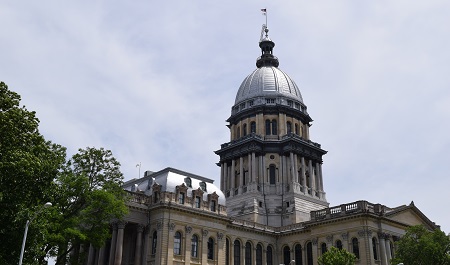
IL state capitol

Recently, the Governor issued an amendatory veto of the school funding trailer bill, which begs the question: what happens next so schools can finally start getting their new funding? But before we answer that, we’ll walk through a few other questions for background:

  • What was the funding bill?
  • What does “trailer bill” mean?
  • What is the amendatory veto (AV)?

What was the funding bill?  SB1947 was a long overdue overhaul of Illinois’s worst-in-the-nation school funding formula, supported on a broad bipartisan basis and signed into law by Governor Rauner. There were basically four steps in the new formula:

  1. First, every district would get the same amount of state funding it received last year. That’s called its Base Funding Minimum.
  2. Then, a Local Capacity Target is calculated to show how much local revenue a school district can collect through property taxes. When we add the Base Funding Minimum and the Local Capacity Target, we can see how much funding the district already has available to spend.
  3. Next, a unique Adequacy Target is determined, based on the actual costs of providing best practices to educate the student population in that district.
  4. Finally, as the state allocates new funds to education, it distributes the new funds in tiers, with the school districts whose Local Capacity Targets are furthest from their Adequacy Targets getting the most. This year, Springfield allocated $350 million in new dollars to education, a significant amount but not nearly enough to get all districts to Adequacy.

SB1947 also included the Invest in Kids Act, a program that would give tax breaks to donors who contributed to a scholarship fund for low-income students attending state-recognized, private schools.

Check out our blog post all about the funding formula here and read more about the tax-credit scholarships here. Even though the Governor has been touting this bill as the top accomplishment of his tenure and a key reason to re-elect him, last week he issued an AV that would delay the neediest schools getting the increased investment they so desperately need. Confused on why he thought doing so was a good idea? Me too.

What does “trailer bill” mean?

Almost any time the legislature passes a huge bill, there are some technical odds and ends that need to be tied up. A “trailer bill” comes after the major substantive legislation. SB1947 was one of the biggest changes in years, and as the State Board of Education (ISBE) began their gargantuan task of implementing the new formula, the agency found a couple of critical changes that had to be tweaked before releasing the new money. ISBE asked the legislature for a trailer bill to make those changes, and SB444 passed on a bipartisan basis, giving ISBE the changes it requested. The House unanimously voted for the trailer bill, and the Senate voted 42-11 for it.

Specifically, the technical changes in SB444 fixed two drafting errors, both of which assumed that districts had access to more property wealth than they actually have. (This is important during that second step: calculating the Local Capacity Target.) Some of those districts couldn’t access the local revenue for a variety of reasons, but regardless, the result is that 178 school districts would unfairly appear to be more adequately funded than they actually are.

There are likely dozens of other technical changes to discuss and clean-up in another trailer bill in the longer term. But these fixes in SB444 are the most critical two to ensure that the funds go where they were intended.

What is the amendatory veto?

Instead of signing the bill into law, the Governor issued an amendatory veto adding another change that has to do with the difference between being a state-recognized school, or merely a state-registered school. Right now, only state-recognized, private schools can participate in the Invest in Kids program Some might say that before tax dollars go to private schools, the schools should at least cross a minimum threshold. Recognition requires site visits, curriculum reviews, staff background checks, anti-discrimination policies, and other ISBE oversight. After all, public school performance is transparent because of the state’s school report cards; there is no private-school equivalent.

The amendatory veto would expand participation in the tax credit scholarship program to schools that are state-registered by February 2018; effectively 250 private schools that are “registered,” but not “recognized,” would automatically be eligible.

Some private schools say they have never pursued recognition because there was no reason to, but now they are scrambling to go through the recognition process so they can accept scholarships.

What happens next before schools can get their funding?

ISBE has a challenge ahead of it to implement the new funding model for the first time, and the language confusion adds to an already-tough job. The Senate comes back to session on January 30, so that is the soonest SB444 could see legislative action. At that point, there are three options, and it is generally up to the chief sponsor to decide which one to pursue (with one big caveat*):

  1. They can override the AV, which requires a three-fifths majority vote. Then the language of SB444 before the AV would take effect, and tax-credit scholarships would only go to state-recognized private schools.
  2. They can accept the AV, which requires a simple majority vote. Then the language of SB444 would take effect, including the Governor’s recommended change expanding participating private schools.
  3. Or, they can do nothing, which would leave 178 school districts with inaccurate local wealth assumptions and cause even more confusion about implementation.

When reasonable people have a desire to compromise and meet each other halfway, they can sometimes negotiate an agreement to address the issues in an AV through another bill. The question is whether leaders in Springfield are feeling amenable to compromise these days. The school year is almost halfway over. We’ve all celebrated passage of this historic bill, which indeed deserves celebration – but our students still haven’t seen a penny of new money through the formula. It is time to stop the administrative delays, give ISBE what it needs to do its job, and get our schools the new investment we promised.

*About that caveat, it is up to the Rules Committee or Assignments Committee to assign the chief sponsor’s motion. (Literally, the chief sponsor will sign a piece of paper that says they move to accept the Governor’s changes or override them. That “motion” is filed and comes before these procedural committees that assign legislation to their next destination, like a substantive committee or to the floor.) If an amendatory veto is deemed “non-compliant,” the Rules Committee won’t move forward a motion to accept the changes. Amendatory vetoes that exceed the scope of the original bill are deemed “non-compliant.”

One of my favorite desserts is a piece of good chocolate cake.

Plenty of ingredients go into making a cake. And plenty of ingredients go into grading schools. As a new parent, it’s important to me that those ingredients make our schools better.

But for too long, Illinois schools have basically been graded on a single ingredient: how many students meet a specific standard. All the other ingredients that go into making a strong school were ignored.

Now, a law called the Every Student Succeeds Act (ESSA) allows Illinois to create a better recipe for school quality. And our state did just that.

Learn more about Illinois’ improved recipe for grading schools through our fun (and delicious!) ESSA recipe video. It will only take two minutes!

No more ignoring important ingredients like school culture, graduation rates, and English learner progress. Many parent suggestions were included in the approved plan, so it is good to see this positive policy development.

As parents, educators, and community members, we deserve to know how our schools are doing. Just like using a full recipe gives you a delicious cake, this new and improved recipe gives us a more complete picture of how our schools are doing and where they need improvement.

But we can’t let this recipe for school quality just sit on the shelf. It must be used for the best results! And I know you will help us in this next phase of the ESSA campaign.

Join us to help Illinois make the most of this new recipe. Visit our ESSA resource page to learn more and sign up to stay in the loop on important education initiatives in our state.