
Confused About… the Federal Tax Credit Scholarship Program? 

Everywhere I look for information about this new federal OBBBA scholarship law, I find arguments from ideologues who are already well entrenched in their feelings about school choice forcefully advocating that Illinois opt out altogether or stridently declaring that we’d be stupid not to take the free money. (For example, here’s a letter from numerous orgs asking Governor Pritzker to opt out,  Comptroller Mendoza editorializing in favor, four Democratic Governors opting out while one opted in, and Illinois Policy Institute supporting and organizing counties across the state to ask a ballot question about it.)  

What I see is a whole lot of gray area and questions. And I’ve been asking them. So, I thought I’d share what I’ve learned so far.  

To be sure, this isn’t the kind of program I would have designed or supported if my goal was to improve educational outcomes and opportunities for the kids left furthest behind in the current system. Looking at the federal law, there are no restrictions on the quality of the programs, requirements for measurement of results, provisions against discrimination of who enrolls, or attempts to balance where scholarships are awarded to enhance equity. Upper-middle class students are just as eligible for scholarships as the most impoverished students. 

But the fact is that the program exists. Illinois taxpayers are eligible for the tax credit whether or not Illinois opts in for our students to receive scholarships. There is no impact on state revenues. The federal coffers have potential to take a big hit, and it’s anyone’s guess whether that will result in lower allocations to public education in future years vs. getting added to a growing deficit vs. spending on military, Medicaid, SNAP, or other programs – but again, Illinois taxpayers will still be able to donate – at no cost to themselves – to scholarship programs in Indiana or Iowa whether or not we participate. 

What’s the Federal Tax Credit Scholarship Program? 

It’s a provision of H.R. 1, better known as the “One Big Beautiful Bill Act” (OBBBA), giving taxpayers an up-to-$1,700 credit on their federal income taxes if they contribute up to $1,700 to a “Scholarship-Granting Organization” (SGO) starting in 2027. That’s a dollar-for-dollar credit, and there’s no cap on the number of taxpayers who can use it. So, this has potential to become a huge program.  

Governors essentially have the unilateral power to identify SGOs; there’s no need for legislation, or consensus from education agencies, or anyone else. OBBBA requires SGOs to be non-profit organizations that spend at least 90% of funds on scholarships, grant scholarships to more than one school, and verify that family income is less than 300% of the area median income (which is about $360,000 for a family of 4 in the Chicago metro area).  

What Types of Scholarships Can Be Funded? 

So far, it looks like many types of scholarships would qualify – tuition to private schools; tutoring, afterschool programs, and summer camp for students in public schools; career development and workforce training for high schoolers; extracurricular activities; and probably lots of other things I’m not thinking of yet among a broad ecosystem of programs. The key is that there must be a non-profit set up to administer the scholarship (and that will take some effort to stand up this sort of organization – here’s a blog about how to start one). 

The main question on my mind isn’t what can be funded, so much as it is what can be blocked from funding. How much power will governors have to pick and choose who gets on their list? We won’t know until late spring/early summer when the Department of Treasury issues regulations. By law, this program is super flexible and governors have a lot of autonomy and power to decide. But in regulations? Department of Treasury wrote in its request for public comment that it “anticipates” requiring inclusion of all SGOs who meet the minimum criteria and request to be on the list.  

Under the minimum criteria, here are some examples of what works and doesn’t work: 

  • If the for-profit House of Violins wanted to accept donations to give free violin lessons to children who live in a nearby public housing high-rise, that wouldn’t work because it isn’t a non-profit. If it created a non-profit arm to receive donations for free violin lessons, that also wouldn’t work because scholarships can’t go to just one school. If all the music schools in the city jointly created a House of Music non-profit to fund lessons for students in multiple schools, that would seem to work.  
  • For another example, if Main Street High School wanted to raise funds to award scholarships for students to participate in a summer enrichment program, they’d have trouble since the school isn’t a non-profit organization. If the Friends of Main Street High School Foundation agreed to raise the funds, they would have to broaden their reach to give to more than one school and verify family income to ensure students receiving scholarships fall under the 300% average area median income threshold.  

What’s the Case for Opting In? 

In an era of unprecedented federal actions against public education, this could be a real opportunity to boost funding and open doors for students. Every public school, after-school program, park district, and tutoring provider could choose to partner with a nonprofit that meets the criteria to qualify as an SGO, widely disseminate information to their constituents to raise funds, cast a wide net to reach the neediest populations of students, and provide opportunities for students who otherwise couldn’t afford them for tutoring, enrichment, and summer camp. Even better, statewide nonprofits could intentionally organize to fundraise from the areas of the state that have the most income and award scholarships in areas with the least resources – mitigating the inequities that would be likely if left to local nonprofits raising and gifting in wealthy areas and leaving poorer regions without scholarships.  

Regardless of federal regulations, this scenario could happen. But it would strongly depend on intentionality in the creation and promotion of SGOs that prioritize equitable opportunities for public school students.  

If federal regulations allow, the state could also add more guardrails: lower income thresholds for scholarship recipients; a prohibition on scholarships to entities that discriminate based on disability, sexual orientation, or religion; and a requirement that schools accepting scholarships release some kind of audit and report on program effectiveness.  

And more importantly, Illinois taxpayers still qualify for the tax credit regardless of whether Illinois participates. If Illinois doesn’t opt in, our neighbors who have already opted in (Indiana, Iowa, and Missouri) will market to Illinoisans to donate across the border, as will states across the country.  

What’s the Case for Opting Out? 

The program obviously wasn’t created with the above scenario in mind—it was created for private school vouchers. Even in the best case scenario, unless federal regulations allow states to impose further guardrails, the majority of scholarships are likely to go to private schools. That could have some negative repercussions if lots of bright students leave their public schools, courted by private schools. (Some research on similar programs show a lot of scholarships go to students who are already there, in which case it seems the impact on the public school would not be some dramatic. So (slightly) lower-income private school families save some money they otherwise would have spent on tuition, while driving the federal deficit a little deeper.) 

If scholarships do indeed drain public schools of significant students, Evidence-Based Funding (EBF) will reflect the decreased enrollment, the school will be closer to its adequacy target, and its funding could be impacted. However, it’s highly unlikely the state will discontinue its promise of allocating $300 million to EBF, so the same amount of state funding should continue going to schools. Still, if students going to private schools are concentrated in particular districts, those schools could net a smaller increase from EBF tier money.  

At the macro-level, there’s no direct connection between the drain on federal resources through the tax credit and the federal education budget. But it wouldn’t be a surprising leap to see a justification for a budget decrease if the tax credit generates significant funds for scholarships. Whether or not Illinois participates, this scenario could happen – though if fewer states participate and fewer people are persuaded to take the credit, the total hole in federal tax receipts would be lower.  

So where does this leave us? 

My personal conclusion is that I’m not comfortable leaving the gray area until the federal regulations are unveiled. There are bills pending requiring Illinois to opt in and others requiring opt out. It doesn’t seem like the right time for any of them… yet. I think Governor Pritzker has the right idea: wait to see the fine print before we get in over our heads.  

Still Confused about the School Accountability System Changes?  

MARCH UPDATE: Unfortunately, the final accountability system draft has been released and discussed at the March ISBE meeting and it looks like it’s a done deal. We are disappointed that we are losing the indicators for ninth-grade on-track and college and career readiness, and that schools with 50-point achievement gaps can still receive the highest rating. The one glimmer of hope we have lies in this sentence: “ISBE remains committed to exploring the possibility of additional elevating indicators in the future, particularly in the area of college and career readiness.”

Our last ask is for ISBE to develop a clear timeline for developing a valid college and career readiness indicator to incorporate within three years. Without intentionality, that “commit[ment] to exploring” other indicators means little. Illinois already tracks lots of data that could feed into this metric, like Career and Technical Education concentration, Dual Credits, AP Tests passed, Freshmen-on-Track rates, and Seals of Biliteracy. Forty-two other states have figured this out and included some kind of college and career readiness metric. It’s not just about graduating; it’s about preparing students for what’s next.

If college and career readiness matters to you, would you take a minute to sign this petition?


In November, we shared our thoughts on proposed changes to Illinois’ school accountability system. Since then, the Illinois State Board of Education (ISBE) has released another version. Next month, the third and final draft will be out – so we have one month to act! Sign up with your email to stay informed:

What’s an “Accountability System”?

What’s an “Accountability System”? 

Think of the state’s accountability system as a grading system for schools. Every state in the country must have one. You’ve probably heard of “No Child Left Behind” (“NCLB”), which was replaced by the “Every Student Succeeds Act” (“ESSA”) a decade ago. NCLB had lots of problems, perhaps the biggest flaw being that schools were graded on just one thing: how many kids passed the test. (And that, of course, doesn’t tell us much about the contributions of the school to student learning because test scores are so correlated to family income.)  

So, we celebrated when NCLB was replaced by ESSA, which looked at lots of other ingredients of school quality. States had more flexibility to decide what to consider and how to support schools to improve. (We got to do my favorite work project ever: this  cake video! In fact, if you prefer to get all your ESSA news via recipe videos, click here to jump to the bottom of the blog where we have linked all the recent ones.) 

Why should we care?  

Every school is going to be held to these standards and receive a rating label based on their performance, so it is super important for us to measure what matters. For parents and communities, this information is often the most accessible way to see how well local schools are doing. If we give schools their grade based on things they can’t control (much like the NCLB era), communities see a distorted picture of the influence of the school. But if we have a well-designed system that measures outcomes accurately, schools are incentivized to focus on improvement and families get a transparent look at school quality.   

Are the changes good?  (Some of them! ) 

Criterion-Based Scoring

Everyone we’ve heard from really likes that the proposed system is based on clear goals instead of ranking schools against each other. The system in place now ranks the top ten percent of schools for the highest rating category, which leaves schools complaining about changing goalposts.  

Clear Summative Labels

The current system ranks 70% of schools as “Commendable,” which doesn’t tell us a whole lot. The proposed changes split schools into five rating categories with more clarity in the labels. Draft #1 included the labels: Exemplary, Commendable, Approaching, Developing, and Comprehensive, but many were concerned that they would drop from their prior “Commendable” rating. The newest draft names the labels: Exemplary, Approaching Exemplary, Commendable, Developing, and Comprehensive.  

Some Valuable Indicators Included

We appreciate the continued focus on academic growth and reducing chronic absenteeism. (We continue to have concerns with some of the indicators that ISBE is proposing eliminating though.)

Graduation Rate Tied to Growth and Proficiency

The proposed system would be based on three “core indicators” for high schools (proficiency, growth, and graduation rate) and two for elementary (proficiency and growth), with three “elevating indicators” (English Learner growth, consistent attendance rate, and climate survey participation). The first draft based the rating on whichever of the core indicators is highest – which is almost always graduation rate. We and other expressed concerns that graduation rate would mask other student performance indicators, so ISBE addressed this in the new draft, now tying graduation rate to growth or proficiency so graduation rate alone would not determine the final rating.  

What’s Concerning? 

It Gives Up on College and Career Readiness Indicators

The current system was designed to include more robust indicators assessing students’ readiness for graduation, post-secondary education, and career, but the agency was never able to successfully incorporate those. This is disappointing because graduation alone isn’t the goal. Students need meaningful high school experiences that prepare them for their future. Even if the design of the metric didn’t work out, ISBE collects lots of data about early college credit, career pathway completion, and seal of biliteracy attainment – all of which would be great additions to the system.

Freshman-on-Track Goes Away

Freshman-on-track is an incredibly powerful metric, with strong research originating from the Consortium for Chicago School Research showing that students who were ‘on-track’ in 9th grade were four times more likely to graduate. Chicago was the home of this measure, with a strong focus on freshman-on-track rates driving a large part of CPS’s huge rise in graduation rates over the last 25 years. ISBE says freshman-on-track too closely tracks with graduation rate to be a meaningful indicator. We disagree: freshman-on-track rates change three years before graduation rates, so it gives an earlier indication of changes. It also sends the wrong signal to remove it as an accountability indicator.  

Student Demographic Groups Only Influence the Outcome if There’s a Huge Gap

If a student group (like low-income students, Black students, white students, students with IEPs, etc.) scores in the lowest rating category, the final rating moves down one notch. But if a student group falls in the second-to-lowest category, there is not penalty. This could mean a school still scores “Exemplary,” even with a 50-point gap in among student groups. We believe the final rating category should never be higher than two rating categories above the lowest-rated student group.  

Indicators Don’t Factor in Growth

The “consistent attendance” (i.e., inverse of chronic absenteeism) metric sorts schools into categories based on whether they hit certain attendance benchmarks. For example, if over 85% of high school students are consistent attendees, the school is ‘Exemplary.’ If 70% – 85% are consistent attendees, the school is ‘Approaching Exemplary.’ (Keep in mind here that 70% is five points lower than state average.) If fewer than 40% of students are consistent attendees, the school is ‘Comprehensive.’ But if a school grows its consistent attendance rate from 70% to 80%, the system does not recognize that.  

What Can I Do? 

First, please sign this petition calling for the Illinois State Board of Education to adopt reasonable policies surrounding college and career readiness indicators and community involvement.

Next, spread the word! Share this blog or any of our videos on social media, ask your friends or colleagues to join you at a listening session, give public comment at the March 11 ISBE Board Meeting, or reach out to us if you have any questions about the content or process.  

Watch to Learn More

Jessica Handy 

[email protected] 

(217) 415-9175 


Image Not Found

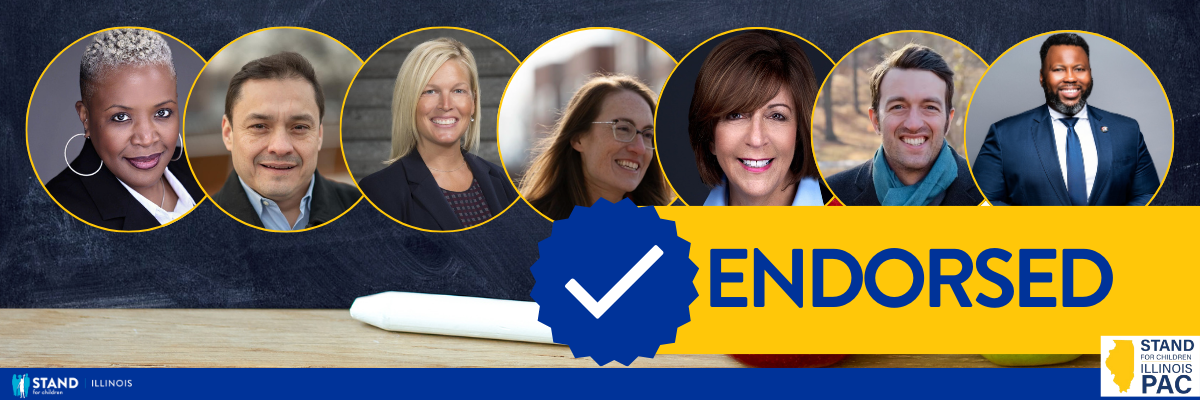
Stand for Children IL PAC, a bi-partisan state political action committee, released today its endorsements for the 2026 legislative Primary Elections. These General Assembly candidates are endorsed: 

  • Paul Kendrick (D – 12th District) 
  • Rep. Kam Buckner (D – 26th District) 
  • Cleopatra Cowley (D – 34th District) 
  • Rep. Jaime Andrade (D – 40th District) 
  • Rep. Tony McCombie (R – 89th District) 
  • Rachel Ruttenberg (D – 9th District) 

“It’s more important than ever to elect strong education champions in Illinois who are committed to working collaboratively to strengthen public education. We are excited to endorse a strong cohort of incumbent and prospective legislators who are committed to evidence-based literacy, adequate and equitable funding, and meaningful early college and career training opportunities,” said Jessica Handy, Chair of the PAC.  

For the 2026 Primary Elections, only legislative candidates in contested Primary races were eligible for consideration for endorsement by Stand for Children IL PAC. Stand for Children is a unique catalyst for educational success and social progress, to create a brighter future for us all.  

### 

Paid for the by Stand for Children IL PAC