
Blue circle with an outline of a megaphone on the bottom left. The circle reads "Career and Technical Education". On the bottom right of the circle there are two blocks, one yellow and one black. They contain text reading "Advancing CTE in IL."

By Theo Rogers

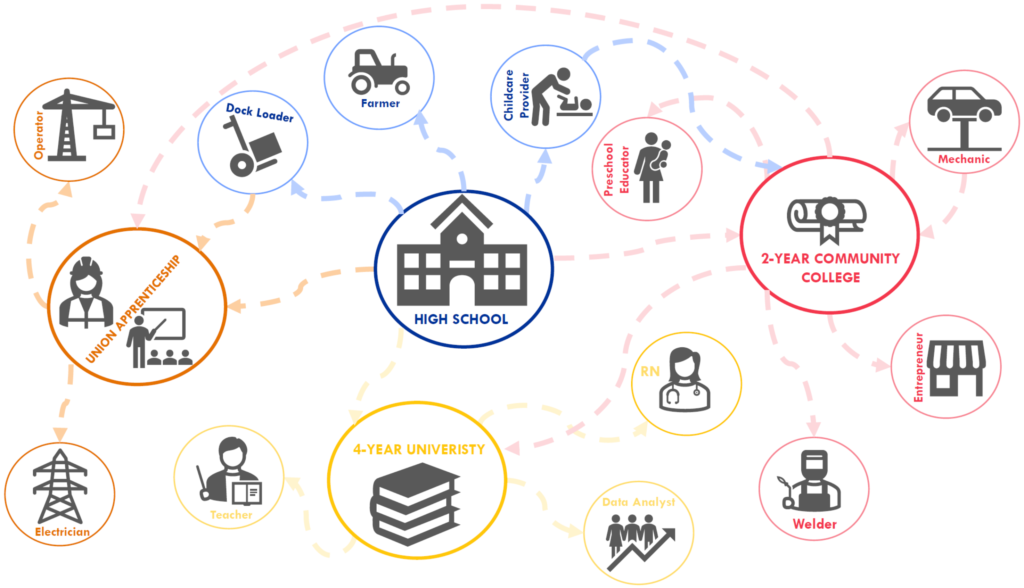
It is quite easy to see how participating in a Career and Technical Education (CTE) program in high school may seem like a declaration of a career or college pathway. The unique learning experience provided by CTE, which includes rigorous Dual Credit and invaluable work-based learning opportunities (WBL), may make high school students feel obligated to further pursue their CTE pathway in a postsecondary setting (studying in college/university or entering the workforce). However, participating in a CTE pathway program is not always a declaration of a postsecondary pathway; high school students should not feel confined to one postsecondary track based on their program pathway. CTE is not only about providing students with early career and learning opportunities, in which students can enter their postsecondary careers with the necessary knowledge and skills to succeed. It is also a tool for career exploration and awareness, even for students who don’t pursue their original program pathway. Here, I will tell my own story with a CTE education program and how I discovered that teaching was not the career for me; yet I was still able to get the most out of my CTE program. I will also explain how, although I decided not to pursue this career pathway, it still greatly affected my postsecondary career choices.

During my sophomore and junior years of high school. I was introduced to a variety of essays on a multitude of educational topics, including Paul Freire’s Pedagogy of the Oppressed, and learned about how schools were failing their students with what he coined the “Banking Method” of education. This term was used to reference the static form of teaching where teachers lecture to their students with the focus on engraining specific pieces of information, which the teachers themselves deemed necessary, into the memory of their students. This ignited a passion within me. I knew I wanted to improve American students’ education quality, but I was unsure how I wanted to enact that change. Therefore, due to this newfound passion, I enrolled in the “Pathways to Teaching” program to see if teaching was the correct pathway to explore. 

While I was enrolled in “Intro to American Education” and “Human and Cognitive Development,” I quickly realized that teaching was not the correct way for me to enact the change I wanted to make in American education. When learning about lesson planning, I discovered I did not share the same drive as teachers. I knew I would not be willing to properly prepare lessons and classroom activities outside of the classroom setting. In “Human and Cognitive Development,” I valued learning how to apply education theories and developmental stages to the classroom, but it was not an area I saw myself pursuing. Despite my lack of interest in teaching, however, I understood the value of taking college-level classes as a high school senior in preparing me for the start of my college journey the following year. 

Through both of these courses, I observed pre-k, and elementary, middle, and high school classrooms. Even though I experienced different grade levels, I still did not feel a pull towards a teaching career. However, I still made thoughtful observations and got the most out of my placements. In the high school classrooms I observed, I noticed how these classes were taught through the “Banking Method” of education. Both were lecture-style classrooms, with students listening to the teacher discuss a topic. 

From my classroom observations, I was able to identify areas of interest to me. What captivated me was seeing the different teaching styles and the impact technology has on the classrooms and these teaching practices. Based on my observations, I believe that teachers are not equipped to provide their students with the highest quality instruction possible; I think the ever-growing use of technology in the classroom plays a significant part in instruction not giving students a personal and meaningful educational experience. 

Presently, I am a sophomore at the University of Michigan – Ann Arbor. I plan on receiving my bachelor’s degree in education through the Marsal Family School of Education’s Learning, Equity, and Problem Solving for the Public Good (LEAPS) program. After participating in the CTE program through my high school, I knew I was not meant to be a teacher; however, my WBL experiences and what I observed from these experiences still very much captivated me. Because I was still interested in education, I chose a program that did not limit me to teaching. My program prepares me to enter any workforce area with the necessary knowledge and experience. During my first year at the University of Michigan, I carried over the interests I gained from the “Pathways to Teaching” CTE program. Over the course of my first year, through discussions with my peers, who all shared a passion for a broader focus on education, and conversations with my professors, I discovered how I wanted to address the issues surrounding my interests: teacher preparation and the role of technology in the classroom. I realized that educational policy work would be the area of study for me to explore further.

Although I decided not to pursue a career in teaching, my experience with CTE was anything but a waste of time. From the college-level classes and WBL experiences, I gained broad knowledge on education. I used this newfound knowledge as a foundation during my first year at the University of Michigan, where I built on it and discovered the career path that was right for me. Now I am an intern at Stand for Children Illinois, researching how high school can become meaningful through properly implementing CTE, while at the same time growing my understanding and experience in educational policy. I can confidently say that my experience with CTE has positively contributed to my career path.

Preparing high schoolers for life Tell us how you think we can make high school meaningful for all students httpsbitlypreparedforlife
Light gray background. Stand for Children Illinois logo. Three silhouettes of adults standing behind the silhouette of a child reaching their hand to the sky on a dark blue background. Dark blue circle with an outline of a megaphone on the bottom left. The circle reads "Career and Technical Education". On the bottom right of the circle there are two cyan blocks reading "Advancing CTE in IL."

By Theo Rogers

This is the story of two college sophomores pursuing education careers after getting a jumpstart in their field through the Education Career Pathway program, a Career and Technical Education (CTE) offering at their high school. The program enabled them to earn early college credits through attending classes at a local private university, while also giving them opportunities to see a variety of classrooms and teachers in action. What none of us knew at the time, and I have been learning more about this summer as Stand for Children’s CTE intern, was that State policy and funding prioritizing educator development led to the rapid growth of this CTE pathway area after a 2018 report about the severe teacher shortage in Illinois. The legislature earmarked $5 million for these CTE educator pathway programs the following year. While their high school was not a recipient of these funds, the local private university developed a strong education CTE pathway program after Illinois added this funding; through their high school’s connection with the university, it was able to fold into this program. This is an example of how State-level policy and funding drives local change around shared priorities, which will ultimately benefit the students of these future teachers. And now, here’s Molly and Megan’s story:

My former classmates, turned friends, Molly (19) and Megan (19), entered their senior year at Oak Park River Forest (OPRF) High School in Oak Park, Illinois, with future plans to enroll in a college teacher preparation program. Molly felt a strong calling to become a high school teacher because she wanted to share her passion for Family and Consumer Sciences with her future students. Megan aimed to follow in her mother’s footsteps, a former high school teacher turned high school guidance counselor at East Leyden High School in Franklin Park, Illinois. Even though most of their lives had been spent inside school classrooms, they wanted to experience what it would be like to be a college student studying education. They wanted to be assured that their career pathway and plans were right for them. 

Molly, Megan, and I enrolled in OPRF’s “Pathways to Teaching” course, under the Human and Public Services CTE pathway. “Pathways to Teaching” was a year-long dual-enrollment course that enrolled us in two semester-long introductory-level education classes at Concordia University – Chicago (CUC), a private, four-year university in River Forest, Illinois. 

Every early Tuesday and Thursday morning, we were transported from OPRF to the private university. For the first semester, we took an “Introduction to American Education,” taught by a former band teacher turned principal. In this class, Molly and Megan learned what it takes to be teachers. It allowed them to explore within themselves and uncover their extrinsic and intrinsic reasons for wanting to become high school teachers. Furthermore, it taught them fundamental teaching skills, such as lesson planning, classroom management, and inclusion. 

For the second semester class, we were enrolled in “Human and Cognitive Development.” In this course, we learned about different educational theories, theorists, and child cognitive and developmental stages. These two courses allowed Molly and Megan to experience a college setting while surrounding themselves with college students who shared the same passion for teaching and education as they did. They both greatly appreciated this opportunity. Megan said that “engaging myself with those already in college helped to give me a better understanding of what I was getting myself into the following year.” 

Though Molly and Megan both believed that experiencing college-level classes when they were still seniors in high school was important and eye-opening for their postsecondary plans, what they both valued the most from this dual-enrollment course was the work-based learning that was a requirement of both courses they took. An “Intro to American Education” required 10 observation hours of an elementary, middle, or high school classroom. Megan observed a high school classroom at East Leyden High School, the same school where her mother worked. Molly observed a classroom at her old elementary school, Lincoln Elementary, in Oak Park. In these classrooms, Molly and Megan were able to experience what it would be like working in a classroom environment. They were able to observe and learn different teaching practices and skills. 

The “Human and Cognitive Development” course required eight observation hours spread evenly across pre-k, elementary, middle, and high school classrooms. Molly completed her observations at Lincoln Elementary for pre-k and elementary classrooms. She also observed a classroom in her old middle school, Gwendolyn Brooks Middle School in Oak Park. Lastly, she observed two culinary arts classrooms at OPRF. Megan completed observation hours at the River Forest Community Center for pre-k, Lincoln School in River Forest for Elementary, Roosevelt for Middle School in River Forest, and West Leyden in Northlake, Illinois, for high school. 

These eight observation hours allowed Molly and Megan to experience different grade levels than solely high school, which was their desired grade level to teach. By experiencing different classrooms with a multitude of age ranges, Megan and Molly were able to apply the educational theories and cognitive and developmental stages that they learned in class to the classrooms they observed, which Megan appreciated: “I think both integrating education and also how people learn is very beneficial.” Furthermore, both students agreed that while it was important for them to experience different styles of classrooms, these observation hours only further confirmed their interest in secondary education. 

This CTE program made high school meaningful to both Molly and Megan, who said, “Putting myself into a college class allowed me to step up and encourage myself to put in more effort, as I knew the class was more beneficial going into college and meant more to those around me.” This program at OPRF allowed them to directly study their field of interest, something that is not always possible at the high school level, giving them an invaluable learning experience before they continued their learning and career journeys. 

Not only did this program increase their knowledge of education and teaching, and confirm their desire to teach secondary education, this CTE program allowed Megan and Molly to graduate from high school, confident that they were on the right learning and career path; it prepared them to enter a new learning environment with the knowledge, skills, and experiences to succeed at the highest possible level. 

Molly and Megan are both currently sophomores in college, studying education. Molly attends Triton Community College in River Grove, Illinois. After her sophomore year, she plans to transfer to Illinois State University (ISU) to receive her degree in Secondary Education, and she intends to teach Family and Consumer Sciences to her future students. Megan is double-majoring in English and Psychology at Western Michigan University (WMU) in Kalamazoo, Michigan. WMU offers a “4 + 1” program. She plans on graduating with a bachelor’s degree in English and Psychology, and then will receive her master’s degree in Secondary Education. Megan plans to teach English and Psychology. Like her mother, after a period of teaching, she plans to return to school to get a second master’s degree in School Counseling. Molly and Megan credit their experience in CTE for playing a significant role in their college and career plans and believe that high school students like themselves deserve to have the same opportunities that they had during high school. 

Preparing high schoolers for life Tell us how you think we can make high school meaningful for all students httpsbitlypreparedforlife