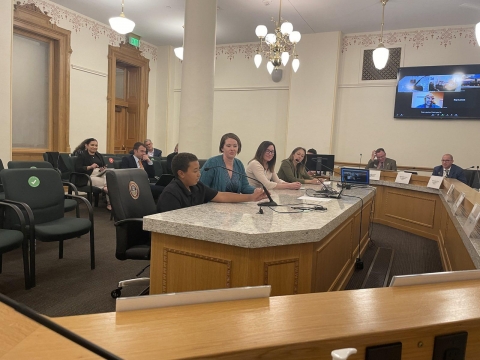
On March 31, the Senate Education Committee passed HB22-1295 Department Early Childhood And Universal Preschool Program on a 5-2 vote. This bill takes several steps to address the existing challenges faced by families and providers, including strengthening Colorado’s early childhood infrastructure, developing a single application for families to access all publicly funded early education services, and better supporting our early childhood workforce. Parent, community leader, and Stand Advocacy Fellow, Yaeel, delivered her testimony in support of the bill.

English below

Mi nombre es Yaeel Duarte y soy Fellow de la organización de Stand for Children hace ya dos años. Estoy aqui para dar tetstimonio a favor de el projecto de ley HB 22 – 1295.  

La razón por la que estoy dando testimonio   a favor  de esta propuesta, es  porque quiero asegurarme que la comunidad a la que sirvo tenga la informacion necesaria para facilitar la educación temprana de sus hijos. 

 Considero que las leyes actuales  No han beneficiado al máximo a la comunidad de habla espanol por varios factores por supuesto el primero es el factor socioeconómico el cual impide en la mayoría de los casos el que los padres se involucren en la educación de sus hijos,  otro factor igual de importante es el del conocimiento, aunque existen ciertas estrategias para pasar el mensaje de inscripción en este caso No siempre son las más efectivas algo que erra el sistema escolar es deducir que el nivel de aprendizaje de los padres es el mismo en todas las culturas y No es así. 

Muchos de estos padres se rinden al momento de buscar opciones para sus hijos en etapa preescolar No solo por el idioma si no también por No tener suficiente apoyo tanto con informacion como con el proceso en general de dicha inscripción, que para variar el personal de las escuelas lo hacen más complicado de varias formas, y es  por eso es que existe ”La Sra que me cuida a mi hijo” porque prefirió pagar menos y prefirió ir con alguien  que le entiende y No le pide tooodos los requisitos que le pide el sistema actual. 

Las consecuencias de esto Son niños analfabetos bajos en vocabulario y por ende bajos en Lectura y Escritura, lo que conlleva a esta famosa brecha académica en los niños.  

El pasar esta Ley le ofrece  herramientas a los padres de hacer hijos independientes y les dará la seguridad de tener éxito académico en el futuro. 

My name is Yaeel Duarte and I am a returning Fellow of the Stand for Children. I am here today to give testimony in favor of House Bill 1295, universal pre-school. I am testifying in favor of this bill in part because I want to ensure the Spanish-speaking community weighs in on this proposed public policy, they deserve to have the information they need to facilitate their children’s early education. I believe that the current practices regarding pre-school  have led to opportunity disparities for Spanish-speaking families for several reasons. The most obvious factor is affordability, which disproportionately punishes single income/low-income families, particularly Latinas as statistically they are more likely to stay at home and save the money than almost any other demographic.  In most cases, these same low socio-economic families are also less likely to get involved in the education of their children. In addition to the obvious language barrier, there is also a lack of access and policy knowledge, although there are certain strategies to pass the registration message in this case. They are not always the most effective. Sometimes we also forget to see how parents have quite different education levels and can help their kids differently at home. They rely on pre-k to give those supports. 

Many of these parents give up when looking for options for their children in the preschool stage, not only because of the language, but also because they do not have enough support both with information and with the registration process. The consequences of this lack of academic access are children with low vocabulary and therefore struggle in Reading and Writing, leading to one of the most notable academic achievement gaps in Colorado schools. 

Passing this Law would help ensure early success for children and more academic options for parents, please vote yes on HB-1295.  

photo of Denver skyline with words this month at the DPS Board

Welcome to the April edition of “This Month at the DPS Board”, a monthly newsletter sharing information about the Denver Public Schools (DPS) Board of Education.   

Our goal is simple: to share what is happening at school board meetings so you can engage with the board and the district even if you cannot attend hours of meetings every month. 

Work Session – April 7 2022 

Sustainability Student Group 

Denver Public Schools high school students from the Sustainability Student group presented their work on climate action, that consequently moved the DPS board to put forth an ENDS statement around environmental sustainability within the district. The goal is to allow DPS become a “national leader in establishing an organizational culture anchored in sustainability, climate action, and environmental justice in both the conservation of natural resources and in minimizing the carbon footprint of DPS’ practices.”  

Declining Enrollment Updates 

Superintendent Marrero shared an update on declining enrollment in the district. He shared that the Declining Enrollment Committee is in the halfway point of their timeline. Superintendent Marrero mentioned that the rationale behind creating this committee is to make sure community engagement is in the forefront during this process when discussing how fewer students enrolling in DPS schools and projections indicating that there will be a continual decline will impact schools financially and how students are being served equitably.  

Superintendent Marrero addressed some concerns around about the process:  

  • No schools have been identified, and there is no current list of schools that is being considered. The committee will create the criteria that will identify schools. 
  • A significant reorganization is currently underway at the central office to address the reduction in funding available and continue to maximize the funding provided to schools. 

He then mentioned that the committee meetings are not open to the public because they are considered “work sessions” intended to be for committee members only.  Meeting recaps are posted in all consent decree languages on the webpage. Opportunities for public feedback will be shared after the committee drafts the guiding principles and criteria through surveys. 

The following timeline for the process was shared: 

  • By Spring 2022, the Declining Enrollment Advisory Committee creates criteria. 
  • By Fall-Winter 2022-2023, criteria will be applied to schools and schools will be identified for closure or consolidation. 
  • In the school year of 2023-2024, schools identified will begin to plan to close or consolidate, plans will be created to support staff and families impacted. 
  • By the end of the school year 23-24, closure and/or consolidations will move forward. For certain schools, there may be an accelerated timeline where closures and/or consolidations will move forward by the end of 2022-2023 school year. 

Discussion of Board Community Engagement 

The Board plans to distribute a survey to the community to gain input on what community engagement means so that the Board’s definition aligns with community under a policy.   

Discussion of Proposed GP15 

The Board discussed possible changes and/or reinforcements for public comment and board meetings. The draft with the policy they were revising can be found here. These changes will be discussed in the June School Board meeting.  

Discussion of the Vacancy Process 

The board then discussed the potential timeline to fill in the District 5 representative vacancy. To recap this topic, check out our newsletter on last month’s work session here.  The board went through possible timelines according to the amount of applicants. “Board members and the Superintendent shall not have any discussions, meetings, or electronic communication with applicants, potential applicants, or supporters of an applicant to uphold the integrity of the process.” The Board of Education will choose the candidate by a majority vote in a public meeting, not by an informal consensus process. The board discussed the background check process the appointee will have to go through. 

Finance and Audit Committee Meeting – April 11, 2022 

2020 Bond Update 

Staff provided an update on the 2020 bond passed by voters. Funds totaling $420 million were wired for the Capital Projects Fund to DPS fulfilling the 2020 Bond Authorization. 

IntegraReport Hotline Update 

A report was provided by auditors on the IntegraReport Hotline – an anonymous hotline for district employees and the public to report suspected fraud, waste or abuse of district assets, or fiscal misconduct. Reports are either investigated by internal audit or human resources. In fiscal year 2020-2021 there were 114 cases reported, 62 cases were valid and addressed, 25 were unsubstantiated, and 11 are still in process.  

Information Items for Board Meeting Consent Agenda: 

The following items were presented and approved to go on the consent agenda for the School Board meeting:  

Grants Report 

Staff shared information about grants that were received in February and March over $50,000. 

Purchasing Report 

Information related to contracts and projects that cost less than $1 million were shared with the committee.  

Focus on Achievement – April 18, 2022 

Executive Limitations 

The board first reviewed some language changes in the executive limitations currently adopted from the “superintendent should” to the “superintendent will not fail to”. Some of the Executive imitations that were pointed out were (EL 2) which talks about succession planning for the superintendent and making sure the decision is still up to the board, (El 3) engage community in the development of policy when appropriate and at his discretion, (EL 4) the board is responsible for their own compliance, (EL 10) Discipline and safety procedure to be revisited at board retreat.  

You can read all here.  

Reasonable Interpretations – Transition Priorities 

Superintendent Marrero shared his reasonable interpretations as linked to his transition priorities. There are five and discussed the first three. The first priority is around equity where they centered the conversation around BIPOC teacher retention. The second priority is around teaching and learning where they focused the conversation on learning disruptions because of COVID-19 and how to ensure the district takes steps to set students back on track. They also had a conversation about accountability and whether to use state assessments for this end. Superintendent Marrero closed  saying it is needed to create some sort of baseline and understand where students are at now. The third transition priority is around students and staff well-being.  

District Five Vacancy Interviews 

The Board set the dates for interviews when it comes to the District Five vacancy to June 2nd between 1-4 pm. They should be open to the public and will be listening to special public comment later that day. 

School Board Meeting – April 21, 2022 

Recognition of DPS Athletic Accomplishments  

Staff highlighted athletic achievements in DPS this school year. 7000 high school athletes participated in DPS athletics this year, which is more than have ever participated.  

Northfield Men’s Soccer was recognized for winning a 4A State Championship and East Men’s Ice Hockey was recognized for winning the 5A State Championship. Staff also highlighted women’s basketball and wrestling.  

Denver Scholarship Foundation Report 

Staff from the Denver Scholarship Foundation (DSF) shared a presentation about their work. The Denver Scholarship Foundation “inspires and empowers Denver Public Schools’ students to enroll in and graduate from postsecondary institutions of higher education, by providing the tools, knowledge, and financial resources essential for success.” 

Annually, DSF serves about 7,500 students. This year, DSF has awarded 1,869 scholarships and operates 14 Future Centers in high school campuses across the district where DSF staff supports high school students in creating post-graduation plans. Additionally, DSF partners with 30 higher education institutions to support scholarship recipients. Demographics of scholarship recipients include 66% female, 60% Hispanic/Latinx, and 16.5% Black students. 82% of scholarship recipients are persisting or have graduated higher education and since DSF’s inception, college enrollment has increased over 100%. 

Welton Street Café Proclamation 

Welton Street Café was recognized with a proclamation acknowledging the impact that Welton Street Cafe has had in the DPS community. Currently, Welton Street Café is raising funds to open a new location after closing its original location of 22 years. Anyone who is interested in supporting can find more information and donate here. 

Superintendent’s Report 

Superintendent Marrero gave a presentation related to District Central Office reorganization plans. Superintendent Marrero cited declining enrollment and feedback from staff and community as rationale for reorganizing the Central Office.  

Intended outcomes of Central Office reorganization include strengthening and tightening central support to ensure resources align to highest priorities and central staff functions are more tightly linked to Board of Education goals and policies. 

Superintendent Marrero previewed an approach to collaborative school structure by highlighting planned collaboration of four DPS schools, called “Collaborative Quads” to engage in shared learning and best practices around facilitating dual-language programs in DPS. The stated goal of the Collaborative Quads is “building communities of learning to drive improvement across our family of schools.” 

Staff outlined 2022-2023 district priorities as follows:  

  • Equity and Excellence 
  • Student Experience & Achievement 
  • Operational Effectiveness 

Finally, staff outlined a plan for central office reorganization structure which will include shifts in senior leadership and departments.  

You can view the presentation here.  

Climate Action  

Students presented a climate action statement, sharing their passion for expanding sustainability and climate-conscious policies and efforts in DPS. The board voted unanimously in support of the proposed revisions to their ENDS statements related to climate action. You can learn more here.  

Consent Agenda 

The board unanimously voted to approve the consent agenda.  

Public Comment  

Educators, parents, and other members of the DPS community delivered public comments about a variety of topics including feedback surrounding Executive Limitation 11 & 12, declining enrollment, and concerns around academic performance.  

Board Retreat April 21, 2022 

Completion of Reasonable Interpretations 

Before embarking on reasonably interpreting several policies, Superintendent Marrero mentioned that he would like to include partnering with the City of Denver to dismantle and revise persistent and enduring systems of oppression outside of our school system to a transition priority which is a policy anchored in equity. He briefly mentioned that this partnership will include the creation of community hubs that will provide services like social-emotional support, GED, citizenship, early literacy, and computer classes, academic tutoring, and basic needs assistance. The Board revisited interpretations for policies transition priorities (TP): Student and Staff Well-Being, Health and Safety, and post-graduation and global citizenship. The Boad then shared the monitoring report cadence to vote on END statements for each monthly board meeting.  

Community Engagement Planning  

Some board directors shared they have been working on a community engagement governance policy that aims “to ensure the DPS Board of Directors has a sustainable connection to the community” they serve “in alignment with district board policies.” The desired outcome for this specific policy is to have it be community led, proactive, and ensure all seven board members work together to find the best path for community engagement. This board policy is meant to be more focused on the long-term vision of the end statements by leveraging the expertise of the Family and Community Engagement (FACE) team and still preserving the ability to gather information on the ENDS statements as a Board. 

 Their proposed timeline to get this policy established is: 

  • May 2022- informal presentation 
  • June 2022- formal presentation with public comment and first read 
  • August 2022- second read and vote 

12-Month Agenda Planning 

The board talked through their upcoming meeting calendar, important dates that will fall within this year and about the timelines around the new executive limitations and their implementation (Els). As they think about community engagement as a part of the reviewal process of Els and TPs they are also thinking what those timelines look like in the calendar. They are hoping to vote on the reasonable interpretations presented by the superintendents during the May 5th work session.  

High School Students With Teacher In Class Using Laptops Smiling

On March 2, 2022, the House Education Committee heard House Bill 22-1220, which will remove barriers to support teacher candidates entering the workforce. The bill passed on a 8-1 vote and now will be heard in the Appropriations Committee. During the hearing educators shared their passion removing educator barriers to increase teacher diversity. We are excited to share their testimony in support of increased teacher diversity and House Bill 22-1220.

Thank you, Madam Chair and Madam Vice Chair and members of the committee. 

I am Dr. Theresa Newsom, and I have been an educator 41 years including 26 years in Colorado. I am testifying in support of House Bill 22-1220. 

As the spouse of an Enlisted Air Force Veteran, I received my first teaching credential from Fresno State in California before we were transferred to South Carolina where I needed to obtain another license to meet their requirements. From there my husband and I were sent to England where I taught for the Department of Defense Dependent Schools at Feltwell AFB in East Anglia for 7 years. Yes, another license was needed. Then we were transferred back to CA where I had to become licensed again. I taught in the Vandenburg AFB community 7 years before coming to Colorado where I was licensed again due to different requirements from the previous locations and no reciprocity between states. 

In order for me to obtain new licenses I needed to pay fees and complete assessment competencies which included traveling to test sites. There were times I felt these barriers were insurmountable due to taking course work and simultaneously raising three children, two who are adopted.  

I completed my Master’s degree in Curriculum and instruction, became a school administrator (another CO license needed) and of course I still renew both licenses every 5 years to remain eligible to work in this state. In addition, I completed my competences to become a licensed Gifted and Talented Resource Teacher. I currently work in the field of gifted education today as the only Black GT teacher in Southern CO.  

House Bill 22-1220 will remove financial and access barriers to ensure a more diverse teacher workforce in Colorado. I respectfully ask for your ‘yes’ today on House Bill 22-1220. Thank you. 

On March 2, 2022, the House Education Committee heard House Bill 22-1220, which will remove barriers to support teacher candidates entering the workforce. The bill passed on a 8-1 vote and now will be heard in the Appropriations Committee. During the hearing educators shared their passion removing educator barriers to increase teacher diversity. We are excited to share their testimony in support of increased teacher diversity and House Bill 22-1220.

Thank you, Madam Chair and Madam Vice Chair and members of the committee. 

My name is Asia Zanders. I am a high school government and history teacher, and I am working on my master’s degree in Transformative Learning Communities. While I am speaking on behalf of Stand for Children, I am also representing all future educators in Colorado. 

Today, I am testifying in favor of House Bill 1220 because of the need to, not only, fill teaching positions necessary to enrich and prepare our children for their futures, but to fill positions with high quality and diversified educators, as well. 

Every year there have been bills created to reduce teacher shortages and recruit educators and counselors, yet every time there seems to be a failure in fulfilling what is truly needed to support that mission. While there are many factors that contribute to the shortage, we must approach the problem from various perspectives.  

Consider the positive impact financial assistance could have on educators in prep programs.  

Reducing the financial barriers to initial licensure like: paying for teacher competency exams and paying student teachers reduces the time they may take in training and possibly dropping out because they are too overwhelmed with working multiple jobs and teaching, among other life impacts. 

We are talking about removing barriers to accessing a job that requires passion and consideration of the student. Therefore, we must remove the arbitrary rules that prevent diversifying the educator workforce. 

Why aren’t we allowing teachers to show their competency in another manner? Some of my students have ADHD and other learning differences, so I allow my students to present their knowledge of the subject in the manner they choose because we all learn and portray our learning in different ways- and it works! It encourages deeper engagement with the subject and a different way of presenting it. 

This generation of educators are bound to be dedicated to their profession due to their experiences with the uncertainties of COVID. Show them your support with House Bill 1220 in removing barriers to educator preparation. 

On March 2, 2022, the House Education Committee heard House Bill 22-1220, which will remove barriers to support teacher candidates entering the workforce. The bill passed on a 8-1 vote and now will be heard in the Appropriations Committee. During the hearing educators shared their passion removing educator barriers to increase teacher diversity. We are excited to share their testimony in support of increased teacher diversity and House Bill 22-1220.

I am the reading interventionist for a rural Title I elementary school on the Eastern plains. I come to you as an educator to ask for your support for HB22-1220. 

As I wrapped up an intervention session one afternoon last spring one of my students, a young Black boy, casually mentioned that he thought he might make a good teacher.  

“You would absolutely make a great teacher, Jonathon!”, I replied.  

“Too bad”, he said, disappointedly. 

“Too bad what?” 

“Don’t you have to be a white lady to be a teacher?” 

Why, in 2021, would a child assume one has to be a “white lady” to be a teacher? For Jonathan, it’s because nearly every teacher he has seen in his school career is a white female. The traditional pathways to teaching are creating artificial barriers to BIPOC teacher candidates from entering the profession in greater numbers. Just as an SAT score doesn’t give a complete picture of the true merit or potential of a future college student, a great teacher is so much more than a passing PRAXIS score; multiple options for demonstrating competency are essential to creating a diverse pool of teachers.  

Unpaid student teaching is another barrier that reduces the diversity of the teaching force, requiring some students to take on second and third jobs in their attempts to satisfy the requirements of their programs. The financial burden is just too great. Addressing these issues would remove some of the barriers that are keeping Colorado schools from diversifying their teaching staff. For Jonathon and other Black and Brown students who might have the same misconceptions about what pathways are available to them in the future, it removes barriers to dreams. 

We need more teachers. We need teachers that reflect the myriad diversities of our students. Please support HB22-1220 and let the diverse teacher candidates of today show the Jonathons of tomorrow what is possible. 

On March 2, 2022, the House Education Committee heard House Bill 22-1220, which will remove barriers to support teacher candidates entering the workforce. The bill passed on a 8-1 vote and now will be heard in the Appropriations Committee. During the hearing educators shared their passion removing educator barriers to increase teacher diversity. We are excited to share their testimony in support of increased teacher diversity and House Bill 22-1220.

As I wrapped up an intervention session one afternoon last spring one of my students, a young Black boy, casually mentioned that he thought he might make a good teacher.  

“You would absolutely make a great teacher, Jonathon!”, I replied.  

“Too bad”, he said, disappointedly. 

“Too bad what?” 

“Don’t you have to be a white lady to be a teacher?” 

Why, in 2021, would a child assume one has to be a “white lady” to be a teacher? For Jonathan, it’s because nearly every teacher he has seen in his school career is a white female. The traditional pathways to teaching are creating artificial barriers to BIPOC teacher candidates from entering the profession in greater numbers. Just as an SAT score doesn’t give a complete picture of the true merit or potential of a future college student, a great teacher is so much more than a passing PRAXIS score; multiple options for demonstrating competency are essential to creating a diverse pool of teachers.  

Unpaid student teaching is another barrier that reduces the diversity of the teaching force, requiring some students to take on second and third jobs in their attempts to satisfy the requirements of their programs. The financial burden is just too great. Addressing these issues would remove some of the barriers that are keeping Colorado schools from diversifying their teaching staff. For Jonathon and other Black and Brown students who might have the same misconceptions about what pathways are available to them in the future, it removes barriers to dreams. 

We need more teachers. We need teachers that reflect the myriad diversities of our students. Please support HB22-1220 and let the diverse teacher candidates of today show the Jonathons of tomorrow what is possible. 

House Bill 22-1220, which will remove barriers in educator preparation to support educator candidates entering the workforce, is scheduled to be heard by the House Education Committee on Wednesday, February 23. 

HB22-1220 will:  

  • support teacher candidates by paying them for their student teaching work 
  • remove financial barriers by paying for teacher exam fees 
  • expand pathways to licensure by allowing multiple ways to demonstrate competency  

We are proud to champion HB22-1220 because we see this policy as a pathway to increasing teacher diversity in Colorado. We know that removing financial barriers and increasing pathways to licensure will ensure a more diverse educator workforce, which is critical for all of Colorado’s students to experience just and supportive schools. 

I am currently the reading interventionist at a rural Title I school in Colorado. My master’s degree is in teaching with a focus on reading intervention. My master’s thesis explored the perceptions of access to information needed by parents of SPED students in order to successfully advocate for those students in one of the largest school districts in Colorado Springs. It came as no surprise that most parents were completely lost or marginalized in a system that they had entrusted their students with. As a parent of a dyslexic child, I knew these struggles; I also had many privileges on my side: English as a first language, transportation, education, funds with which to have my child assessed. If I was completely lost with so many resources, what must it be like for a parent without just one of them?

I share this story because people are entrusting us, as educators, to take care of their children’s educational needs. They shouldn’t have to navigate the system to ensure their child gets appropriate interventions. Parents of struggling readers, no matter their privileges, should be able to rest confidently in the knowledge that we have the skills and resources to effectively help their children with reading. The READ Act was intended to address achievement gaps in reading by implementing accountability measures and suggesting programs informed by the science of reading. Why then, by 2019, did we see no growth in our readers? The answer lay in the implementation: it is not enough to suggest or even require that schools implement reading programs informed by the science of reading. Most teacher prep programs do not teach pre-service teachers how to teach reading. Many veteran teachers have continued to use methods discredited by brain research. Teachers must be instructed in the science of reading, the way the brain facilitates the skill of reading, and the practices that inform solid reading instruction. It is not a one-day workshop’s worth of information. This is why the 45-hour science of reading requirement for Colorado teachers is an important step.

I understand that this requirement asks for precious time that is already in short supply for most teachers. We need to remember, however, that these reading struggles will still be with us when we all return to the classroom someday, and that those children who struggle the most will be relying on us more than ever to deliver instruction that is effective and backed by science. We cannot let our guard down now. We have navigated teaching during a pandemic; we can hold on for 45 hours of reading science. A successful READ Act, and most importantly our students’ success, depends on us.

EDUCATORS CAN LEARN MORE HERE

Brooke is the reading interventionist at Calhan Elementary School in Calhan, CO. She is committed to social justice and liberation in our schools and pedagogy, and is currently pursuing a PhD in educational leadership and policy at the University of Denver. She lives outside of Colorado Springs with her partner and children.