Welcome to this week’s edition of Capitol Week in Review, a weekly update on education policy at the Capitol!  

Legislative Update

HB22-1010 Early Childhood Educator Income Tax Credit, which gives educators a tax break for dollars they spend in their classrooms, passed out of the Senate Finance Committee and was referred to the Committee on Appropriations.   

HB22-1052 Promoting Crisis Services To Students, which will earmark funds to promote awareness about public mental health resources, was passed by the Senate Education Committee and referred to the Appropriations Committee.       

HB22-1131 Reduce Justice-Involvement for Young Children was passed by the House and now will be heard by the Senate Judiciary Committee. The bill will create a taskforce to study the prosecution of children ages 10 – 12.  

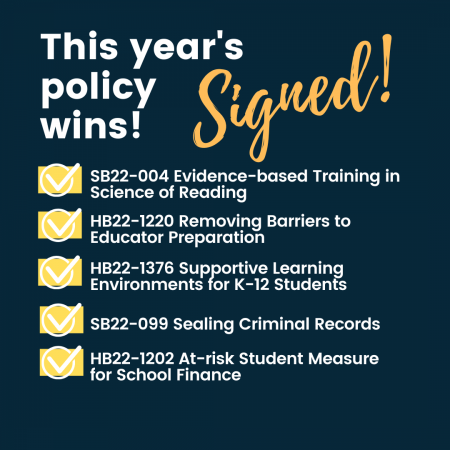
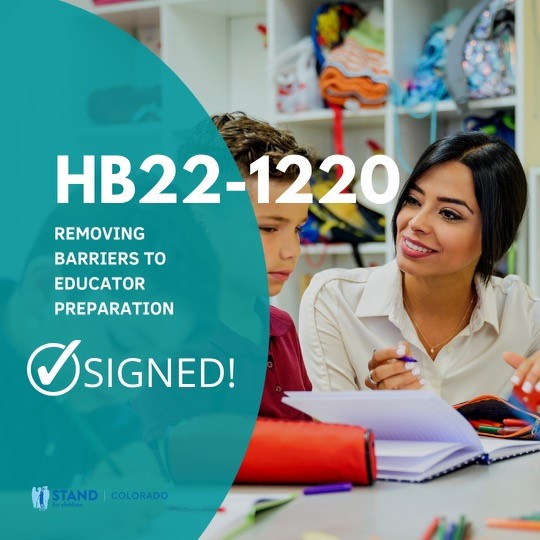
HB22-1220 Removing Barriers to Educator Preparation, which will remove barriers in educator preparation to support educator candidates entering the workforce, passed out of the Senate Education Committee as amended, and was referred to the Appropriations Committee.  

HB22-1260 Access To Medically Necessary Services For Students, which ensures that physically, cognitively, or emotionally impaired students will be able to access services in their schools with local providers, was passed by the House and now will be heard in the Senate.  

HB22-1295 Department Early Childhood And Universal Preschool Program, which establishes the Department of Early Childhood to elevate early childhood education and ensures that early childhood care is easy to navigate for all Colorado families, was signed into law by the Governor.   

HB22-1376 Supportive Learning Environments for K-12 Students passed out of the House Appropriations Committee and passed the House second reading. This bill updates Colorado’s policies and practices to improve school climate for students. 

SB22-099 Sealing Criminal Records passed out of the House Judiciary Committee unanimously and now will be heard by the Appropriations Committee. This bill will automatically seal the criminal records of individuals who are convicted of a non-violent offense if the person has completed their sentence, completed a waiting period of several years, and has not committed another criminal offense. 

SB22-127 Special Education Funding, which would increase funds for each child who receives special education funding to $1,750 (rather than the current $1250) and require the amount to increase by the rate of inflation each budget year beginning with the 2024-25 school year, was passed by the House and is headed to the Governor. 

SB22-147 Behavioral Health-care Services For Children passed the House and is headed to the Governor’s desk. This bill creates in the University of Colorado the Colorado Pediatric Psychiatry Consultation and Access Program (CoPPCAP) to support primary care providers in identifying and treating mild to moderate behavioral health conditions in children in primary care practices or school-based health centers.  

SB22-197 Innovation School Zones With Alternative Governance, passed out of the Senate and is now will be heard by the House Education Committee. This bill allows innovation schools to set up their own form of governance, provided they also provide student success data to the state and sets up a dispute resolution process. 

SB22-202 – State Match for Mill Levy Override Revenue passed out of the Senate. This bill will allocate more money to school districts with a much leaner municipal tax base.  

Our Take

We are thrilled that SB 22-1220, Removing Barriers to Educator Preparation, was passed by the Senate Education Committee.  This legislation is one of our top priority bills this year because it provides a pathway to increasing teacher diversity in Colorado and addressing the teacher shortage. Removing financial barriers and increasing pathways to licensure will ensure a more diverse educator workforce, which is critical for all of Colorado’s students to experience just and supportive schools.  

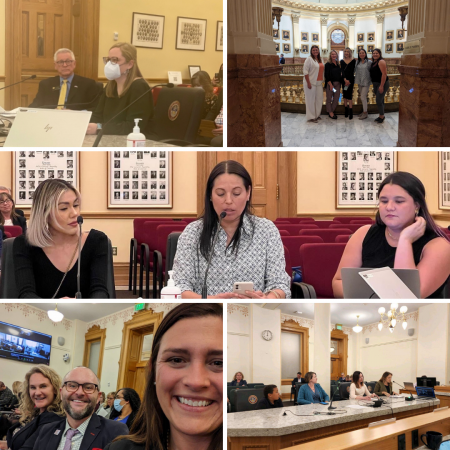
Parent, community leader, and Stand Advocacy Fellow, Pamela, testified in favor of SB-1220 saying,  “What this bill does is address the barriers that people pursuing a career as a teacher face. Barriers that impact people of color as well as those in poverty most….As we continue to correct the inequities that exist in our education system, we should acknowledge that nothing can replace a person’s lived experience. It shouldn’t be assumed that everyone is starting at the same point on the same starting line. That everyone has the privilege to obtain their credentials without amassing a crippling amount of debt, or is able to work full time hours without being monetarily compensated for their time and skill.” 

Take Action

Ask Policy Makers to Support Innovation in Our Schools with SB-197! 

14 years ago, legislation was passed to create innovation zones and schools. Senate Bill 22-197 updates that policy and codifies lessons learned over the last 14 years in innovation schools and establishes fair processes to resolve issues if they arise between Innovation Zones and their local districts.

Email House Education Committee Members and ask them to support SB 22-197 with one click!  

For More Information

These four states already have universal preschool. What can Colorado learn from them?, Chalkbeat 

Lawmakers propose matching fund to help property-poor Colorado school districts, Chalkbeat 

Colorado Education Bill Tracker 2022, Chalkbeat 

We are on step closer to House Bill 22-1220 becoming a reality! 

House Bill 22-1220, which will remove barriers to support teacher candidates entering the workforce, passed the House and is being heard in the Senate Education Committee TOMORROW. We need to show Senators how much support there is for this policy, so will you send an email with one click?     

EMAIL SENATE EDUCATION COMMITTEE MEMBERS

HB22-1220 will:  

  • support teacher candidates by paying them for their student teaching work, 
  • remove financial barriers by paying for teacher exam fees, and
  • expand pathways to licensure by allowing multiple ways to demonstrate competency. 

Read more about HB22-1220 in this Colorado Sun article. We are proud to champion HB22-1220 because we see this policy as a pathway to increasing teacher diversity in Colorado. We know that removing financial barriers and increasing pathways to licensure will ensure a more diverse educator workforce, which is critical for all of Colorado’s students to experience just and supportive schools. 

We are on step closer to House Bill 22-1220 becoming a reality! 

House Bill 22-1220, which will remove barriers to support teacher candidates entering the workforce, passed the House and is being heard in the Senate Education Committee TOMORROW. We need to show Senators how much support there is for this policy, so will you send an email with one click?     

EMAIL SENATE EDUCATION COMMITTEE MEMBERS

HB22-1220 will:  

  • support teacher candidates by paying them for their student teaching work, 
  • remove financial barriers by paying for teacher exam fees, and
  • expand pathways to licensure by allowing multiple ways to demonstrate competency. 

Read more about HB22-1220 in this Colorado Sun article. We are proud to champion HB22-1220 because we see this policy as a pathway to increasing teacher diversity in Colorado. We know that removing financial barriers and increasing pathways to licensure will ensure a more diverse educator workforce, which is critical for all of Colorado’s students to experience just and supportive schools. 

Connect Academy Classroom at Abraham Lincoln High School

In early April Colorado’s Center for High School Success (CHSS), in partnership with Abraham Lincoln High School (ALHS), hosted a unique opportunity for the CHSS Directors from across the country to visit Lincoln High School’s Ninth Grade Connect Academy and learn from Principal Antonio Esquibel, current school leaders, and students who are involved in the ninth-grade success work.  

The National CHSS Director and six State CHSS Directors were joined by school and district leaders from Denver Public Schools, Englewood High School, Littleton Public Schools, and Pueblo D60 to experience a guided tour of Connect Academy and hear from students. While visiting classrooms, observers were encouraged to look for strong student-teacher relationships, adult collaboration to enhance student experience, and students engaging in a productive struggle with high-level academic work.  

ALHS staff gave a presentation about their focus areas in building the Connect Academy which include parent engagement and communication, student supports and interventions, positive culture builders, and high priority staffing and scheduling.  

Lincoln High School’s Ninth Grade Connect Academy 

The Ninth Grade Academy (NGA) starts with a week-long transition program designed to support incoming 9th grade students with their transition to high school. This feeds into the year-long Connect Academy concept that focuses on building connections between teachers and students and providing a level of comfort and understanding for students as to how to be successful at ALHS and raise awareness of the opportunities for them at the school. 

CHSS Partnership  

CHSS partners with Lincoln High to advance their ninth-grade success goals by providing training, coaching, data, analysis, resources and peer networking opportunities.  CHSS Coach, Gina Yacovetta, works directly with Connect Academy Team Specialist, Cassandra Tafoya, to support ninth grade success teams and track progress in raising ninth grade course performance. 

CHSS Directors reflect on their experience  

“It is clear that Lincoln High School values the 9th grade experience for its students and they have created systems and supports that validate the importance of the students’ 9th grade year.” Henterson Carlisle, Washington Director, Center for High School Success 

“There is no better way to understand the positive impact of this work than to fully immerse yourself into a school community for a day and see it in action!” – Tara DeBois, Oregon Director, Center for High School Success 

“Visiting Lincoln High School gave me energy and excitement moving forward with our work in Arizona.” -Keith Smith, Arizona Director, Center for High School Success 

Special thanks to Abraham Lincoln High School for hosting a visit to their Connect Academy! Shoutout to Principal Esquibel, Assistant Principal Noel Nieves and Cass Tafoya for your hospitality and sharing your school and amazing students with the CHSS group.

Welcome to this week’s edition of Capitol Week in Review, a weekly update on education policy at the Capitol! 

Legislative Update 

HB22-1010 Early Childhood Educator Income Tax Credit, which gives educators a tax break for dollars they spend in their classrooms, passed out of the House and is scheduled to be heard in the Senate Finance Committee on April 27.  

HB22-1220 Removing Barriers to Educator Preparation, which will remove barriers in educator preparation to support educator candidates entering the workforce, passed out of the House. It now moves to be heard in the Senate.  

HB22-1260 Access To Medically Necessary Services For Students, which ensures that physically, cognitively, or emotionally impaired students will be able to access services in their schools with local providers, unanimously passed out of the House Education Committee.  

HB22-1295 Department Early Childhood And Universal Preschool Program, which establishes the Department of Early Childhood to elevate early childhood education and ensures that early childhood care is easy to navigate for all Colorado families, will be signed into law by the Governor on April 25.  

HB22-1376 Supportive Learning Environments for K-12 Students passed out of the House Education Committee on a 6-3 vote. This bill updates Colorado’s policies and practices to improve school climate for students. 

SB22-004 Evidence-based Training In Science Of Reading, which ensures that principals and building level administrators are trained in current best practices regarding teaching the science of reading, passed unanimously out of the House Education Committee. It was referred to Appropriations.  

SB22-099 Sealing Criminal Records passed out of the Senate and will now be heard in the House. This bill will automatically seal the criminal records of individuals who are convicted of a non-violent offense if the person has completed their sentence, completed a waiting period of several years, and has not committed another criminal offense 

SB22-197 Innovation School Zones With Alternative Governance, passed out of the Senate Education Committee and was referred to the Committee of the Whole. This bill allows innovation schools to set up their own form of governance, provided they also provide student success data to the state, and sets up a dispute resolution process. 

Our Take 

We are incredibly pleased that HB22-1376 passed out of the House Education Committee and we are energized by those who testified in support of the bill.  

This bill makes several updates to Colorado’s policies and practices to improve school climate for students including increasing funding for the successful Expelled and At-Risk Student Services Grant, updating restraint and seclusion policies and ending practices that have been shown to harm students, requiring better data collection on disciplinary incidents and indicators of school climate and promoting best practices and proper training for school security staff. 

Parent, community leader, and Stand Advocacy Fellow, Pamela, joined us to testify sharing her experience with her son to demonstrate her support. She shared, “the school [my son] attended showed little interest in offering any support for my son’s communication or behavioral needs, much less his social and emotional wellbeing. He was repeatedly sent home from school, moved from one class to another and was often in the principal’s office. As it turns out, the school had not been documenting when he was sent home and why. If that documentation had been provided for us, it would have painted a very grim picture of what the school’s discipline policy looked like and have helped my son get the support he needed earlier.”  

Read Pamela’s full testimony here and learn more in Chalkbeat’s recent reporting here.  

Take Action 

THANK LAWMAKERS FOR REMOVING BARRIERS TO HOUSING AND EMPLOYMENT! 

SB22-099 Sealing Criminal Records, passed out of the Senate with bipartisan support! It now moves to be heard in the House. SB22-099 automatically seals the criminal records of individuals who are convicted of a non-violent offense if the person has completed their sentence, completed a waiting period of several years, and has not committed another criminal offense. Removing these barriers to housing and employment equips everyone with the opportunity to provide for their families and become more engaged citizens.  

Will you take a minute to send a thank you note to your Senator for supporting pathways for safe and supportive families and communities? 

More Information 

Colorado bill to improve school climate, limit seclusion and restraint advances, Chalkbeat 

Colorado Education Bill Tracker 2022, Chalkbeat 

Pamela and her son Tristan in the Colorado state Capitol.

On April 21, the House Education Committee passed HB22-1376 Supportive Learning Environments for K-12 Students on a 6-3 vote. This bill makes several updates to Colorado’s policies and practices to improve school climate for students including increasing funding for the successful Expelled and At-Risk Student Services Grant, updating restraint and seclusion policies and ending practices that have been shown to harm students, requiring better data collection on disciplinary incidents and indicators of school climate and promoting best practices and proper training for school security staff. Parent, community leader, and Stand Advocacy Fellow, Pamela, delivered her testimony in support of the bill.

My name is Pamela Kaspar, I am a District 1 resident, a social work scholar, and a parent. I’m speaking in favor of House Bill 1376.   

With me today is my brilliant and talented son, Tristan, who is 11. Tristan had a rough start in his journey in public schools. We had just moved back to Colorado from Virginia, and in order for me to continue my education and save money, we were living with my parents. These types of life transitions can be challenging even for adults, but are especially more so for young children.   

Tristan lagged in his verbal communication skills; as you can imagine, it was incredibly frustrating for him as he tried to communicate with the world around him.  The school he attended showed little interest in offering any support for my son’s communication or behavioral needs, much less his social and emotional wellbeing.  As his mother, I knew that he was acting out because he was feeling scared, but his school saw an angry, problem child. He was repeatedly sent home from school, moved from one class to another and often in the principal’s office. I had to advocate on behalf of my son to have him see a counselor, it was never offered by the school. We qualified for assistance with a child therapist through the University of Denver, and my son began seeing them. This was all research and work that we had to do on our own with really no great idea of where to begin.   

The decision to change schools finally came when Tristan was once again sent home after crying while in class. I was at work that day, so my mother offered to pick him up. She insisted that his suspension and all prior suspensions be documented for her. As it turns out, the school had not been documenting when he was sent home and why. If that documentation had been provided for us, it would have painted a very grim picture of what the school’s discipline policy looked like, and perhaps have helped my son get the support he needed earlier. 

I’m sharing this experience with you all to illustrate the need for legislation like this. There is a need for a holistic approach to education, where the wellbeing and growth of teachers, caregivers, support staff and scholars are just as important as standardized test scores. Caregivers need resources to assist with addressing problematic behaviors, and as numerous studies have shown, the emotional quotient is as imperative as an intelligence quotient.  

Let’s support our kids like Tristian. Please vote yes on House Bill 1376.  

We are thrilled to announce that bipartisan legislation we have been working on to ensure safe and supportive schools for all students has been introduced: HB22-1376 Supportive Learning Environments For K-12 Students.

We all agree that schools should be positive, safe, and inclusive places for students to learn. A broad coalition of partners engaged key stakeholders to identify updates to Colorado’s policies and practices to improve school climate for students. Those updates include:

  • Increasing funding for an evidence-based program (the successful Expelled and At-Risk Student Services Grant) that supports students, teachers, and administrators.
  • Updating restraint and seclusion policies and ending practices that have been shown to harm students.
  • Requiring better data collection on disciplinary incidents and indicators of school climate.
  • Promoting best practices and proper training for school security staff.

Will you email House Education Committee members to let them know you support HB22-1376?

EMAIL LAWMAKERS WITH ONE CLICK!

These changes will help ensure we have information about the gaps that need to be filled right now to ensure safe and supportive environments for every student.

To learn more about the specifics of the legislation you can see the bill here and read Chalkbeat’s reporting here

Welcome to this week’s edition of Capitol Week in Review, a weekly update on education policy at the Capitol! 

Legislative Update 

HB22-1064 Prohibit Flavored Tobacco, which would prohibit flavored tobacco, passed in the House Finance Committee and was referred to Appropriations.  

HB22-1220 Removing Barriers to Educator Preparation, which will remove barriers in educator preparation to support educator candidates entering the workforce, was referred back to House Education Committee for technical amendments and passed 6 – 3.  

HB22-1260 Access To Medically Necessary Services For Students, which will allow students to access medically-necessary services in the school setting, was laid over in the House Education Committee. 

SB22-004 Evidence Based Training in the Science of Reading, which will ensure principals and administrators who oversee K-3 teachers will be trained in the science of reading passed out of the Senate and will now be heard by the House Education Committee.  

SB22-008 Higher Education Support For Foster Youth, which will give children in foster care who were placed out of Colorado the undergraduate tuition rate, was rescheduled to be heard in the House Education Committee on April 14.  

SB22-127 Special Education Funding, which would increase funds for each child who receives special education funding to $1,750 (rather than the current $1250) and require the amount to increase by the rate of inflation each budget year beginning with the 2024-25 school year, is scheduled to be heard in the House Education Committee on April 13.  

SB22-171 Privacy Protections For Educators, which will prevent teachers from being doxed, scheduled to be heard in the Senate Education Committee on April 14.    

Our Take 

We are incredibly pleased to see broad, bipartisan support for Senate Bill 22-004. Like teachers, principals and administrators should also be trained with research-based knowledge of how students learn to read so that they can support teachers in effectively utilizing the science of reading and now we are one step closer to that reality. 

We cannot say it any better than special education teacher, Laura Haller said in her testimony,

“Imagine a world where every single adult in the building knew how to teach scholars how to read using the science of reading. It would mean that principals and assistant principals could coach early elementary teachers to use evidence-based instructional practices. It would mean fulfilling the promise we’ve made to parents that schools would teach their scholars how to read.” 

Take Action 

Senate Bill 22-004 will now be heard in the House and lawmakers need to hear from you!   

Will you take a minute to ask members of the House Education Committee to support SB22-004? 

With your help, we can be one step closer to ensuring principals and administrators are equipped with the training needed to support educators in teaching students how to read! 

TELL LAWMAKERS TO SUPPORT SB22-004!

More Information 

Colorado Education Bill Tracker 2022, Chalkbeat 

Senate Bill 22-004, which ensures principals and administrators are trained with the most up-to-date, research-based knowledge of how students learn to read, passed out of the Senate! It now moves to the House and lawmakers need to hear from you!

Will you take a minute to ask members of the House Education Committee to support SB22-004?

Colorado educator, Molly Veliz shares why this bill is so important saying,

“We have the opportunity to change the course for so many more students in Colorado to become successful, fluent readers.  And when students can read, we know the world opens up to them.”

With your help, we can be one step closer to ensuring principals and administrators are equipped with the training needed to support educators in teaching students how to read! 

TELL LAWMAKERS TO SUPPORT SB22-004!

On March 31, the Senate Education Committee passed HB22-1295 Department Early Childhood And Universal Preschool Program on a 5-2 vote. This bill takes several steps to address the existing challenges faced by families and providers, including strengthening Colorado’s early childhood infrastructure, developing a single application for families to access all publicly funded early education services, and better supporting our early childhood workforce. Parent, community leader, and Stand Advocacy Fellow, Jesse, delivered her testimony in support of the bill.

My name is Jesse Rula and I am a DPS employee for the Career and College Success Department. I am also the mother to 3 sons who were all fortunate enough to attend preschool for free. I know personally how important preschool is for children and their early childhood development. My middle child has a significant learning disability and struggles socially and emotionally.  

We were concerned about how he would adjust when entering school but were able to get him into the Head Start Program. We were fortunate enough to have him attend 2 yrs in a row and I am so grateful for that experience. My son was able to learn all the things he needed to enter kindergarten and be successful. Despite being very shy and struggling in social settings the staff took such a patient and caring approach to getting him used to the classroom and socializing with his peers.  

While I appreciate all the other academic things he learned such as his colors, numbers, and letters it was so much more than that. He learned how to navigate his classroom, how to advocate for himself, and how to socialize with his peers. It made the transition into kindergarten so much easier. So many families are in need of this kind of exposure and education for their children. So many could benefit from being able to access pre-k and start their child off on the right path.  

Being able to have a streamlined approach to accessing quality preschools that are affordable, is so crucial for all families with young children. This is especially true for families that are struggling just to put food on the table. Families who can’t afford to put their child in an expensive preschool and don’t have the time to try to navigate a complicated and confusing system to access preschool.  

All children have the right to start off life with the best chance possible. Research has shown how important preschool is for giving children a strong foundation in school and setting them up for future success. It had such a positive effect on my son and I want all families to experience that. Not only does it benefit these families but it benefits society as a whole. Getting children set up for success early on is one of the best ways to ensure future success, which benefits us all.  I respectfully ask for your ‘yes’ vote on House Bill 22-1295.