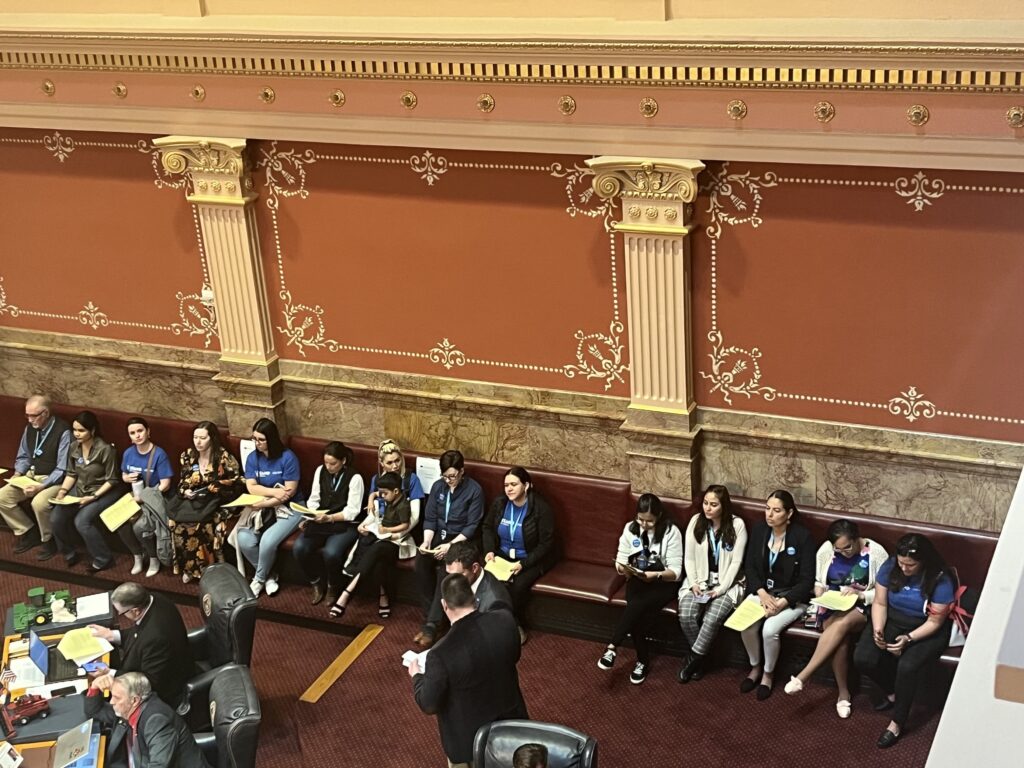
Capitol Week in Review brings you news of bills we are tracking around our priorities of advancing educational equity and racial justice in Colorado and making our schools and communities safer and more supportive.  

Legislative Update

HB23-1042, Admissibility Standards For Juvenile Statements, which increases funding for interrogation training for law enforcement, as well as improves the general reliability of confessions by requiring all juvenile interrogations to be recorded was passed by the Senate Appropriations Committee and is expected to be considered by the full Senate this weekend.   

HB23-1100, Restrict Government Involvement In Immigration Detention, was passed by the Senate Judiciary Committee and full Senate. For years, Colorado taxpayers have been picking up the bill of the federal government by allowing the state to contract a private company to detain individuals for federal immigration purposes. This bill would prevent any such further contracts and begins a review process of these contracts over the next two years. 

HB23-1168, Legal Representation And Students With Disabilities, which requires CDE to create and maintain a list of attorneys qualified to represent a parent in a due process complaint and creates a fund to pay attorneys defending parents against due process complaints filed by an education provider, passed the Senate and is headed to the Governor for signature.   

HB23-1231, Math in Pre-Kindergarten Through Twelfth Grade, will be heard by the Senate Education Committee April 24th. This bill will support math educators with evidence-based training and interventions to help K- 12th-grade students struggling in math. Importantly, this bill includes $1.6 million for the Ninth Grade Success Grant program to help ensure that more Colorado students finish their 9th-grade year on track and graduate high school prepared for post-secondary success.   

HB23-1235, Technical Modification To Department Of Early Childhood, makes technical changes HB22-1295, which created Colorado’s universal preschool program. This bill would allow the Department of Early Childhood to enter into contracts for early literacy programming and whole-child services and ensures policy is aligned with current state and federal standards and was passed by the Senate. 

HB23-1241, Task Force To Study K-12 Accountability System, which creates a task force to study academic opportunities, inequities, practices in schools, and improvements to the accountability and accreditation system, is scheduled to be heard by the Senate Education Committee April 26th.  

HB23-1249, Reduce Justice Involvement for Young Children, which changes the minimum age – from 10 to 13 – of children who are subject to prosecution in juvenile court; except in the case of homicide, was passed by the House.

HB23-1263, Translating Individualized Education Programs, which permits the multidisciplinary team that creates an individualized education program (IEP) for a child, who may be eligible for special education services, to translate the IEP draft documents into the dominant language spoken in the child’s home, is scheduled to be heard by the Senate Education Committee April 24th.  

HB23-1291, Procedures For Expulsion Hearing Officers, was passed by House Education Committee and referred to the House Appropriations Committee. This bill addresses due process rights for students by mandating the sharing of evidence during an expulsion hearing, prohibiting conflicts of interest for the hearing officer, as well as requiring annual training regarding student development, restorative justice, and special education and the law. 

SB23-004, Employment Of School Mental Health Professionals, which authorizes a school district to employ health professionals, who are not licensed by the Colorado Department of Education but hold a Colorado license for their profession is headed to the Governor for signature.   

SB23-087, Teacher Degree Apprenticeship Program, which creates a teacher degree apprenticeship program as an alternative route to teacher licensure and helps to alleviate the educator shortage, passed House on second reading and is awaiting a final vote.   

SB23-099, Special Education Funding, which increases special education funding by an additional $40,203, 671, unanimously passed the House on second reading and is awaiting a final vote.  

SB23-158, Sunset Colorado Commission On Criminal And Juvenile Justice, which continues the Commission until September 1, 2028, will be heard by the Senate Judiciary Committee April 24th.  

 
SB23-258, Consolidate Colorado Educator Programs In Colorado Department of Education, which consolidates the review and approval process for educator preparation programs under the Department of Education and the State Board of Education passed the Senate Education Committee and was referred to the Appropriations Committee and will be heard April 27th.  

SB-23-287, Public School Finance, which sets school funding levels, passed the Senate Education Committee and was referred to the Senate Appropriations Committee. The bill increases the statewide base per pupil funding for the 2023-24 budget year by $598.25 (to account for inflation) and creates a public-school finance task force.  

Our Take

Monday, the Senate Education Committee is considering HB23-1231, Math in Pre-Kindergarten Through Twelfth Grade a bill to support math educators with evidence-based training and interventions to help K- 12th-grade students struggling in math. The bill includes $1.6 million for the Ninth Grade Success Grant program to help ensure that more Colorado students finish their 9th grade year on-track and graduate high school prepared for post-secondary success.  

Decades of research shows that ninth grade students who are on-track at the end of their first year of high school are as much as four times more likely to graduate from high school than their off-track peers. Ninth graders who earn at least a quarter of the credits required for graduation and receive no more than one “F” are on-track to graduate. Schools and districts implementing ninth grade success strategies are showing tremendous results. Implementing a focused 9th grade success approach is changing the trajectory for Colorado students. 

Take action

Please email members of the Senate Education Committee and ask them to support Colorado educators in preparing the next generation of students.

What We’re Reading

Colorado school finance act boosts K-12 spending, steers clear of formula changes

Colorado bill would add protections for students facing expulsion 

Chalkbeat’s Education Bill Tracker 

Why 9th Grade Matters  

9th grade has come to be well known as the make-or-break year. How well students perform academically in 9th grade can predict their future success. The first year in high school has a huge impact on whether students graduate. In fact, students who end 9th grade on-track are three times more likely to graduate from high school than their off-track peers. (toandthrough.uchicago.edu

To be on-track means a 9th grade student has earned at least a quarter of the credits needed to graduate and received no more than one F in any course. Research shows that on-track status is a stronger predictor of high school graduation than race/ethnicity, level of poverty, and test scores combined!  

At Stand Colorado, we prioritize policy solutions and implementation efforts to ensure that high schools across the state are implementing a 9th grade success approach, a proven strategy to improve graduation rates.  

What’s happening in Colorado  

In 2019, the Colorado state legislature created the Ninth Grade Success Grant Program. Informed by the research around 9th grade success, the grant supports schools to implement key components of a 9th grade success approach including establishing Ninth Grade Teams, implementing data systems and transition programs, and providing targeted instructional support for ninth grade students. Stand Colorado championed efforts to secure $800K for the Grant Program to maximize the number of Colorado students who finish 9th grade on-track.  

There are currently nine Colorado school districts receiving funds through the grant. In Colorado, the Center for High School Success (CHSS), a Stand for Children program, partners with four of those districts, Denver Public Schools, Center Consolidated Schools 26JT, Poudre, and Pueblo 60, to increase 9th Grade On-Track Rates. Colorado’s Center for High School Success, which currently partners with eight total districts across Colorado provides coaching, training, collaboration, and data and technical support. In the 2021-22 school year, On-Track Rates in schools that partner with CHSS in Colorado grew an average of 19 percentage points, drastically increasing the number of students who will graduate in 2025.  

It’s clear that implementing a focused 9th grade success is changing the trajectory for Colorado students. By ensuring that students finish their 9th grade year on-track, we ensure students graduate high school prepared for post-secondary success.  

TAKE ACTION

The Senate Education Committee is considering HB23-1231, Math in Pre-Kindergarten Through Twelfth Grade a bill to support math educators with evidence based training and interventions to help K- 12th grade students struggling in math. The bill also includes $1.6 million for the Ninth Grade Success Grant program to help ensure that more Colorado students finish their 9th grade year on-track and graduate high school prepared for post-secondary success. 

Decades of research shows that ninth grade students who are on-track at the end of their first year of high school are as much as four times more likely to graduate from high school than their off-track peers. Ninth graders who earn at least a quarter of the credits required for graduation and receive no more than one “F” are on-track to graduate. Schools and districts implementing ninth grade success strategies are showing results. Implementing a focused 9th grade success approach is changing the trajectory for Colorado students.

Please email members of the Senate Education Committee and ask them to support Colorado educators in preparing the next generation of students.  

HB 23- 1042, Admissibility Standards For Juvenile Statements was heard by the Senate Judiciary Committee on April 17, 2023. The bill passed the House and the Senate and is off to the Governor’s office for signature. Below is the prepared testimony of our Government Affairs Director Bri Buentello.

My name is Bri Buentello, and I’m the government affairs director for Stand for Children, Colorado. Stand advances educational equity and racial justice through meaningful partnerships with families, educators, schools, and policymakers.  

We strongly support HB23-1042. 

But today, I’m here to talk to you about what it’s like to be Noel’s mama.  

You see, I have one child; a boy named Noel. He’s a kind, vivacious kid who’s twelve years old and already wearing size 7 men’s shoes.  

And I still remember when I realized that there was something different about him, more than ten years ago. 

As a baby, he made fine eye contact and gurgled often, but eventually fell silent and stopped looking at me. As he grew into a toddler, he began intentionally hitting his head when he was frustrated and silently dancing when he was ecstatic.  

He was soon diagnosed with Autism Spectrum Disorder, as well as having Intellectual/Developmental disabilities.  

Becoming a mama changes everything, but becoming a mama to a child with disabilities changes it all over again. 

My whole world shifted as the thought occurred to me – what could go wrong, raising a little boy who might not ever speak? Even more distressingly, what happens when he stops being that sweet toddler, who’s afraid of sirens, loved toy trains, and trying to catch fireflies at Grandma’s cabin? 

It wasn’t so very long ago, back in our hometown of Pueblo, that there was another young man with intellectual disabilities named Joseph Arridy. He was also a sweet, naive boy that loved toy trains. 

And he was killed by the state of Colorado, at the age of 23, on a criminal conviction that was largely based on a false confession extracted by the then Pueblo County Sheriff.  

You see, the Sheriff had a witness who stated a tall man with dark features was seen fleeing the scene; he decided that Arridy fit that bill, and so Arridy became the sole person of interest in a murder investigation. 

Arridy understood so little of the gravity of the situation that he falsely confessed, thinking he could just leave afterwards. He was convicted and subsequently sentenced to death; he even requested ice cream for his last meal. 

The sad fact is that Joseph Arridy is far from the last person with disabilities to be unjustly thrown in prison or even killed by the Centennial state. Recently, the murder of Elijah McClain, another young man with autism, filled me with a profound existential anxiety; I could so easily see my own boy dancing on the side of the road and then panicking under physical restraint of a poorly trained police officer. 

Over the years, I’ve learned to live with anxiety as my boy grows up to be a man. But last year, it was estimated that 1 in 36 children were diagnosed with autism; my kid is far from the only kid in Colorado or even Pueblo, with autism. And our knowledge and understanding of this disability has changed. 

It’s about time our laws do too.  

HB23-1042 also provides some modest legal safeguards for these kids, and training for law enforcement officers for a understanding of these disabilities, as well as best practices engaging this emerging population as these kids grow into adults.  

Stand for Children, and myself as Noel’s mama, would like to thank Senator Gonzales for her fearless leadership for kids, and urge the committee to vote yes on HB-1042, unamended. Thank you.

Learn more about HB23-1042 and why we are supporting it.

Capitol Week in Review brings you news of bills we are tracking around our priorities of advancing educational equity and racial justice in Colorado and making our schools and communities safer and more supportive.  

Legislative Update

HB23-1003, School Mental Health Assessment, creates the sixth through twelfth grade mental health assessment program. The hearing for this bill was rescheduled for  April 13th.     

HB23-1024, Relative And Kin Placement Of A Child, which establishes measures to support reunification of a child or youth with their family when the child or youth has been temporarily placed with a relative or kin, will be heard April 12 by the Senate Health and Human Services Committee.  

HB23-1109, School Policies and Student Conduct, was postponed indefinitely, meaning it will not advance further this year, by a unanimous vote in the House Education Committee. This bill aimed to strengthen due process rights for students, particularly as it pertained to behavior off school grounds and outside of school hours. It also increased the training for expulsion hearing officers, including training around disabilities and trauma-informed care and interventions.   

HB23-1168, Legal Representation And Students With Disabilities, which requires CDE to create and maintain a list of attorneys qualified to represent a parent in a due process complaint and creates a fund to pay attorneys defending parents against due process complaints filed by an education provider, is scheduled to be considered by the Senate April 10.  

HB23-1169, Limit Arrest For Low-level Offenses, which prohibits a peace officer from arresting a person based solely on the alleged commission of a petty offense, except for high level misdemeanors directly impacting victims (e.g. theft), was postponed indefinitely by the House Judiciary Committee.  

HB23-1231, Math in Pre-Kindergarten Through Twelfth Grade, will be heard by the House Appropriations Committee April 10. This bill will support math educators with evidence-based training and interventions to help K- 12th grade students struggling in math. The bill also includes $1.6 million for the Ninth Grade Success Grant program to help ensure that more Colorado students finish their 9th grade year on-track and graduate high school prepared for post-secondary success.   

HB23-1235, Technical Modification To Department Of Early Childhood, makes technical changes HB22-1295, which created Colorado’s universal preschool program. This bill would allow the Department of Early Childhood to enter into contracts for early literacy programming and whole-child services, and ensures policy is aligned to current state and federal standards and was passed 7-4 by the House Education Committee.   

HB23-1249, Reduce Justice Involvement for Young Children, which changes the minimum age – from 10 to 13 – of children who are subject to prosecution in juvenile court; except in the case of homicide, was passed by the House Judiciary Committee 9-4 and referred to the House Appropriations Committee.  

HB23-1263, Translating Individualized Education Programs, permits the multidisciplinary team that creates an individualized education program (IEP) for a child, who may be eligible for special education services, to translate the IEP draft documents into the dominant language spoken in the home of the child’s parent, guardian, or legal custodian. The bill is scheduled to be heard by the House Education Committee April 13th.  

SB23-004, Employment Of School Mental Health Professionals, which authorizes a school district to employ health professionals, who are not licensed by the Colorado Department of Education but hold a Colorado license for their profession was passed unanimously by the House Education Committee. 

SB23-039, Reduce Child And Incarcerated Parent Separation, which requires the Department of Human Services to prioritize and facilitate communication and family time between children and their parents who are incarcerated, passed unanimously by the House Public & Behavior Health and Human Services Committee and was referred to the Appropriations Committee. 

SB23-70, Mandatory School Resource Officer Training, is a bill that would require a law enforcement officer to complete a Safe2Tell training curriculum before working as a school resource officer; it was passed unanimously by the House Education Committee.  

SB23-087, Teacher Degree Apprenticeship Program, which creates a teacher degree apprenticeship program as an alternative route to teacher licensure and helps to alleviate the educator shortage, was passed unanimously by the House Education Committee.  

SB23-099, Special Education Funding, which increases special education funding by an additional $40,203, 671, is scheduled to be heard by the House Education Committee April 10.

 
SB23-258, Consolidate Colorado Educator Programs In Colorado Department of Education, which consolidates the review and approval process for educator preparation programs under the Department of Education and the State Board of Education is scheduled to be heard April 10 by the Senate Education Committee.  

Our Take

After hours of compelling testimony, nine members of the House Judiciary Committee voted to pass HB23-1249, Reduce Justice-involvement For Young Children. This legislation will end the prosecution of children 12 years and younger and empower alternative child-serving systems, including mental health, education, and child welfare agencies, to address the behavior, deliver treatment and family supports instead of prosecution. We applaud the members that voted to advance this important legislation.  

Take Action

Send a thank you note to the legislators that voted to pass HB23-1249 with one click!   

What We’re Reading

Opinion: Families shouldn’t go into debt paying for prison calls

School district invites mental health co-responders to assist school resource officers

Chalkbeat’s Education Bill Tracker 

The House Judiciary Committee is considering HB23-1249, Reduce Justice-involvement For Young Children, bipartisain legislation to end the prosecution of children 12 years and younger and empower alternative child-serving systems, including mental health, education, and child welfare agencies, to address the behavior, deliver treatment and family supports instead of prosecution.

Did you know that kids as young as 10 years old are subject to being arrested and prosecuted— most for child-like behavior or minor misbehavior? Children of color bear the brunt of Colorado’s reliance on prosecuting young children. 

Research shows that addressing a child’s misbehavior through the justice system harms them AND is more expensive and less effective than alternative interventions. There are other reasons that it’s problematic to address a child’s misbehavior through the juvenile justice system, too:

  • It increases their chances of incarceration as an adult by up to 41%. 
  • It decreases the chances of high school graduation by up to 39%. 
  • 1 out of every 4 incarcerated children between ages 10 to 12 are victims of violence while incarcerated.

there’s a better way…

Community-based programs outside the justice system are a safer, cheaper, and more effective way to get to the heart of family problems, trauma, or just a poorly thought-out decision by a child. 

This bill will end the prosecution of children 12 years and younger and empower alternative child-serving systems, including mental health, education, and child welfare agencies, to address the behavior, deliver treatment and family supports instead of prosecution.  

Tell policymakers you support HB23-1249 today! 

photo of Denver skyline with words this month at the DPS Board

Our goal is simple: to share what is happening at school board meetings so you can engage with the board and the district even if you cannot attend hours of meetings every month. 

Work Session – March 2, 2023 

The board discussed potential edits to Ends Policy 5, Post Graduation and Global Citizenship, which states in part, “Graduates will be civically changed lifelong learners with the necessary knowledge and skills to adapt to changing local, regional, and global demands. To this end, all graduates will be prepared for a successful post-secondary experience…” Discussion primarily surrounded how explicit and specific to be in language related to civic engagement and voter registration. Because one board member was not in attendance, the discussion around Ends Policy 5 was tabled and will be added to a future agenda. 

Special Board Meeting– March 9, 2023 

Declining Enrollment- Denver Discovery School (DDS), Mathematics and Science Leadership Academy (MSLA), Fairview Elementary 

Superintendent Marrero and staff presented an update on the recommendations for the critically-low enrolled schools, DDS, MSLA, and Fairview Elementary. DPS secured some community input from each school to inform recommendations presented to the Board. For context, DDS’ projected total enrollment is 62, with $1,056,611 in supplemental funding needed, MSLA’s projected total enrollment is 104 with $693,282 in supplemental funding needed, and Farview’s projected enrollment is 118 with $680,139 in supplemental funding needed.  

Meetings were held in person and virtually with each schools’ staff, families and community and the options discussed with them were:  

Some of the feedback expressed from the DDS community was a “strong desire to not be merged into a welcoming school,” families wanted priority in other DPS schools when participating in School Choice process and direct support with choosing a school for next year. Staff asked for support in finding a job at a school and to receive incentive pay for closing the school. As for the timeline, staff and families asked for a quick decision. MSLA community also asked for a quick decision and wanted to stay close to Valverde as well as opportunity to selected schools elsewhere. Fairview staff surveys indicated staff are frustrated by years of uncertainty, stating they want support ASAP with finding a job. The Fairview community wants to merge with Cheltenham and asked for transportation resources for students to cross the busy road to Cheltenham. Fairview does have the potential to serve as a community hub and/or reopen if enrollment comes back.  

In the end, the recommendations presented were to close DDS at the end of the 2022-2023 school, unify MSLA into Valverde for the 2023-2024 school year, and unify Fairview into Cheltenham for the 2023-2024 school year. The recommendations were approved and passed.  

Legislative Update 

Staff from DPS gave an update on the legislation they are supporting this session. There were numerous bills presented but some highlights are: 

DPS is supporting several school to prison pipeline reform, housing and gun bills including HB23-1042 Admissibility Standards for Juvenile Statements, HB23-1109 School Policies and Student Conduct, HB23-1120 Eviction Protections for Residential Tenants, SB23-169 Increasing Minimum Age to Purchase Firearms.  

Innovation Zone Reviews and Plans 

DPS staff presented recommendations on the Luminary Learning Network, Becon Network Schools Innovation Zone, and Northeast Denver Innovation Zone. First, they shared some context on how innovation zones work and how they differ from charter renewals when it comes to the guidance provided by the state and Colorado’s State Board of Education’s role. State statute does not provide the same level of guidance as charter renewals and if an innovation zone is not approved by the Board and  asks the State Board to review the decision, the decision that comes from the State Board is not binding as it is with the charter process.  

The criteria that DPS uses when reviewing an innovation zone is: 

  • Academic Outcomes (primary)  
  • Organizational Health (primary)  
  • Zone Plan Quality and Implementation  
  • Stakeholder Engagement and Consent  

Considering the criteria, Luminary Learning Network’s recommendation was to approve the innovation zone. Beacon Network’s Schools innovation zone was recommended to be revoked due to “insufficient academic progress of students at Kepner Beacon Middle School, and concerns with the organizational health of the zone, which are likely to negatively impact academic outcomes.” Northeast Denver Innovation Zone’s recommendation to the Board was to continue to review due to the lack of clarity when the plans were submitted and vote on the review in the April or May meeting.  

Redistricting 

The DPS Board discussed the need to prolong the timeline to redistrict DPS. For some context, DPS district borders need to change because as population grows only in certain districts, each district must have close to the same amount of people, so the borders must adjust. This process was supposed to start in the fall of 2022, but due to other priorities confronting the board it was pushed to February 2023. There was minimal participation in the in-person community engagement meetings and minimal participation from groups of people who should have a say in the conversation. The Board is seeking to delay the timeline to vote for the new maps, but clarity and guidance is expected from the Denver Elections Division.  

Budget Advisory Committee – March 13, 2023 

DPS staff said the district is on track to meet its budget by the end of the year. At this point schools have entered their hiring timeline and PERA funding is on track as well. Then they presented an update around how the stimulus funds have been used. DPS is currently spending ESSER II funds and those end September 2023. They have spent around 78% of those funds and are on track to spend 100% and move into the last year of ESSER Funds (ESSER III) by September 2024. You can find these updates on the district stimulus website.  

Public Comment and Progress Monitoring Session – March 20, 2023 

DPS staff presented updated next steps for the two innovation zones, Northeast Denver Innovation Zone (NDIZ) and Beacon. They presented some context that led them to create specific next steps.  

Northfield High School, which is the NDIZ zone, voted to leave the innovation zone, but remain an innovation school. Teachers were surveyed and the resulting numbers were 62.9% of teachers voted to exit the zone and 68% voted to retain innovation status as a school. Due to Northfield leaving the zone, NDIZ will need to revise the plan. They also mentioned the NDIZ is out of compliance with calendar guardrails, the Healthy Start Times resolution, and forced placement.  

The Beacon Innovation Zone information presented consisted of finances, staff management, and their academic. Beacon’s finances were said to be unreliable, and they spent more than was allocated for the year. Some of Beacon staff are technically DPS employees, but not managed by DPS, which can cause issues in staff management. The academic data that was presented showed that students are underperforming, but they are working towards closing gaps. 

The next steps recommended for Beacon consist of adding support to the personalized learning efforts already being done at each campus and funding support. 

Special Board Meeting –March 23, 2023 

Board Discussion and Update on School, Student, and Adult Safety  

This Special Board meeting was scheduled after the regular board meeting got cancelled due to the school shooting tragedy at East High School. The DPS board went into executive session which means their discussion was held without a public audience. After hours of the executive session, the board came back to a public forum and read aloud a memorandum directing actions by Superintendent Marrero. In the memorandum, it mentioned that the district will be collaborating with DPD again to get armed officers in high schools for the remainder of the school year. The Superintendent was also directed to work with Mayor Michael Hancock to provide at least two armed police officers and as many as two additional mental health professionals at all Denver high schools with external funding and support.   

After they adjourned the meeting, they attended a press conference where they expressed how DPS, and society failed the student involved in the shooting.    

ENGAGE WITH THE BOARD 

Do you want to let the board know your thoughts on any of these topics? You can sign up for public comment and speak directly to the board about what matters to you. You can sign up here

Capitol Week in Review brings you news of bills we are tracking around our priorities of advancing educational equity and racial justice in Colorado and making our schools and communities safer and more supportive.  

Legislative Update

HB23-1003, School Mental Health Assessment, which creates the sixth through twelfth grade mental health assessment program will be heard April 6 in the Senate Health and Human Services Committee.  

HB23-1024, Relative And Kin Placement Of A Child, which establishes measures to support reunification of a child or youth with their family when the child or youth has been temporarily placed with a relative or kin, will be heard April 5 by the Senate Health and Human Services Committee.  

HB23-1089, Special Education Services For Students In Foster Care, which designates students in out-of-home placements as residents of the school district of their school of origin to increase stability and learning success, will be heard April 5 by Senate Education.  

HB23-1169, Limit Arrest For Low-level Offenses, which prohibits a peace officer from arresting a person based solely on the alleged commission of a petty offense, except for high level misdemeanors directly impacting victims (e.g. theft), was rescheduled to be heard by the House Judiciary Committee April 5.  

HB23-1235, Technical Modification To Department Of Early Childhood, makes technical changes HB22-1295, which created Colorado’s universal preschool program. This bill would allow the Department of Early Childhood to enter into contracts for early literacy programming and whole-child services, and ensures policy is aligned to current state and federal standards and is scheduled to be considered by the House April 3.   

HB23-1241, Task Force To Study K-12 Accountability System, which creates a task force to study academic opportunities, inequities, practices in schools, and improvements to the accountability and accreditation system, passed 10-0 by the House Education Committee.  

HB23-1249, Reduce Justice Involvement for Young Children, which changes the minimum age – from 10 to 13 – of children who are subject to prosecution in juvenile court; except in the case of homicide, will be heard April 5 by the House Judiciary Committee.  

SB23-004, Employment Of School Mental Health Professionals, which authorizes a school district to employ health professions, who are not licensed by the Colorado Department of Education but hold a Colorado license for their profession will be heard by the House Education Committee April 6.  

SB23-039, Reduce Child And Incarcerated Parent Separation, which requires the Department of Human Services to prioritize and facilitate communication and family time between children and their parents who are incarcerated, is scheduled to be heard April 5 by the House Public & Behavior Health and Human Services Committee.  

SB23-70, Mandatory School Resource Officer Training, is a bill that would require a law enforcement officer to complete a Safe2Tell training curriculum before working as a school resource officer; it is scheduled to be heard April 6 in the Senate Education Committee.  

SB23-087, Teacher Degree Apprenticeship Program, which creates a teacher degree apprenticeship program as an alternative route to teacher licensure and helps to alleviate the educator shortage, is scheduled to be heard April 3 by the House Education Committee.  

Our Take

Legislators are considering a policy that will help reduce recidivism by keeping families connected while a loved one is incarcerated. HB23-1133, Cost of Phone Calls for Persons in Custody, would make prison communication free across Colorado.  

Every year, Colorado families –who are disproportionately Black, brown, and low-income – pay over $8.8 million to speak to their incarcerated loved ones. Over 50% of families with an incarcerated loved one struggle to meet basic housing and food needs. One out of three families with a loved one behind bars goes into debt just to stay in touch, and women carry 87% of the burden. 

Research has repeatedly shown that when incarcerated people and their families are in regular communication, they do better both while they are behind bars serving their sentence and when they reenter the community, which improves safety for correctional officers and the public. 

Take Action

Ask legislators to reduce recidivism and keep families connected! 

Email your representative and ask them to support HB23-1133.  

What We’re Reading

State budget clears Colorado Senate, school funding TBD 

Chalkbeat’s Education Bill Tracker 

Legislators are considering important policy that will help reduce recidivism by keeping families connected while a loved one is incarcerated. HB23-1133, Cost of Phone Calls for Persons in Custody, would make prison communication free across Colorado. Every year, Colorado families –who are disproportionately Black, brown, and low-income – pay over $8.8 million to speak to their incarcerated loved ones. Over 50% of families with an incarcerated loved one struggle to meet basic housing and food needs. One out of three families with a loved one behind bars goes into debt just to stay in touch, and women carry 87% of the burden

Research has repeatedly shown that when incarcerated people and their families are in regular communication, they do better both while they are behind bars and when they reenter the community, which improves safety for correctional officers and the public.

We need you to weigh in please! Will you email your representative today and ask them to support HB23-1133?    

On Thursday, March 16 the House Education Committee heard HB23-1231: Math In Pre-kindergarten Through Twelfth Grade, which requires CDE to create and offer free, optional trainings in evidence-based practices in mathematics, including a training specifically designed for elementary school educators and a training specifically designed for secondary school mathematics educators. The bill also amends the ninth-grade success grant program and requires the CDE to prioritize applicants that propose programming focused on evidence-based mathematics skills and intervention strategies, including a focus on students who are below grade level or struggling in mathematics and have academic achievement levels in mathematics that are consistently ranked the lowest for public high schools in the state. Funding for the Ninth Grade Success Grant program is a top priority of Stand Colorado. Below is the testimony in support of HB23-1231 of Krista Spurgin, Stand Executive Director.

“Good afternoon Mr. Chair, House Education Committee Members, my name is Krista Spurgin and the Executive Director with Stand for Children Colorado. Stand for Children is an education advocacy and racial justice nonprofit that supports parents, teachers, and community members in their fight for excellent public schools and systems changes that directly impact all of Colorado’s kids.

We are very supportive of HB1231 as a whole and want to specifically speak to the section of this bill that increases funding for the 9th Grade Success Grant program and prioritizes schools focused on math.

The 9th Grade Year has been called the Make Or Break year because Students who are on track at the end of the 9th grade year – meaning they are passing core class such as math and are meeting attendance expectations – are 3 times more likely graduate on time.

Research actually shows that on-track status is a stronger predictor of high school graduation than race/ethnicity, level of poverty, and test scores combined!  

In School year 21-22 schools focused on 9th grade success work increased 9th grade on-track rates by an average of 19 percentage points putting 2,300 additional students on track to graduation.

We believe that prioritizing grantees that have a plan to focus on math is a great use of the funding and the program.  I appreciate your time today and ask for your support of HB23-1231.”

Capitol Week in Review brings you news of bills we are tracking around our priorities of advancing educational equity and racial justice in Colorado and making our schools and communities safer and more supportive.

LEGISLATIVE UPDATE

HB23-1001, Expanding Assistance For Educator Programs, which supports student teachers toward the goal of diversifying the teacher workforce, is scheduled to be heard in the Senate Education Committee on March 13.  

HB23-1037, Department Of Corrections Earned Time For College Program Completion, which permits an inmate sentenced for a nonviolent felony offense to have earned time deducted from their sentence for each accredited degree or other credential awarded will be heard by the Senate Judiciary Committee March 13.  

HB23-1042, Admissibility Standards For Juvenile Statements, which increases funding for interrogation training for law enforcement, as well as improves the general reliability of confessions by requiring all juvenile interrogations to be recorded passed second reading in the House and a final vote is expected soon.  

HB23-1064, Interstate Teacher Mobility Compact, which makes it easier for active-duty military spouses to transfer their teaching licenses without further testing, thereby allowing them to teach in Colorado classrooms faster, is headed to the Governor for signature. 

HB23-1089, Special Education Services For Students In Foster Care, which designates students in out-of-home placements as residents of the school district of their school of origin to increase stability and learning success, is scheduled to be heard in the House Education Committee on March 16.  

HB23-1100, Restrict Government Involvement In Immigration Detention, passed out of the House. For years, Colorado taxpayers have been picking up the bill of the federal government by allowing the state to contract a private company to detain individuals for federal immigration purposes. This bill would prevent any such further contracts and begins a review process of these contracts over the next two years. It passed the House and was introduced in the Senate and assigned to the Judiciary Committee.  

HB23-1109, School Policies and Student Conduct, is scheduled to be heard for action only by the House Education Committee March 29.  This bill aims to strengthen due process rights for students, particularly as pertains to behavior off school grounds and outside of school hours. It also increases the training for expulsion hearing officers, including training around disabilities and trauma-informed care and interventions. 

HB23-1145, Hearing Timelines Juveniles in Adult Facilities, which aligns Colorado law’s hearing timelines for juveniles held in an adult facility while awaiting trial with the timelines in the federal “Juvenile Justice and Delinquency Prevention Act”, passed the Senate on third readings 35-0.   

HB23-1198, Teacher Externship Program for Science Technology Engineering and Math Disciplines, which creates a statewide program to provide kindergarten through twelfth grade teachers work-based learning opportunities, passed House Education Committee and was referred to the Finance Committee.  

HB23-1207, Stipends For National Board-certified Educators, which allows stipends (up to $3200) for educators serving in low-performing, rural or high-needs school districts, passed the House Education Committee and was referred to the Appropriations Committee.   

HB23-1211, Collect Data Language Translation Services Special Education, which requires the Department of Education to track the provision of language translation services related to IEPs and include such data as part of its annual “SMART Act” was postponed indefinitely.  

SB23-004, Employment Of School Mental Health Professionals, which authorizes a school district to employ health professions, who are not licensed by the Colorado Department of Education but hold a Colorado license for their profession will be heard by the House Education Committee March 29.  

SB23-70, Mandatory School Resource Officer Training, is a bill that would require a law enforcement officer to complete a Safe2Tell training curriculum before working as a school resource officer; it passed the Senate unanimously on third reading.  

SB23-181, Concerning Screening of Dyslexia in Public Schools, builds on recommendations for further screening and training on how best to screen for individual literacy deficiencies was introduced in the Senate. The bill also establishes an independent ombudsman to represent parents of students with literacy needs.  

Our Take 

The House is expected to take a final vote soon on HB 23- 1042, Admissibility Standards For Juvenile Statements.  

In Colorado, children of color are one and a half to three times more likely to be arrested and interrogated than their white counterparts (CO Dept. of Public Safety, 2020). As a result, children of color are more often harmed by false confessions, directly contributing to the racial disparity in the criminal justice system.   

Currently, law enforcement may use deception during interrogation of youth. As you would imagine, children are more susceptible to manipulation and more likely to provide inaccurate information and false confessions under such pressure. In the last twenty-five years, youth who were exonerated after being convicted of crimes, 38% gave false confessions. 

 HB 23- 1042, Admissibility Standards For Juvenile Statements will: 

  • Increase funding for interrogation training for law enforcement, and 
  • Improve the general reliability of confessions by requiring all juvenile interrogations to be recorded, and 
  • If law enforcement does use deceptive tactics during custodial, interrogation, the judge may discern whether the resulting confession was voluntary and therefore reliable and admissible in trial. 

Read personal testimony in support of this legislation on our blog here, here, here, and here.  

Take Action 

Last week, members of the House Education Committee heard hours of testimony from students, educators, and legal experts asking them to support HB23-1109, School Policies And Student Conduct. This is legislation that promotes restorative practices, ensures reduced legal system involvement, fosters fairness in a system that otherwise considers students guilty until proven innocent, and creates accountability for unregulated and untrained expulsion hearing officers 

Expelling students exposes them to a greater likelihood of delinquency or criminal system involvement and is therefore more expensive and less effective than keeping students in school. Email the House Education Committee and ask them to support HB23-1109.  

What We’re Reading 

The ‘Science of Reading’ and English-Language Learners: What the Research Says 

Chalkbeat’s Education Bill Tracker