Over two years ago, I posted this video. In it, I talk about the opportunity gap in IPS and why I want to see more just and equitable schools. Since then, two of my children have started attending one of the schools in our city that is doing a much better job of closing the opportunity gap. My understanding of how important it is to close the gap has only grown.

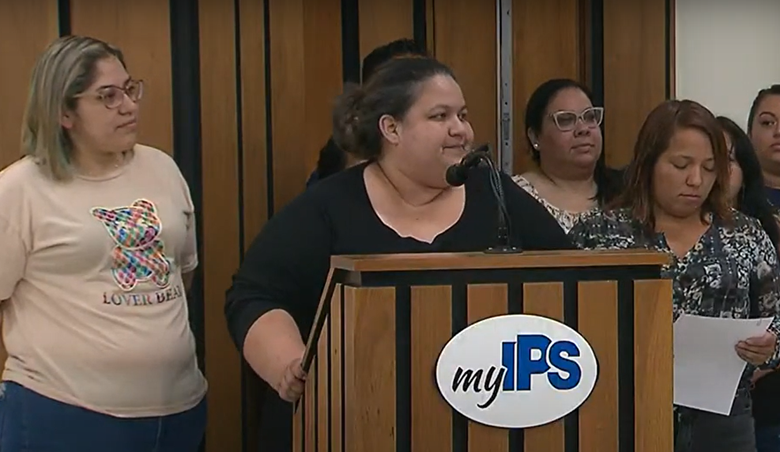
Last night, I spoke to IPS leaders at the Action Session. I requested they share data about the schools that close the opportunity gap in October. Watch my video from last night here.

Today, I also want them to do something about it. I want them to feel what I feel when I see that only 5.4% of Black students in IPS passed both section of the ILEARN and allow that heartbreak to push them to grow schools that are working for children of color and low-income students.

Please join me in asking IPS leaders to grow schools that work and close the opportunity gaps we’ve experienced for decades now by adding your name to this petition.

Too many kids are failing and too many kids aren’t getting an equitable shot at success. I will no longer accept the status quo because our kids deserve more. Our kids not getting a great education affects our whole community.

I know IPS leaders care, but we need them to act in the best interest of Indianapolis kids and grow data-proven schools. If you agree, please add your name to this petition today. Our kids can’t wait.

At the Indianapolis Public Schools (IPS) Action Session, I asked district leaders to transparently share the data that highlights public schools in IPS boundaries that close the opportunity gap, regardless of school type.


I want them to share this data in October because I know that we can partner together and learn from this data. It is so important for us to not only look at the schools that are equitably educating Black and Brown students, but for us to do something about it.

Watch my remarks here:

Last night, I spoke at the IPS board meeting. During this meeting, I requested IPS leaders share data about schools in our city, not all of which are IPS schools (but all are public schools), that are doing a much better job of closing the opportunity gap. I also asked them to take action and create a plan to partner and grow schools that are seeing much better outcomes for Black and Brown students.  

Watch my speech to the IPS board here:

View data about the opportunity gap in our city here:

This is not the first time I have asked IPS leaders to close the opportunity gap. For years, parents like me have been asking IPS leaders to use data to drive decisions that can help grow schools that working for Black and Brown children. If this data tugs at your heart, please join me in being a part of the solution. The more people who sign the petition, the more likely IPS leaders will act.  

I went to the Indianapolis Public Schools (IPS) Action Session in August to thank IPS leaders for agreeing to create a language justice plan back in December and to speak about why this plan is critical for students.

Asistí a la Sesión de Acción de las Escuelas Públicas de Indianápolis (IPS) en agosto para agradecer a los líderes de IPS por aceptar crear un plan de justicia lingüística en diciembre y hablar sobre por qué este plan es fundamental para los estudiantes.

Watch or read what I told IPS leaders below | Mire o lea lo que les dije a los líderes de IPS a continuación:

Read my speech in English

Good evening Superintendent Dr. Johnson and IPS board members,

My name is Lizzbeth Arias and I am a High School ELA Tutor at GEO Next Generation. I am here to thank you for agreeing to create a language justice plan back in December and to speak about why this plan is critical for students.

I want to start by telling you about an encounter I recently had with a really young child who was crying in the hallway of the school next door to mine. In this school, absolutely no one speaks Spanish. And this student was crying in the bathroom and in the hallway because he did not understand anything. He was trying to follow the other students but ultimately felt lost. He was in a new place, and he couldn’t communicate his needs or understand what he was meant to be doing. Trying to learn in an environment where you cannot be heard or understood is an injustice. I support IPS in creating a plan for language justice because I don’t want any student to feel how that boy did, but I know there are students across this city and this district who feel this way every day. Can you imagine arriving somewhere new and always feeling lost?

Supporting a plan for language justice is one thing, but for it to be successful, you have to get feedback from the immigrant and ELL communities. You will need to find ways to reach the families who do not have access to technology, who work long hours, who do not speak English and have possibly felt outcasted due to this, and whom you may not have heard from before.

Behind every English learning student is a community of parents and as you gather feedback to create the plan, I hope you also create communities of parents in schools. These parent communities can help you reach more families and gather more input. They can also create a sense of belonging and understanding in schools that need it. For our students to succeed in school, we need to make sure they are fully supported. A triangle of family, school, and student has to exist.

Again, I thank you for supporting the creation of a language justice plan. I hope through thoughtful feedback from ELL families, the plan can become a model for even more schools in our city. I also hope you offer time for the public to offer feedback on the plan and that you vote on the final version. And please ensure the district takes the time to gather input from the hard-to-reach parents, who desperately want to be a part of their child’s education but sometimes feel forced to live in the shadows. This will be a challenge for IPS, but it’s well worth the time, and you have partners who are ready and willing to help.

Thank you for your time.

Lee mi discurso en español

Buenas noches, Superintendente Dr. Johnson y miembros de la junta de IPS,

Mi nombre es Lizzbeth Arias y soy tutora de ELA de secundaria en GEO Next Generation. Estoy aquí para agradecerles por aceptar crear un plan de justicia lingüística en diciembre y para hablar sobre por qué este plan es crítico para los estudiantes.

Quiero comenzar contándoles sobre un encuentro que tuve recientemente con un niño muy pequeño que estaba llorando en el pasillo de la escuela al lado de la mía. En esta escuela, absolutamente nadie habla español. Y este estudiante estaba llorando en el baño y en el pasillo porque no entendía nada. Estaba tratando de seguir a los otros estudiantes, pero finalmente se sintió perdido. Estaba en un lugar nuevo, y no podía comunicar sus necesidades o entender lo que estaba destinado a hacer. Tratar de aprender en un ambiente donde no puedes ser escuchado o entendido es una injusticia. Apoyo a IPS en la creación de un plan para la justicia lingüística porque no quiero que ningún estudiante sienta cómo lo hizo ese niño, pero sé que hay estudiantes en esta ciudad y este distrito que se sienten así todos los días. ¿Te imaginas llegar a un lugar nuevo y sentirte siempre perdido?

Apoyar un plan para la justicia lingüística es una cosa, pero para que tenga éxito, debe obtener comentarios de las comunidades de inmigrantes y ELL. Tendrá que encontrar formas de llegar a las familias que no tienen acceso a la tecnología, que trabajan largas horas, que no hablan inglés y posiblemente se han sentido marginados debido a esto, y de quienes quizás no haya escuchado antes.

Detrás de cada estudiante que aprende inglés hay una comunidad de padres y a medida que reúna comentarios para crear el plan, espero que también cree comunidades de padres en las escuelas. Estas comunidades de padres pueden ayudarlo a llegar a más familias y reunir más información. También pueden crear un sentido de pertenencia y comprensión en las escuelas que lo necesitan. Para que nuestros estudiantes tengan éxito en la escuela, debemos asegurarnos de que reciban todo el apoyo. Tiene que existir un triángulo de familia, escuela y estudiante.

Una vez más, les agradezco por apoyar la creación de un plan de justicia lingüística. Espero que a través de los comentarios reflexivos de las familias ELL, el plan pueda convertirse en un modelo para aún más escuelas en nuestra ciudad. También espero que ofrezca tiempo para que el público ofrezca comentarios sobre el plan y que vote sobre la versión final. Y asegúrese de que el distrito se tome el tiempo para recopilar comentarios de los padres difíciles de alcanzar, que desean desesperadamente ser parte de la educación de sus hijos, pero a veces se sienten obligados a vivir en las sombras. Esto será un desafío para IPS, pero vale la pena el tiempo, y tiene socios que están listos y dispuestos a ayudar.

Gracias por su tiempo.

I strongly believe that for any plan to succeed, it must consider the feedback of the people it is meant to help, which is why I spoke at the IPS board meeting last night. I thanked IPS leaders and also asked them to seek more parental input, especially from our ESL parents in IPS, as they produce the final plan.

Read my speech or watch the video of it below:

Read my speech

Good evening Superintendent Johnson and IPS board members,

My name is Mary Bova and I am an ELL teacher in Indianapolis. I am here tonight because I am grateful that this district voted to support the production of a language justice plan back in December and I want to see that plan be as strong and as beneficial as possible to our ELL students and families.

I strongly believe that for any plan to succeed, it must consider the feedback of the people it is meant to help, so I am also here to ask you to seek more parental input, especially from our ELL parents in IPS, as you produce this final plan.

Without feedback, we don’t know what our families want or need or get the full picture of what it really means to be an ELL student or parent. Without feedback, the plan won’t account for the entire spectrum of English Language Learning students – from students who are fully bilingual and born here to our newcomers. Without feedback, you might not see what I see in my ELL students every day — that they are the hardest-working and most dedicated people I know.

From my experience as a teacher, I know ESL parents want to be involved, but without equitable language access, they are dependent on receiving information regarding their children’s lives at school from their children and are often at the mercy of an unjust system.

I have seen our ELL families be ignored and go unheard, which is one reason I realize gathering this feedback won’t be easy. But if this district truly wants to be inclusive, I believe being intentional about gathering feedback for a language justice plan will show our families that this is something different from their previous experience. As the district considers how to gather feedback, please also consider the families who are afraid to speak up, the families who may fear being deported, and the families who have no access to technology or the internet. As I said, there are going to be obstacles to making connections with some of these families, but I truly believe this plan can offer great, positive change that helps IPS ELL families feel included and ELL students be supported.

Language Justice for me means that all students are seen. It means that parents and students have equitable opportunities to succeed in the classroom. It means ensuring students aren’t repeating classes they do not need to repeat due to communication issues. With a great plan for language justice, instances that overcrowd classrooms and put ELL students at a disadvantage could be avoided.

Thank you so much for voting to produce a language justice plan in December. I hope to see this board vote on the final plan once it is produced and includes critical feedback from the very families it is meant to help.


My parents brought me to this country when I was five years old. As an immigrant, I had to navigate the education system on my own. It was difficult, but I learned early on how to be an advocate.

Now, as an organizer with Stand for Children Indiana, I want to share what I’ve learned and help as many people as I can advocate for their children to receive an equitable education, which is why I am hosting an online workshop next Wednesday evening.

If you’ve ever seen an issue with our education system and wished you could fix it, I hope to see you online at 6 p.m. on August 23.

As an organizer at Stand for Children Indiana, I meet a lot of people. Sometimes I meet them in person and other times because I am placing a phone call or sending an email.

I met Dontia when I was calling around asking community members to support a local school district initiative. I wasn’t having a lot of luck that day, but when Dontia answered he was excited to support students who needed more resources to thrive in their classrooms. He also wanted to learn more about advocacy.

That was three years ago.

He’s now a Stand Indiana fellow and expert advocate. He has not only improved students’ lives in his local school district but also helped better youth justice laws in Indiana through sharing his story with legislators.

I know that every person I connect with is capable of creating the type of positive change that Dontia has, which is why I hope you’ll join me for our upcoming workshops!

These virtual meetings are a great way to learn about Stand for Children Indiana’s mission and team, what advocacy means and how to get involved!    

Because language justice plays such a huge role in student outcomes and parent engagement, we spoke at the IPS board meeting in June.
We thanked the board for listening to us and passing a language justice policy back in December because we know everyone needs to be at the table for academic growth and equity.

We requested IPS leaders share a public update on the state of language justice in the very near future and ensure all families, no matter their language, are welcome to that update. We also asked them to invest time in gathering input from families that have long felt silenced because we believe it will help this district continually improve a great policy.


Watch our testimony, translated by Stand Indiana Organizer Carolina Figueroa, here:

Come to our upcoming workshops to learn about Stand for Children Indiana’s mission and team, what advocacy means and how to get involved!

We want to support you in finding your place in the movement to fight for justice and ensure children – especially those facing generational poverty and systemic racism – receive an equitable education free of opportunity gaps.