

Schools across the country are wrestling with cell phone policies. Principals report that phones undermine student learning, fuel bullying, and escalate conflicts during school hours. But implementation matters, and there is a lot we can learn from those who have successfully implemented phone-free schools already.
We created this guide to help educators get it right.
Built on Research from 100,000+ Educators
This implementation guide draws on extensive research conducted with Phones in Focus, who surveyed more than 100,000 educators nationwide. We also interviewed principals and superintendents who have successfully implemented phone-free policies in their schools.
Their insights are clear: bell-to-bell policies work. Instructional-time-only policies do not solve the problem.
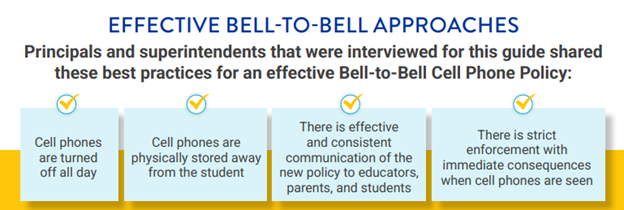
Four Proven Approaches
The guide outlines four proven strategies:
- No phones at school. Students leave devices at home.
- Cell phone lockers. Students store phones in dedicated lockers with combination locks near building entrances.
- Lockable pouches. Students place phones in locked pouches they carry all day.
- Lockers only. Students store phones in their regular lockers.
Enforcement Without Suspensions
The guide includes a three-level consequence framework. A consequence framework should not include fees, fines, suspensions, expulsions, or the deployment of a school resource officer or local law enforcement officer.
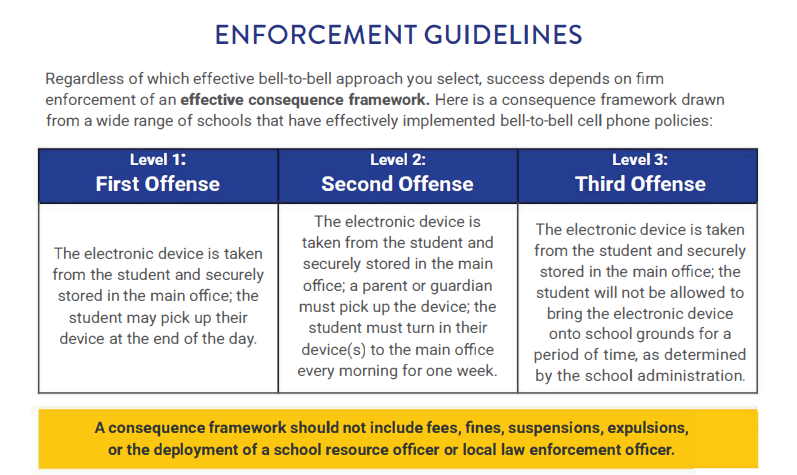
This approach comes directly from schools that have successfully implemented phone-free policies. It holds students accountable without pushing them out of the classroom.
Why This Matters
Recent research from Florida shows that phone bans can boost test scores by 2-3 percentiles and reduce unexcused absences. But that same study found suspensions more than doubled in the first year, with Black students bearing the brunt of disciplinary action. Schools like the one led by Alabama principal Charles Longshore show there is a better way. His school used other disciplinary approaches instead of suspension. The result: far fewer students failed their classes and students referred to summer school dropped from 80 to 20.
Longshore told Chalkbeat Colorado, that “in fact, discipline at the school improved significantly. There was less drama, Longshore said, and far fewer fights. The lunchroom got loud again with students talking to their classmates.”