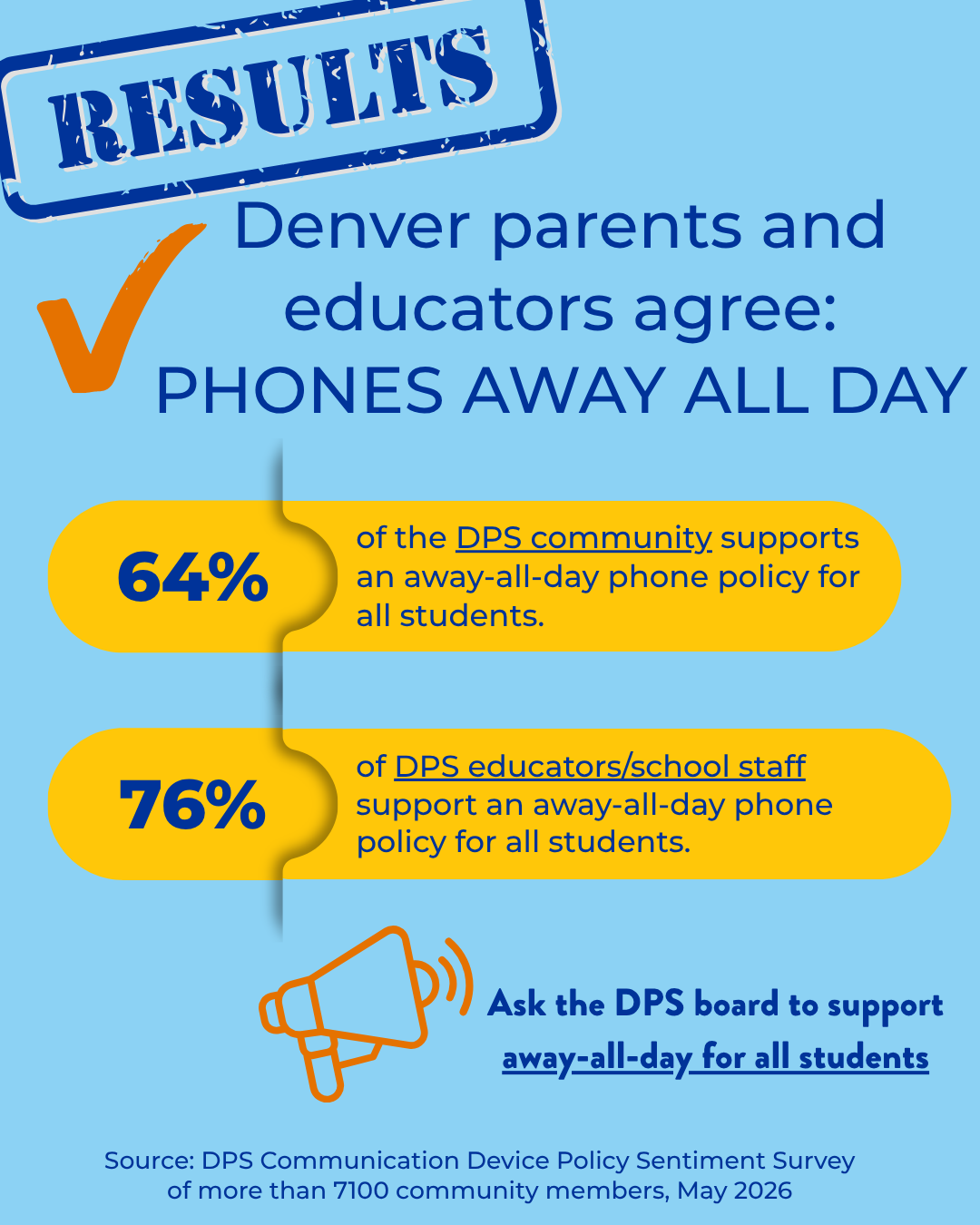
The Denver Public Schools Board of Education is preparing to vote on a new student device policy. DPS’s own survey found that 76% of educators and 64% of the broader community support a bell-to-bell phone policy.

They created the Communication Devices Advisory Committee (CDAC) who spent months developing a clear, research-aligned recommendation: a districtwide bell-to-bell policy that keeps phones away during instructional time, passing periods, lunch, and all school-supervised time.

Now we need the board to follow through.

School board members have said they are considering adjustments to the strong, research backed policy CDAC has put forward for high school students. Let’s ensure DPS becomes the leading example of the state by being bold with an away all day,  bell to bell policy for all students to thrive.

CDAC was clear: consistency is what makes this policy effective. The CDAC recommendations already include exceptions for students with medical needs, IEPs, and 504 plans. A strong policy and an equitable policy are not in conflict. Every student can be supported, and every student deserves a focused learning environment.

The board has a strong roadmap. Urge them to use it.

Send a message to the DPS Board today.

Over the past several months, Denver Public Schools put together the Communications Devices Advisory Committee (CDAC) to tackle a question many districts across the country are wrestling with: What role should cell phones play in schools? 

The committee, made up of parents, educators, mental health professionals, and community members, spent months reviewing research, hearing from stakeholders, and discussing what would best support student learning and well-being. Ultimately, the committee recommended a districtwide bell-to-bell, away-all-day phone-free policy. 

As the DPS Board of Education considers the recommendation, some board members have expressed concerns about student pushback and whether such a policy is realistic for high schools. 

One CDAC member, DPS parent Sarah, recently shared a message with board members urging them to stay the course. 

As both a parent and a participant in the committee process, Sarah believes the district has a responsibility to act on what it has learned. 

“As I listened to the May 20 board meeting, I heard some board members share concerns that students really don’t want this policy. As the parent of a high school student, I hear this regularly myself,” she wrote. 

But Sarah argues that student resistance should not be confused with what is best for students. 

“We adults have collectively enabled a reliance on and an addiction to these devices by our teens. We have built systems that make students feel like the phone is ever more important to be able to navigate their daily lives. But now that we know better, we as the adults MUST do better.” 

Her message speaks to a growing concern among parents, educators, and mental health professionals: many young people have never experienced a school day without the constant presence of a smartphone. 

Sarah shared examples she has heard from students who worry about how they would find friends during lunch or navigate their day without texting. 

“Kids are telling you they cannot be without their phones because many have never been forced to learn how,” she wrote. “I have heard comments like, ‘How would I find my friends at lunchtime?’ Are we really okay with preparing students who lack the creativity and skills to meet up with friends without a phone?” 

Importantly, Sarah pushes back on the idea that the committee failed to listen to students. 

In fact, she says student voices played a critical role in shaping the recommendation. 

“The kids admitted the policies some high schools currently have to put phones away just during instructional time are not effective. The recommendations came from what we heard from students.” 

That finding echoes what we’ve heard from families and educators across Colorado. Policies that allow phone use during passing periods, lunch, and other parts of the school day often create inconsistency and make enforcement more difficult. Bell-to-bell policies provide clear expectations for everyone. 

Another concern raised during board discussions has been implementation. Can a district as large and diverse as Denver successfully implement a bell-to-bell policy at the high school level? 

Sarah believes the answer is yes. 

“At this point, 22 states have passed a K-12 bell-to-bell policy and more are moving in this direction every day.” 

She points to examples across the country—including some of the nation’s largest school districts—that have successfully adopted similar policies and seen positive outcomes. 

“DPS high schools are not being asked in any way to do something revolutionary here. And it works.” 

At Stand for Children Colorado, we’ve heard similar stories from districts across the state and nation. Educators report improvements in student engagement, classroom focus, and face-to-face interaction when phones are removed from the school day. 

For Sarah, however, the conversation is ultimately bigger than implementation logistics. 

It’s about preparing students for life beyond high school. 

“As more and more districts and states move to bell-to-bell, high school kids who do not learn how to engage and interact device-free and to survive without their devices for a sustained period of time are going to be at a distinct disadvantage when entering post-secondary education and the workforce.” 

Her message concludes with a challenge to district leaders: 

“Please do not shy away from something that is unequivocally better for kids’ mental well-being and learning because it seems logistically complicated or because kids are resisting due to the ways we adults have failed them.” 

Denver Public Schools created the CDAC because it recognized the importance of getting this decision right. The committee did the work. It listened to students, families, educators, and experts. It reviewed research and wrestled with difficult questions. 

Now, as the Board of Education considers the recommendation, it has an opportunity to honor that process and put student well-being first. 

As Sarah reminds us: 

“Now that we know better, we must do better.” 

Last night, the DPS Communication Devices Advisory Committee (CDAC) held its final meeting and official finalized its recommendations to the Board of Education.

Here is what happened:

CDAC members worked through final language and aligned on a set of recommendations that reflect months of input from students, families, and educators. Across the conversation, there was clear agreement on the need for a strong, consistent approach to student device use across the district.

The final recommendations center on a bell-to-bell expectation, where phones and personal devices are off and away from the first bell to the last bell, including passing periods, lunch, and all school-day activities. Members also emphasized that this policy should:

  • Prioritize student learning, mental health, and in-person connection
  • Be implemented consistently across all schools with clear expectations and accountability
  • Focus on support and wellbeing, not punishment
  • Include strong communication, training, and ongoing evaluation

There was also alignment on clearly defining what counts as a personal device and ensuring expectations apply across the entire school campus.

Overall, the direction from CDAC was clear: consistency and clarity are essential for this policy to work.

Now, the decision moves to the DPS Board of Education.

Take action: Urge the Board to adopt a strong, districtwide K–12 bell-to-bell policy that reflects the CDAC’s recommendations. 

This is a key moment to make sure these recommendations turn into real, districtwide policy for every student.

The Communication Devices Advisory Committee (CDAC) met for its fifth meeting on March 10 to continue shaping recommendations for Denver Public Schools’ upcoming communication device policy. The committee heard presentations from district leaders in academics, technology, and safety to better understand how devices impact learning environments and student wellbeing.

Public Comment Highlights

District leaders emphasized that students already have access to all required learning materials through district-provided devices, meaning personal phones are not necessary for instruction. DPS maintains a 1:1 Chromebook program with more than 80,000 devices to ensure equitable access to digital tools, assessments, and curriculum across schools.

The meeting also explored how the district approaches digital citizenship and emerging technology like artificial intelligence, with the goal of helping students navigate digital spaces responsibly while ensuring technology supports, rather than replaces, human connection in the classroom.

Safety was another key focus. District safety leaders shared how personal phones can create challenges during emergencies, including spreading rumors, overwhelming emergency services, or distracting students from important safety instructions. They also discussed how district-managed devices allow for safety monitoring and intervention tools that are not available on personal devices. Committee members also discussed implementation challenges, equity considerations, and the importance of balancing technology access with opportunities for human connection and focused learning environments. The conversation highlighted that while technology plays an important role in education, student-to-student and student-to-teacher interaction remains essential for learning and wellbeing.

Next Steps

The committee will continue refining recommendations in upcoming meetings and community sessions. Final recommendations from the council will be presented to the Board of Education on April 15th, with an anticipated vote on first reading on April 23rd, and with the goal of informing a districtwide communication device policy for DPS by the end of May.  There will not be public comment during the next two CDAC meetings, but members of the DPS Board of Education are hosting community engagement events where you can share feedback: 

  • Monday, March 23 from 5:30-8pm in SE Denver with Director Kimberlee Sia at Slavens K-8 Schools (3000 S Clayton St.)
  • Monday, April 6 from 5:30-8pm in Central Denver with Director Dr. DJ Torres at George Washington High School (655 S Monaco Pkwy)
  • Monday, April 13 from 5:30-8pm in NW Denver with Director Marlene De La Rosa at North High School (2960 N Speer Blvd)
  • Wednesday, April 29 from 5:30-8pm with Board President Xochitl Gaytan at Florence Crittenton High School (55 S Zuni St.)

We’ll continue to monitor CDAC’s progress and share updates as the conversation moves forward. As always, thank you for staying engaged in this important work for DPS students and families.

We are continuing to summarize the on-going work of the DPS Communication Devices Advisory Committee (CDAC). Below is a summary of key discussions and themes from the February 24, 2026 meeting.

Public Comment Highlights

A parent spoke in support of a bell-to-bell phone-free approach, emphasizing that during emergencies families should communicate through the school’s front office rather than student cell phones. Research and school safety guidance were referenced noting that phones can increase confusion, noise, and misinformation during emergencies. The speaker also shared a desire for students to remain attentive to educators throughout the school day.

Community Engagement

The district reported receiving 385 responses to the community feedback form, demonstrating strong interest and engagement from families and community members.

Student Perspectives: Benefits & Concerns

Students acknowledged that limiting phone use could lead to increased attention and focus in classrooms, stronger academic honesty, improved peer connection and community building, and greater engagement in learning that could ultimately support improved grades. At the same time, students expressed concerns about reduced communication with parents during emergencies, potential impacts on students who rely on technology for creative or alternative learning styles, worries about being less prepared for technology use in future careers, and fears that restrictive policies could alienate students or negatively impact their sense of belonging.

Fishbowl Exercise Highlights

During the fishbowl exercise, committee members engaged directly with students to better understand their experiences and perspectives. Students emphasized a strong desire for autonomy and described a deep sense of identity connected to their phones as tools for communication, organization, and daily planning. Safety and communication remained central themes, and many students shared feelings of anxiety about losing access to their devices during the school day. Students also expressed that consistent expectations across all schools would feel fairer and easier to follow. Many welcomed the idea of digital citizenship and technology literacy education, acknowledging that while phones may be limited at school, students still navigate digital spaces outside of school. Conversations also surfaced differences between normal classroom distraction and digital distraction, with recognition that instruction-only policies often result in inconsistent enforcement from classroom to classroom.

Policy Language Discussion

Small groups began discussing how policy language should be framed, focusing on creating clear expectations, ensuring consistency across schools, and balancing student wellbeing, learning environments, and communication needs.

Next Steps

The community feedback form will remain open through February 27, and committee members will review additional resources ahead of the next meeting on March 10, 2026. The committee will continue working toward final recommendations to the Board of Education, which are expected to be presented in April.

There is still time to sign up to give public comment at the upcoming CDAC meeting. Register here.

We’ll continue to monitor CDAC’s progress and share updates as the conversation moves forward. As always, thank you for staying engaged in this important work for DPS students and families.

This week, the Denver Public Schools Communication Devices Advisory Committee (CDAC) held its second meeting, continuing the district’s discussion on student communication device policies, including bell-to-bell phone-free approaches, and how those policies intersect with accessibility, equity, and student safety. 

Below is a summary of key updates, testimony, and themes from the meeting:

Public Comment Highlights

Public commenters expressed strong support for bell-to-bell phone-free policies, citing research and lived experience that link unrestricted technology use to increased anxiety, reduced focus, poor sleep, and challenges to student well-being. Speakers emphasized that partial or instructional-time-only policies place an unfair enforcement burden on teachers and create inconsistencies across classrooms. Parents highlighted the opportunity for DPS to lead with an equitable, student-centered approach that supports learning, mental health, and school culture.

Multilingual Learners (MLLs) and Linguistic Access

The committee reviewed legal requirements and best practices for ensuring linguistic access for MLL students under ESSA (Every Student Succeeds Act), state ELPA (English Language Proficiency Act) requirements, and the DPS Consent Decree.

Key Takeaways:

  • Linguistic access goes beyond English translation and includes allowing students to use their native language to understand complex ideas, demonstrate knowledge, and fully participate in learning.
  • Examples of approved linguistic tools include pocket translators, handheld scanners, camera-based translation tools, speech-to-speech translation, and district-approved software such as Google Translate and Google Read&Write on district-issued devices.
  • DPS policy language should clearly state that technology restrictions, including cell phone policies, must not prevent access to necessary linguistic tools.

Students with IEPs and Section 504 Plans

The committee discussed the role of assistive technology under IDEA (Individuals with Disabilities Education Act) and the importance of explicitly protecting communication devices used by students with disabilities.

Key points included:

  • Assistive technology is essential, not optional, and includes any equipment or system that increases, maintains, or improves a student’s functional capabilities.
  • Communication tools such as tablets with communication apps, speech-generating devices, and symbol-based systems must be allowed and protected throughout the school day.
  • Policy language must clearly state that device restrictions cannot limit communication or access to instruction for students with disabilities.

There is also an opportunity for public comment at upcoming meetings, with time set aside at the beginning for community voices.

Nursing Services and Medical Needs

Members emphasized the need for policies to protect access to medically necessary devices.

Examples discussed:

  • Cell phones or devices linked to continuous glucose monitors (CGMs), insulin pumps, cardiac or neurological monitoring systems.
  • Apps such as Dexcom Follow and Dexcom Sugarmate often require a personal smartphone to be within 20 feet of the student, creating challenges under a bell-to-bell phone-free policy.
  • For students with IEPs or 504 plans, these tools are medical supports critical to student health and safety.

Policy Questions and Tensions Raised

  • Do students access these tools through DPS-issued equipment or personal devices?
  • How will accessibility be ensured when DPS-issued devices are damaged or delayed in replacement?
  • Are cell phones the only viable option for some medical monitoring needs, or could iPads be used (and at what fiscal cost)?
  • How will staff — including substitute teachers — be informed about student exemptions?
  • With over 30,000 MLL students, 14,000 students with IEPs, and 195 languages spoken in DPS homes, how can policy language be inclusive, practical, and enforceable?

Some questions, including how many students currently rely on DPS-issued equipment, were tabled for future discussion.

Small Group Work (Gallery Walk)

Committee members broke into groups to discuss:

  • Intended benefits of communication device use for specific student populations
  • Potential unintended consequences of restrictive policies
  • Intersections between access tools and communication devices
  • Policy language that could address these challenges

Closing and Next Steps

  • A survey will be released next week to gather broader feedback.
  • Members noted growing agreement around bell-to-bell phone-free approaches, including examples from KCAA where students showed improved attention and engagement.
  • A recurring theme was the need for transparent, inclusive policy language and strong cross-department coordination to ensure policies are realistic and workable in schools.

Upcoming CDAC Meeting & Public Comment Opportunity

  • The next CDAC meeting will take place on February 10.
  • Community members will have an opportunity to provide public comment.
  • Sign up for public comment can be submitted in advance using this form.

We’ll continue to monitor CDAC’s progress and share updates as the conversation moves forward. As always, thank you for staying engaged in this important work for DPS students and families.

Colorado families now have a powerful new tool to advocate for effective phone-free school policies.

Our Phone-Free Schools Action Center brings together everything you need to support bell-to-bell policies in your community. Whether you’re just learning about this issue or ready to contact your school board, you’ll find the resources and guidance to make your voice heard.

Why This Matters Now

Colorado legislation requires every school district to adopt cell phone policies by July 2026. This creates a critical window to ensure districts choose policies that truly work.

The research is clear. Students lose an average of 43 minutes of learning daily to phone distractions. When phones are away all day, educators report that drama is down, bullying is down, absenteeism is down, and students actually connect with each other during lunch instead of scrolling through social media.

But not all phone policies are created equal. Instructional-time-only policies lead to inconsistent enforcement and continued harm to student wellbeing. Effective bell-to-bell policies require phones to be turned off and stored away for the entire school day.

What You’ll Find in the Action Center

  • A video featuring research from over 20,000 educators on why phone-free schools work
  • Downloadable resources including parent one-pagers and educator implementation guides
  • Clear guidance on contacting your school board members

Denver Public Schools’ Communication Devices Advisory Committee (CDAC) met for the first time on Tuesday January 27, to continue shaping recommendations for a districtwide cell phone policy. We wanted to share a quick update on what happened, what we’re hearing, and how it connects directly to our work on phone-free schools.

As shown below, CDAC will meet twice a month through April, and we will be present to keep the community informed on their progress:

  • January 27, 2026 
  • February 3, 2026 
  • February 10, 2026 
  • February 24, 2026 
  • March 10, 2026 
  • March 24, 2026 
  • April 7, 2026

Who was at the table
The committee brings together a broad range of voices: parents, educators, principals, mental health professionals, community advocates, and students. All are grappling with the same core question: How do we create school environments where students can learn, connect, and thrive without constant digital distraction?

What the conversation focused on
Committee members reviewed examples from other Colorado districts that have already implemented administrative cell phone policies, including BVSD,  Adams 12Colorado Springs, D11, and Mesa. A few key themes came up repeatedly:

  • Clarity matters. Policies need simple, student-friendly language that clearly names which devices are covered and when they’re restricted.
  • Bell-to-bell consistency. Many members emphasized that “all or nothing” approaches are easier to understand and enforce, especially when phones are kept away for the full school day.
  • The “why” is essential. Framing phone-free policies as a way to protect student mental health, learning time, and social connection — not as punishment — resonated strongly.
  • Age-appropriate supports. There was recognition that older students may need additional support, communication, and buy-in.
  • Emergency access. Families’ concerns about emergencies were discussed, with an emphasis on clear, reliable school-based communication systems.
  • Evidence-based policy. Committee members lifted up research showing improved focus, stronger social skills, and even higher student happiness and academic outcomes when phones are limited during the school day.

What’s next

  • April 7: CDAC finalizes its recommendations
  • April 15: Recommendations are presented to the DPS Board of Education
  • April–June: Policy drafting and refinement

There is also an opportunity for public comment at upcoming meetings, with time set aside at the beginning for community voices.

Why this matters for our work

Everything discussed reinforces what we’ve been saying all along: bell-to-bell phone-free policies are an equity-centered, evidence-based investment in students. When phones are away all day, students get more learning time, stronger relationships, and healthier school cultures, and educators can focus on teaching instead of policing screens.

We’ll continue showing up, sharing research, and lifting up parent and educator voices to ensure DPS prioritizes students with the strongest policy.

Thank you for staying engaged and standing with us as we advocate for school environments where students can truly be present.

More information and resources to learn more:

As we’ve been talking to people across Colorado about our advocacy for phone-free schools, we hear one concern consistently, “what if the unthinkable happens at my child’s school and I need to reach them?” We want to share some information we found while we were learning about phone-free schools. In this post we compiled information from school safety experts, first responders, and law enforcement professionals who specialize in school emergency preparedness.

As parents, we understand the fear. When we hear about another school emergency on the news, our first thought is: “I need to be able to reach my child.” It’s natural. And school safety experts understand precisely why we feel this way.

But they also need us to hear something critical: The phones that make us feel safer may create more danger for our children during emergencies.

Dr. Kenneth Trump is one of the nation’s most respected school safety experts. He’s advised schools after almost every major school crisis over the past two decades. He’s trained first responders, worked with law enforcement, and he’s studied what actually saves lives during school emergencies.

He says, “While the cellphone meets the emotional security needs of a parent, it can make their child actually less safe in the moment of an incident, because they’re paying attention to the phone, they’re responding. They’re sending messages, possibly even live streaming it. They’re not listening to the adults who should be trained to give them directions.”

A superintendent shared a story with researchers from the Screenagers documentary project. During an actual lockdown at his school, students immediately started texting their parents. Within minutes, he faced a new crisis, “Our first responders were arriving at the school, and we had parents lined up in our driveway, and the first responders literally couldn’t get their vehicles to our school. The driveway was backed up all the way to the street.”

School security experts, first responders, and law enforcement agencies like the National Association of School Resource Officers (NASRO) consistently share these reasons that cell phones put our students at risk during an emergency:

1. Traffic prevents emergency response When students send frantic texts, parents rush to the school. Roads and access points get blocked, and emergency vehicles can’t get in.

2. Noise reveals hiding locations During silent lockdowns, survival depends on absolute quiet. Phones vibrate, ping, and put off light that can be seen under doors. Security experts warn that even one noise could reveal a hiding spot to someone with harmful intentions.

3. Important information gets missed In emergencies, students need to give 100% of their attention to trained adults giving life-saving instructions. When they’re texting, calling, or checking to see if friends are okay, they miss critical information.

4. Misinformation can be spread Students posting on social media during incidents can spread misinformation that causes panic or potentially give attackers information.

5. System overload impacts emergency response When hundreds of people call 911 simultaneously, they overwhelm emergency dispatch systems and first responders have a harder time coordinating their response.

If cell phones can put students at risk in emergency situations, what do security experts say actually helps? Students need to be fully present and attentive when it matters most. Students need to follow safety protocols and listen to instructions without digital distraction.  Schools have communication systems, protocols, and trained staff who know how to reach families safely when it’s appropriate to do so.

None of this makes the fear go away. We live in a time when school safety concerns are ever-present, and that’s a terrible burden for all of us. But phone-free schools aren’t just better for learning, mental health, and social development, according to the people who train for, respond to, and study school emergencies, they create safer conditions when the unthinkable happens, too.

Schools across the country are wrestling with cell phone policies. Principals report that phones undermine student learning, fuel bullying, and escalate conflicts during school hours. But implementation matters, and there is a lot we can learn from those who have successfully implemented phone-free schools already.

We created this guide to help educators get it right.

Built on Research from 20,000+ Educators

This implementation guide draws on extensive research conducted with Phones in Focus, who surveyed more than 20,000 educators nationwide. We also interviewed principals and superintendents who have successfully implemented phone-free policies in their schools.

Their insights are clear: bell-to-bell policies work. Instructional-time-only policies do not solve the problem.

Four Proven Approaches

The guide outlines four proven strategies:

  • No phones at school. Students leave devices at home.
  • Cell phone lockers. Students store phones in dedicated lockers with combination locks near building entrances.
  • Lockable pouches. Students place phones in locked pouches they carry all day.
  • Lockers only. Students store phones in their regular lockers.

Enforcement Without Suspensions

The guide includes a three-level consequence framework. A consequence framework should not include fees, fines, suspensions, expulsions, or the deployment of a school resource officer or local law enforcement officer.

This approach comes directly from schools that have successfully implemented phone-free policies. It holds students accountable without pushing them out of the classroom.

Why This Matters

Recent research from Florida shows that phone bans can boost test scores by 2-3 percentiles and reduce unexcused absences. But that same study found suspensions more than doubled in the first year, with Black students bearing the brunt of disciplinary action. Schools like the one led by Alabama principal Charles Longshore show there is a better way. His school used other disciplinary approaches instead of suspension. The result: far fewer students failed their classes and students referred to summer school dropped from 80 to 20.

Longshore told Chalkbeat Colorado, that “in fact, discipline at the school improved significantly. There was less drama, Longshore said, and far fewer fights. The lunchroom got loud again with students talking to their classmates.”

Get the Guide