

Advocates Senate Bill 78
Advocates rally for Senate Bill 78

Today, passionate advocates gathered at the Indiana Statehouse to voice their support for Senate Bill 78, known as the Away for the Day policy. Supporters believe the Indiana phone‑free schools bill SB 78 represents an important step forward. This initiative calls for a full-day policy that keeps cell phones out of classrooms, ensuring consistent enforcement across schools. In fact, the Indiana phone‑free schools bill SB 78 has garnered bipartisan attention and coverage statewide.

Supporters emphasized how the Indiana phone‑free schools bill SB 78 policy:

  • Maximizes learning time by reducing distractions
  • Improves student focus and test scores
  • Creates safer, healthier school environments
  • Encourages genuine engagement between students, peers, and teachers

The message was clear: when phones are put away, students can truly be present in their learning.

Watch advocate testimony here:


About us: Stand for Children is a unique catalyst for educational success and social progress. The positive impact of the Indiana phone‑free schools bill SB 78 will likely be felt for years to come.


In our second video update, we share important progress on two bills. This update is part of the Statehouse Standby newsletter Jan. 29:

  • Senate Bill 78 – Great news: SB78 passed in the Senate and is now headed to the House. This bill supports “away for the day” cell phone policies that research shows improve academic achievement, mental health, and school safety.
  • House Bill 1423 – HB1423 continues to move through the legislative process. This bill would establish an independent building and transportation authority for IPS, helping ensure reliable transportation for every student. Parents and advocates previously testified in support of this bill, noting their desires for an accountability system and transportation for all.


Watch the video below to get the full update.

Thank you for standing with us and for your continued advocacy on behalf of Indiana’s students.

5 Reasons for Schools To Go Phone Free

How much time do you spend on your phone each day? If you’re anything like the average U.S. adult, according to a recent YouGov poll you’re averaging more than 5 hours a day of screen time— and that doesn’t even take into account your TV, smart fridge and robot vacuum cleaner. We all know that our overuse of screen-based devices is a problem, with a large percentage of adults actively attempting to limit their screentime. There are strong arguments in support of 5 Reasons for Schools To Go Phone Free as well.

Now imagine if you’d had an iPad since you were in diapers. That’s the reality for many of the Gen Alpha students who are using their phones for an average of 1 hour of school time each day, playing games, scrolling on social media, and watching videos.

Young people are becoming more aware of the problem with cell phone dependency, but it’s not as easy as telling them to just “put down their phones” as adults often say. These distraction machines are built to keep their attention, even when they should be focused on learning or connecting with peers.

With school-age kids spending more than half of their waking hours in school, it is important that schools create an environment for children to develop the skills they need to succeed, including how to learn, think, and connect without screens.  

Here are 5 reasons our schools should go phone free:
1. FOCUS

Up to 97% of students report using their phones during the day — spending an average of 1 hour of class time on social media, YouTube, or gaming.

And the distraction isn’t limited to just the student on their phone. Phone use during class creates a ripple effect, distracting all the students around them, and even students in other classrooms who may be receiving text messages or DMs from their friends.

A pair of studies out of the University of California show that it takes between 8 and 23 minutes to refocus after being distracted. Meaning, one distraction from a phone might cause a student to lose focus for nearly half a class period.

UPenn Professor of Psychology, Angela Duckworth laid the issue out clearly— the further students are from their phones, the higher their GPA.

2. SAFETY

With the heartbreaking frequency of school-wide emergencies in the U.S., it is completely understandable that parents and families may be nervous about the idea of students not having access to their phones throughout the school day.

But, researchers and safety experts, including the Association of School Resource Officers, have consistently concluded that students’ access to cell phones actually make them less safe in an emergency situation.

During a school-wide emergency, it is critical that students are able to focus on receiving potentially life-saving instructions from staff, resource officers, and first responders. When they’re on their phones, they can be distracted, or cause others to miss instructions. And when hundreds or even thousands of students attempt to make calls on their phones at once, it can clog the networks and hinder emergency responders from communicating during an emergency.

That’s why any proposed cell phone policy must clearly outline contingencies for school-wide emergencies such as text or email emergency communication systems for families to stay informed on what is happening in their school, without leading to dangerous confusion and distraction. Families must have a voice in deciding these systems to ensure they work for the entire school community.

3. MENTAL HEALTH

There is an abundance of evidence that links extensive cell phone usage to negative mental health effects on young people. Young people who spend a lot of time on their phones report increased levels of anxiety, including social media driven anxiety.

These anxieties include low self-esteem caused by the endless comparison from social media which acts as a highlight reel, making it appear that everyone else is more attractive, more social, and more successful than you.

Anxiety is also driven by current events, breaking news, and other points of fear-inducing content that, while important for young people to stay informed, in the massive quantities and graphic details shown on social can have detrimental mental health effects on children.

Students at schools who have already gone phone-free report feeling less anxiety, and increased self-esteem.

It is up to parents to determine the right balance of social media use for their children, but our schools do have a responsibility to ensure classrooms are safe, affirming spaces that allow students to develop into healthy, well-rounded community members.

4. CONNECTION

So many young people today struggle to connect with their peers, and deal with serious social anxiety, much of which can be linked to social media and screens in general.

Phone-free schools allow students to actually talk to each other between classes and at lunch time, rather than immediately putting their AirPods in and scrolling on their phones.

Schools with phone-free policies report students talking with each other, creating new clubs to learn skills like crocheting or woodworking, and building connections across class years!

5. TEACHERS

If the above reasons weren’t enough, then think of the teachers!

Even the most interactive lesson plan is going to have an impossible time competing with TikTok for students’ attention. It’s no wonder that 83% of educators support full-day cell phone bans.

While the national teacher shortage and teachers leaving the field have stabilized since the extreme highs at the start of the pandemic, there are still over 400,000 teacher positions in the U.S. that are unfilled, underfilled, or filled by people who do not meet the qualifications (such as those without a teaching license). 53% of teachers report feeling burnout, with teachers being more likely than other workers to report poor wellbeing on every indicator.

If districts want to hire and retain qualified educators, they need to do their part to reduce the burden on already over-stretched teachers and staff. That includes removing distractions from their classrooms that don’t allow then to do their job effectively.

Our schools must establish clear, consistent, effective cell phone policies that address the harms of in-school cell phone use. Across the country, principals and school leaders have proven that phone-free policies are possible — and powerful.  


If you agree, and support an away for the day policy in Indiana schools,  take the pledge today. 

Together, we can give our children the focus, safety, and academic success they deserve. Every voice matters—yours can make a real difference. Speak up at the Statehouse, share your story online, or record a quick video using this tool. Let’s show lawmakers that Indiana students deserve classrooms where they can truly learn and thrive.


About us: Stand for Children is a unique catalyst for educational success and social progress.

Check out the Statehouse STANDby—our trusted bi-weekly newsletter keeping Stand for Children Indiana advocates informed about what’s happening at the Statehouse. This year, we’re trying something new: instead of only written updates, we’re adding a video format so you can hear directly from me and follow along more easily as things move quickly during session.

In this first video update, I cover two major issues:

  • Senate Bill 78 – supporting “away for the day” cell phone policies that research shows improve academic achievement, mental health, and school safety
  • House Bill 1423 – establishing an independent building and transportation authority for IPS, a step toward closing opportunity gaps and ensuring reliable transportation for every student. 

You’ll also hear powerful testimony from parents and advocates who are shaping these conversations in real time.  

Watch the video below to get the full update.

Thank you for standing with us and for your continued advocacy on behalf of Indiana’s students.

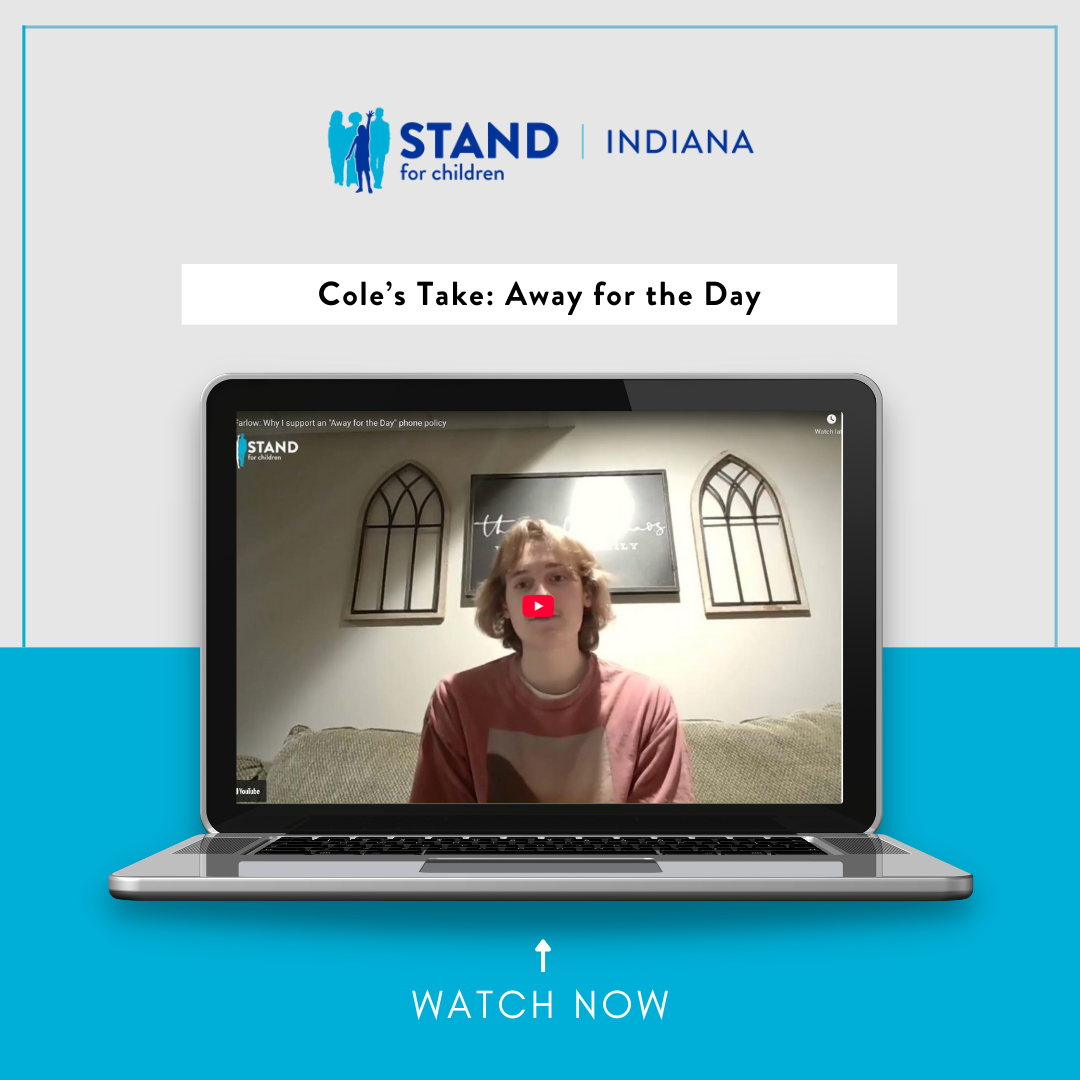
Meet Cole, a college student from Indiana who’s speaking up for the #AwayForTheDay phone policy. He shares why stepping away from screens can make a big difference for students’ focus, friendships, and learning.

Watch his story here:


If you agree, take the pledge today. Together, we can give our children the focus, safety, and academic success they deserve. Every voice matters—yours can make a real difference. Speak up at the Statehouse, share your story online, or record a quick video using this tool. Let’s show lawmakers that Indiana students deserve classrooms where they can truly learn and thrive.


For anyone following the away for the day legislation, #SB78, check out this update from today. #INLegis #awayfortheday


If you support Senate Bill 78 and an away for the day policy, take the pledge today. Together, we can give our children the focus, safety, and academic success they deserve. Every voice matters—yours can make a real difference. Speak up at the Statehouse, share your story online, or record a quick video using this tool. Let’s show lawmakers that Indiana students deserve classrooms where they can truly learn and thrive.


About us: Stand for Children is a unique catalyst for educational success and social progress.

As a mom, I’ve seen how we’ve traded real, in-person connection for screens and algorithms designed to keep us hooked—at the cost of meaningful relationships. In his best-selling book The Anxious Generation, Jonathan Haidt writes:

“The phone-based life produces spiritual degradation, not just in adolescents, but in all of us.”

I couldn’t agree more. I’m old enough to remember what coffee shops and restaurants were like before smartphones. You looked up instead of down. You talked to the person next to you, not just the contact in a text bubble. Today, an entire generation of young people barely knows what that feels like. They’re living a phone-based life, and it’s hurting them.

School should be a place for learning and connection—not constant distraction.
Even with current rules requiring phones to be put away during instruction, the reality is that a vibrating phone in a pocket or bag still pulls a student’s attention away from the teacher. Removing smartphones for the entire school day would help kids be present, engaged, and ready to learn. It would also give them the chance to build real friendships and improve their mental health.

I’ll admit—my perspective has evolved. I used to believe my kids needed their phones at school, especially my daughter. I wanted to reach her anytime to make sure she was safe. But as I’ve learned more and seen the impact on my children—and on me—I’ve changed my mind. The addictive nature of smartphones and the toll on mental health are real. We need to act.

Today, I even plan to encourage lawmakers to review the medical exemptions in this bill to ensure there aren’t better alternatives that allow kids to put their phones away while still getting the support they need. After all, we all survived and thrived without cell phones for generations. We can do it again—and honestly, we desperately need to.

I’m grateful to the authors of SB78 for taking this issue seriously. Today, I’m urging the committee to pass this bill and make our schools truly smartphone-free. Our kids deserve the chance to focus, learn, and connect—without the constant pull of a screen.


If you agree, take the pledge today. Together, we can give our children the focus, safety, and academic success they deserve. Every voice matters—yours can make a real difference. Speak up at the Statehouse, share your story online, or record a quick video using this tool. Let’s show lawmakers that Indiana students deserve classrooms where they can truly learn and thrive.


FOR IMMEDIATE RELEASE 
December 8, 2025 

Media Contact: 
Kayla Mattas 

Marketing and Communications Director | She, Her, Hers |  Stand for Children Indiana | M 765-721-2833 | [email protected]  

Surveys: Hoosiers want cell phones to be away for the day in schools 

Indianapolis – Survey results released today by education advocacy non-profit Stand for Children Indiana show overwhelming support for a stronger smartphone policy in Indiana schools. This data comes as lawmakers consider changing the law that allows students to use cell phones during non-classroom instructional time. The Senate education committee will take up one such bill, SB 78, on Tuesday.  

In two separate surveys — one focused on Stand Indiana’s internal membership base and one scientific poll of likely voters within Indianapolis — support for eliminating cell phone use by students throughout the school day surpassed 60%.  

The internal survey of Stand Indiana’s list of advocates and supporters saw 138 respondents with 84 (more than 60%) saying they support a “phone away for the day policy, where phones are off and away from students during the entire school day in order to reduce distractions and improve focus” 
 

  • Nearly 23% in the same survey said they prefer the current policy in Indiana, which allows for students to use phones outside of class time. 
  • 17% indicated they want more information before choosing a preferred policy. 

In addition to its internal survey, Stand Indiana commissioned a scientific poll in October of Indianapolis residents, where 69% of respondents supported a so called “bell-to-bell” policy for phones — where the smartphone is secured away from the student from the start of school through the final bell. Support for restricting smartphone in schools is popular with voters of all political backgrounds – with the polls showing self-identified Democrats, Republicans and Independents all support a bell-to-bell policy by margins 63% and higher.    
 

The scientific poll, done by LJR Custom Strategies, was completed by more than 600 likely voters with a margin of error of +/- 3.9%.  

There is a growing body of research showing that the elimination of cell phone use during the school day has academic and mental health benefits for young people. School safety experts have also cited the downside of cellphone access in school emergencies where devices create distractions and tie up cell tower bandwidth that is best used to support the response of public safety personnel.   

Stand Indiana plans to have advocates testify in favor of SB 78 this week.  

### 

About Stand for Children IndiaAbout Usna: Stand for Children is a unique catalyst for educational success and social progress, to create a brighter future for us all. 

Let’s be honest—cell phones are everywhere. And while they help us stay connected, they can also be a major distraction, especially in schools.

Right now, Indiana law says phones should be put away during class time. But in many schools, students can still use them during lunch and passing periods. That means a lot of screen time—and not always the kind that helps kids learn.

That’s why there’s growing momentum around a stronger policy: “Away for the Day.”

It’s simple: phones off and put away from the first bell to the last, except in emergencies.

So far, most Indiana residents taking our survey say they support this idea. But we know every story is different—and we want to hear yours.

We’re collecting short videos from:

  1. Parents who’ve seen how phones affect their kids
  2. Students who’ve experienced the ups and downs of phone use at school
  3. Teachers who’ve had to manage distractions in the classroom
  4. Anyone with a perspective on how phones impact learning, safety, or school culture

Whether you’re all in on “Away for the Day,” prefer the current policy, or are still figuring it out—your voice matters.

Share your story in a short video here: https://vocalvideo.com/c/stand-indiana-phones

It can be quick and casual or more polished—just be real. Your experience could help shape how Indiana schools approach phone use and make classrooms better for everyone.

Let’s make sure every voice is heard.