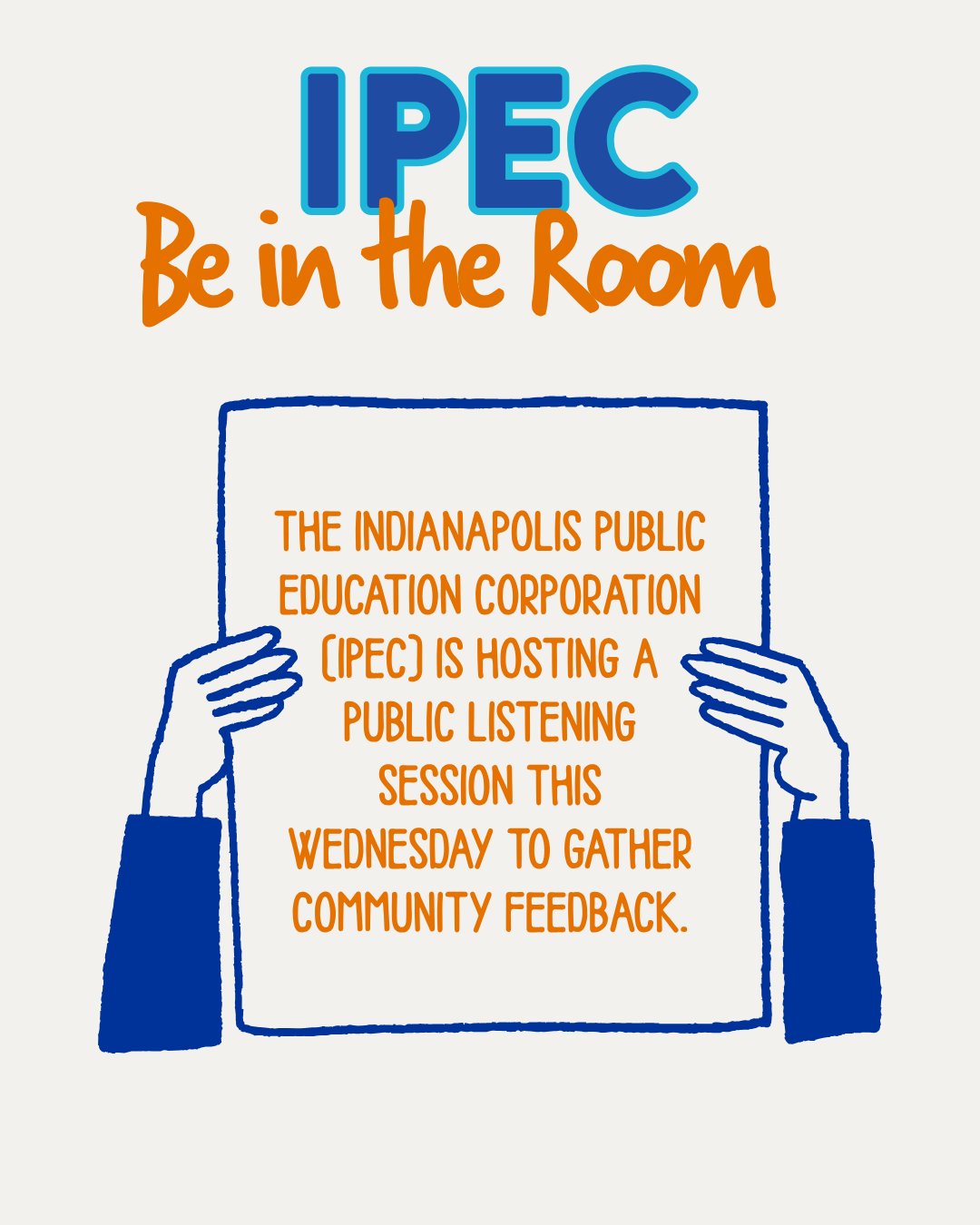
Photo that states IPEC be in the room followed by hands holding a sign that reads: The Indianapolis Public Education Corporation (IPEC) is hosting a public listening session this Wednesday to gather community feedback.

Big decisions about the future of public education in Indianapolis could be on the horizon—and your input matters right now.

The Indianapolis Public Education Corporation (IPEC) is hosting a public listening session this Wednesday to gather community feedback about a potential referendum levy that could impact both Indianapolis Public Schools and public charter schools within district boundaries.

This is your chance to show up, be heard, and help shape what comes next.

When: June 10, 2026 | 12–2 PM
Where: Northwest Middle School/Monarca Academy
5525 W 34th St, Indianapolis, IN 46224

Whether you’re a parent, educator, advocate, or community member, your voice belongs in this conversation. Decisions like these shape classrooms, resources, and opportunities for students across our city.

Don’t just hear about it later—be in the room.


PLEDGE TO STAY ENGAGED AS IPEC REACHES KEY MILESTONES: Pledge to show up, speak up, and ensure IPEC reflects our community’s values.

IPEC Frequently Asked Questions For Families

Because parents, caregivers, and advocates spoke up for years—at IPS board meetings, during the ILEA task force and at the Statehouse—House Bill 1423 passed into law, creating the Indianapolis Public Education Corporation (IPEC). This FAQ is designed to help families understand what IPEC is, why it was created, and what it means for Indianapolis public schools. 


IPEC is a new local education governmental body created in March 2026 to bring together some important core functions of Indianapolis Public Schools and public charters schools – expanding collaboration between the two sectors. Over the next two years, IPEC will begin to oversee transportation, facilities and a shared school accountability system across all public schools within IPS boundaries – traditional schools and public charter schools. 


IPEC was created through state law after a mayoral-led task force, called the Indianapolis Local Education Alliance (ILEA), made several recommendations focused on changing school governance in order to elevate collaboration between IPS and the charter sector. The recommendations specifically focused on the creation of a unified accountability and transportation system, as well as an authority that would oversee facilities in IPS and the charter sector. These ILEA recommendations were outlined in House Enrolled Act 1423, which ultimately passed into law earlier this year.   

For many years, parents and advocates have called for changes to close opportunity gaps, grow schools that work for students, and make it easier for every child to access a great public school – especially when families can’t provide transportation on their own. Also, IPS is facing significant financial challenges with the district likely to run out of funding to operate by the end of 2026. IPEC was created to address these issues while greatly enhancing collaboration between charters and IPS. 

Stand for Children Indiana is advocating for an expanded and consistent transportation system that serves all public school students, data-driven decisions about school quality and access, and fair funding approaches that reflect enrollment and facility needs across both IPS and charter schools. Stand Indiana advocates want greater accountability for improving student outcomes in both sectors and a strategy to replicate school programs that we know work thanks to objective data.  

It’s true that IPEC’s board is appointed by the mayor of Indianapolis. However, voters still very much have direct influence over IPEC. For example:  

  • Indianapolis’ mayor now has direct engagement with IPS and traditional public education and can be held accountable for IPEC and future outcomes for Indianapolis students. 
  • Three of the nine IPEC members are current commissioners of the IPS board, who are all elected by voters. It’s important to note that the IPS school board still exists with all seven members being elected by voters. 
  • All members of IPEC are required to live within IPS boundaries, and if they move, they must give up their seat on the board.  

Data show very few voters actually know who their school board member is, and voter engagement in school board races is dramatically lower than other government offices on the ballot. However, local voters are very familiar with the mayor of Indianapolis, and there’s a belief that education – which is critical to the long-term success of a community – will now be a much more significant issue in future mayoral races. 

Lastly, there are many local government boards that make decisions around taxes and other initiatives where the mayor appoints some or all of the members, so IPEC is not unique in that aspect.  

IPEC will manage setting future property tax rates for public schools, overseeing student transportation, and managing school facilities in both IPS and the charter sector. IPEC focuses on systems—not day-to-day school operations. 

IPEC does not run schools. The IPS school board continues to oversee traditional IPS schools, and charter school boards continue to oversee their own schools or networks. These boards still make decisions about staffing, curriculum, instruction, and budgeting. 

IPEC is governed by a nine-member board appointed by the mayor of Indianapolis. The board includes leaders from IPS, charter schools, and the broader community, bringing a mix of education, nonprofit, and financial experience to guide IPEC’s work. 

Current IPEC Board Members 

  • Hope Star, President, IPS Board of School Commissioners 
  • Ashley Thomas, Member, IPS Board of School Commissioners 
  • Deandra Thompson, Member, IPS Board of School Commissioners 
  • David Harris, President & CEO, Christel House International 
  • Janet McNeal, President, Herron Classical Schools 
  • Dexter Taylor, Director, Paramount Brookside Charter School 
  • Patricia Castañeda, Vice President, KeyBank 
  • John Hammond, Partner, Taft Stettinius & Hollister LLP 
  • Edward Rangel, Founding CEO, Adelante Schools 

What This Moment Means—and Why Engagement Matters 

The first phase of an important shift in public education in Indianapolis has started.   

Mayor Joe Hogsett officially announced his appointments to the board of the Indianapolis Public Education Corporation (IPEC) — a newly created municipal corporation that will play a major role in how public education resources are utilized, managed, and coordinated across all public schools within the boundaries of Indianapolis Public Schools. 

This announcement marks the launch of a new system designed to increase transportation, improve school performance and accountability, and ensure school facilities are safe and utilized in the highest and best interest of the community. Here are the leaders who will guide major decisions that are fast approaching as IPEC gets up and running this month.   

Meet the Mayor’s IPEC Appointees

We congratulate these leaders appointed to serve on the IPEC board: 

  • Hope Star, President, IPS Board of School Commissioners 
  • Ashley Thomas, IPS Board of School Commissioners 
  • Deandra Thompson, IPS Board of School Commissioners 
  • David Harris, President & CEO, Christel House International 
  • Janet McNeal, President, Herron Classical Schools 
  • Dexter Taylor, Director, Paramount Brookside 
  • Patricia Castañeda, Vice President, KeyBank 
  • John Hammond, Partner, Taft Stettinius & Hollister LLP 
  • Edward Rangel, Founding CEO, Adelante Schools 

This group brings together IPS and traditional public schools, charter school operators, and community and business professionals—reflecting the collaborative structure envisioned when IPEC was created. 

What Will IPEC Do? 

IPEC is not advisory. Its responsibilities are substantial. The board will guide decisions related to public education funding, facilities, accountability, and transportation citywide. This includes overseeing shared systems that affect both Indianapolis Public Schools (IPS) and local charter schools. 

Among its key duties, the IPEC board will: 

  • Approve how education dollars are raised locally and determine when voters are asked to consider education funding proposals through a referendum. 
  • Oversee the management of school facilities and student transportation. 
  • Establish and approve a school performance framework and accountability system that includes all public schools within the IPS boundary. These decisions directly affect how schools operate, how students get to class, and how resources are shared across public schools.  

How We Got Here—and Why Engagement Still Matters

IPEC exists because community members fought for it. 

Parents, educators, and advocates organized and pushed lawmakers to pass House Bill 1423, which detailed the recommendations approved by the Indianapolis Local Education Alliance (ILEA). Many of the ideas and goals that are now part of IPEC connect back to the work of Stand advocates and their vision for improving public education in IPS, “Together We Thrive.” Stand parents and youth have long pushed for a new governance structure that is more coordinated, more equitable, and more accountable to the public.  

Now the opportunity is here to shape these ideas and policies through IPEC, and community voices must remain a key influencer throughout this process. 

A Call to Stay Engaged

As IPEC begins meeting, we’re asking Indianapolis residents to recommit to this work by signing the pledge to stay engaged

By taking the pledge, community members commit to staying informed, participating when possible, and advocating for: 

  • Transparency in decisions and finances 
  • Equitable opportunities for students in every neighborhood 
  • Accountability for better student outcomes and the use of taxpayer investments 
  • Community‑centered, data‑driven decision‑making 

This pledge is a promise to stay involved not just today—but throughout the many decisions still ahead. 

This Is the Beginning—not the End 

We congratulate the new IPEC board members and recognize the responsibility they’ve taken on. At the same time, we know that strong systems are built not only by boards and policies—but by active, informed communities. 

Sign the pledge. Stay engaged. And help ensure IPEC becomes what Indianapolis families fought for.