This short legislative session was shaped by tough budget choices and big questions about how Washington supports students and young people. Many of those questions remain unanswered; below is a snapshot of where progress was made—and where momentum is building for the year ahead.

Ninth Grade Success

One of the bright spots this session was continued funding for the Ninth Grade Success Initiative. The legislature approved $1.5 million to keep this work going in 50 schools, supporting thousands of students at a critical moment in their education. Ninth grade is one of the strongest predictors of whether a student will graduate on time, and this investment means more students are staying on track, regaining credits, and building confidence early in high school.

Progress Toward Distraction‑Free Schools

Lawmakers heard parents, students, and educators voice strong support  for limiting cell phone use during the school day. The legislature stopped short of requiring statewide policies, instead directing OSPI to review what districts are doing and recommend next steps. The research is clear: schools that reduce phone use are seeing better focus, stronger relationships, and fewer disruptions—and this conversation is far from over. Stand will be working this interim to ensure Washington is on track to join a majority of states with a strong, clear, and consistent statewide policy on this issue. 

Check Out what Gov. Ferguson said about cell phone free schools

Supporting Fairer Outcomes for Youth in the Justice System

Lawmakers spent time this session debating how Washington responds to young people involved in the justice system. We were deeply disappointed that  the Individualized Justice for Youth Act (HB 2389) did not pass. The difficult conversations with lawmakers and stakeholders reaffirm the importance of solutions that focus on growth, accountability, and public safety rather than incarceration alone. The legislature did approve an additional $2 million for local juvenile court services, bringing more resources directly to communities to support youth and families. We’ll be monitoring implementation and impact of that investment on youth access to services. 

Have you met Rashan? Check out this powerful video of what community support can do to support WA youth. 

Second Chances for Long Sentences

The legislature also considered proposals that would allow people serving very long prison sentences to ask a judge to review their case after many years. These efforts did not move forward this session, but it’s clear there is a growing awareness that people can change—and that Washington relies heavily on some of the longest sentences in the country. We will continue working with impacted individuals and community leaders to push for pathways that recognize rehabilitation while centering victims and safety.

Coming Soon: Dual Credit Communications Toolkit

Clear communication makes it easier for students and families to access opportunities. We’re excited to share a new Dual Credit Communications Toolkit launching in May to help schools and districts streamline messaging and better explain program options to families. Keep your eyes peeled—more details coming soon!

Welcome to the Team!

We’re thrilled to welcome Lindsey Peterson (she/her) as our new State Operations Coordinator. Lindsey brings over a decade of nonprofit experience across outreach, fundraising, communications, and events, along with recent experience supporting leadership teams at Microsoft. Outside of working hours she’s usually writing, cross stitching, and/or watching tv with her little black cat. She’s passionate about education equity, believes deeply in the dignity of all people, and we’re so excited to have her join Stand for Children Washington. 

We’re heading into the interim encouraged by the progress made and energized to keep pushing forward. The outcomes of this session reinforce what we know to be true: when we invest early, lead with fairness, and listen to students, families, and communities, better systems are possible. Thank you for standing with us—we look forward to continuing this work together in the months ahead and into the next legislative session.

My name isn’t important. You can call me Kara. I’m 15 years old, live in Clark County, and over the last two years, I’ve been charged with two felonies.

When I was 13, I stole my first car. At 14, I did it again. I won’t pretend those weren’t serious mistakes—they were. But if all you hear is “criminal” then you’re missing most of my story.

At the time, my home life was unstable. I didn’t feel safe or supported at home and was dealing with adult problems that I couldn’t control. Feeling trapped, I didn’t have the tools to cope or language to deal with it, so I avoided being home as much as possible. I wasn’t trying to ruin my life; I was trying to escape what was happening around me at home.

That escape led me straight into the juvenile justice system.

After my charges, I spent time in juvenile detention. People sometimes assume that time “sets kids straight.” For me, it didn’t. It wasn’t good. I was more scared and less safe than ever. Being locked up didn’t fix what was going on at home. It didn’t teach me how to manage my anger or stress. It just made everything feel heavier.

What actually changed my life happened when I was kept in community and given support and supervision.

I was incredibly lucky. There was a waiting list for community-based services, and I happened to get a spot so I could get help. Through that, I gained access to the Boys & Girls Club and a therapeutic support program that worked with me in the community instead of locking me away.

At first, I had three different therapists supporting me and court officers tracking me. We didn’t just sit in an office and talk the whole time. Sometimes we got food, built Legos, or went to the library. It sounds small, but those moments mattered. They helped me trust adults again. They helped me learn how to calm down, make better choices, and focus on school.

As I improved, the level of support adjusted. One therapist stepped away, then another. Now, I meet with one therapist every other week. I also know that if I’m ever in crisis, I can call for help instead of spiraling. That safety net made all the difference.

I live with my grandma now. For the first time in a long time, my life feels stable. I go to school every day—and I actually like it. My grades are good because I’m staying on top of my work instead of giving up. I enjoy art, learning new things, watching movies, and baking at home. I’ve made new friends who support where I’m trying to go, even though it meant walking away from people I cared about before.

I’m proud of myself for stopping, for taking responsibility, and for choosing a different path.

Here’s what I wish lawmakers understood: even though I did mess up and got into bad stuff that I shouldn’t have, it doesn’t mean I’m a bad person. Just like any other kid, my past and my home life don’t define me—and they shouldn’t define other kids either. What matters is what I’m doing now and the future I’m building.

It also matters how much our choices as a system cost—both financially and humanly. It costs about hundreds of dollars a day to lock kids up. That money didn’t make me safer. It didn’t make my community safer. The support I received in the community cost far less and actually worked.

Most of the time, it’s not kids just wanting to do stupid things. It’s kids trying not to focus on what’s going on at home and what they cannot control. When adults respond with punishment alone, they miss the chance to change the outcome.

I’m not a statistic; I’m a sophomore in high school who wants to graduate, get a job, and buy my own car. I’m someone who made mistakes—and then was given the chance to grow from them.

Community supervision didn’t excuse my behavior. It gave me the tools to change it. I hope lawmakers choose to give more kids the same chance I was lucky enough to get.

—-

This session, Stand is advocating for restorative educational justice by urging lawmakers to build a debt-free youth justice system. One way to reduce the harmful impacts of juvenile legal system involvement on young people’s educational and life opportunities is to eliminate the ineffective and inefficient practice of imposing financial restitution in juvenile cases. That’s why, alongside our partners in the Debt Free Youth Justice Washington Coalition, we are advocating for the passage of Senate Bill 5474 and House Bill 1432.  

Our coalition was thrilled to see this powerful and compelling article by Claudia Rowe, who spotlights the experience of one of our amazing coalition members, and outlines the overall impacts of a system that allows kids to be fined in ways that can create life-altering barriers. Claudia writes:  

‘If we want young people who have committed crimes to change their lives and get on a better path, saddling them with an impossible debt only hinders that goal.’      

Concluding that this only results in “a criminal justice system that provides very little justice — to anyone” this article is a powerful illustration of why we must replace inequitable, systemically flawed policies with community-based solutions that build pathways of opportunity and potential for young people. 

Read the full article here. And to track progress on this effort, subscribe to Stand’s list and visit dfyjwa.org.  

Stand for Children is proud to be a member of the youth justice reform community in Washington State. Working together, we must reduce the harmful impacts of juvenile legal system involvement on young people’s opportunities and eliminate pipelines from K-12 education that push young people into carceral systems.

King County has been leading the way in progressive juvenile legal reform, and we must continue that progress as we work to change our systems across every county in the state.

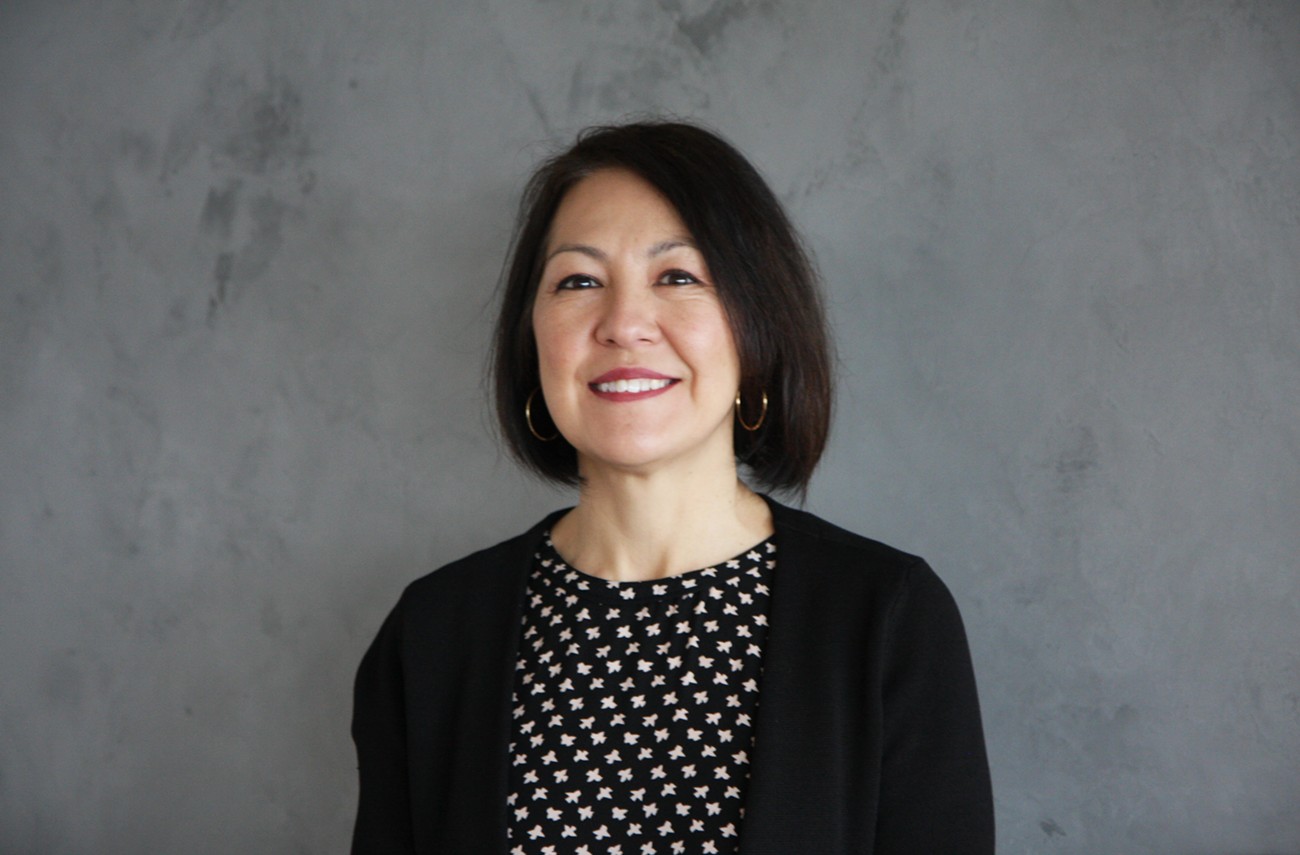
This election cycle in King County has the oft-overlooked but very impactful office of the county’s Prosecuting Attorney on the ballot, and the Stand for Children Washington PAC is proudly endorsing Leesa Manion in this race.

Leesa is the current Chief of Staff of the King County Prosecuting Attorney’s Office, where she has spearheaded projects aimed at protecting public safety, reducing racial inequity, strengthening victim services, and holding repeat criminals accountable.  She has a clear track record of creating programs that help young people learn from and acknowledge their mistakes while also repairing harm to the community and understanding that each young person has more human worth than the sum of their missteps.

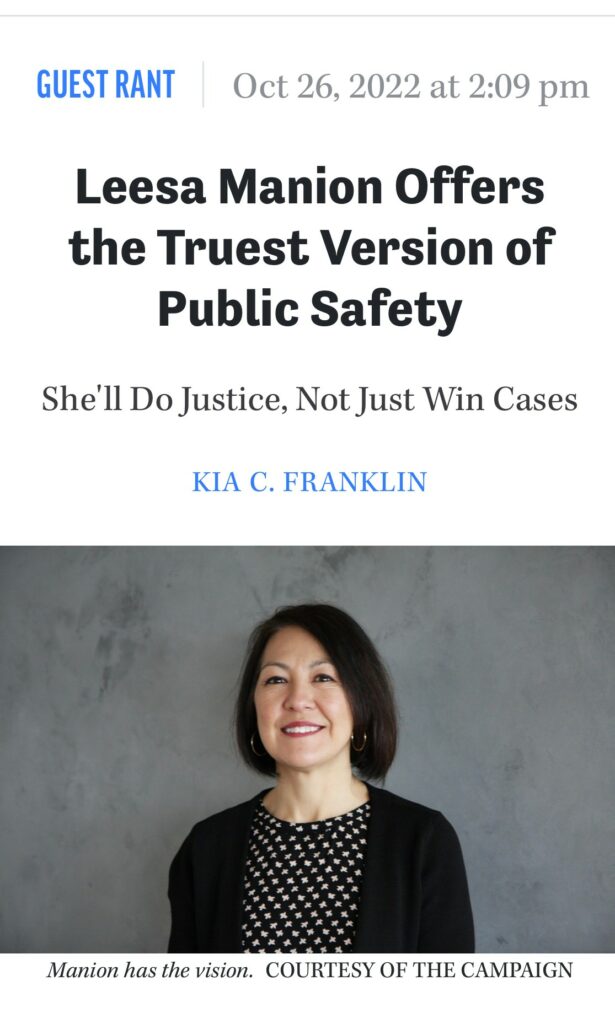
As election day approaches on November 8th, I felt compelled to set the record straight about Leesa’s candidacy and her data-driven approach to supporting young people and building safer communities. I made my case about why you should vote for Leesa this week in The Stranger. As you fill out your ballot, I encourage you to read it if you need more information.

If you haven’t voted yet, you can view our whole list of endorsed education and justice champions here. And no matter where you are in the state, you can find information about your ballot and voter guide at vote.wa.gov.

For anyone who has been impacted by court costs like fines, fees, or restitution as a young person – will you take our 3-minute survey? It will help support our advocacy to hopefully eliminate those fees in Washington state.

To access the survey link, please contact Meghan Grace at [email protected] or 510-984-4167 and she’ll send it to you.

This survey was developed by the Debt Free Youth Justice Washington coalition, which Stand for Children co-leads. We are a statewide coalition of directly-impacted advocates, community leaders, and policy experts committed to ending the harmful impacts of juvenile fees, fines, and restitution in Washington state.

PDF Version of Press Release Available Here

Ending “parent pay” – a 2022 Legislative Session priority for Stand for Children – allows Washington to uphold racial equity and help youth successfully transition into adulthood while eliminating a wasteful government policy

 “Parent pay” eliminated following overwhelming bipartisan support in State House and Senate, Governor’s signature

OLYMPIA – Today, the Department of Children Youth and Families (DCYF), Stand for Children, and the Center for Children and Youth Justice applaud Governor Inslee and the Washington State Legislature for adopting HB 2050 and ending “parent pay” in Washington State. Parent pay, which requires families to pay a percentage of their income to support their child’s incarceration, was a barrier to young peoples’ successful transition out of the juvenile system and toward a second chance. The policy had inequitable racial outcomes, created debt for families already struggling financially, and was an inefficient source of revenue for the state.

The coalition of voices that advocated for the elimination of parent pay in Washington applaud the legislation’s prime sponsors Representative Kirsten Harris-Talley and Senator Claire Wilson, as well as Governor Inslee, and the Department of Children Youth and Families. As a result of their leadership, HB 2050 earned broad bipartisan support in the House (85-13) and the Senate (41-6). A direct outcome of HB 2050 will be the ending of an ineffective, expensive, and harmful practice in Washington.

“Just as we support improvements in our education system that help students successfully transition into adulthood, Stand for Children was pleased to support this law, which will enable young people in our state to better transition toward the fresh start they deserve after navigating the juvenile court system,” said Kia Franklin, executive director of Stand for Children Washington. “This law meaningfully mitigates the devastating financial destabilization and debt that follows young people and their families at a time when they should be able to focus on moving forward.”

“DCYF has been working to eliminate practices that are harmful to children and their families, and particularly those practices that are financially stupid,” said Ross Hunter, DCYF Secretary.  “Requiring parents to pay for the incarceration of their children is a prime example – it probably costs more to collect than we bring in and may make it less likely for youth to reunify with their families, destabilizing their transition back to the community. We’re excited the Legislature repealed it!”

“The elimination of ‘Parent Pay’ moves us toward our vision of a more equitable, just, and truly rehabilitative system,” said Rachel Sottile, President & CEO of the Center for Children & Youth Justice. “It is one step in our collective effort to reform the youth criminal legal system; we must remain steadfast in eliminating all fines and fees. They are harmful, counterproductive, and racist. Fines and fees threaten the economic stability of families and entrench youth in a cycle of incarceration.”

Fines and fees in the juvenile system create significant obstacles for families who often become forced to choose between affording basic needs and paying the court. This is especially true for families of color and low-income households, who are disproportionately impacted at every decision point in the juvenile system. By eliminating economic sanctions like parent pay, Washington State is taking steps toward a more just judicial system—one without unnecessary, punitive, and long-term debt for families in crisis.

More than 22 states have taken steps to eliminate all or some juvenile costs, including fees like parent pay. Today, Washington continues to be a key driver in the movement to eliminate all juvenile fees nationwide.

Stand for Children Washington
As a nonprofit advocacy organization active in Washington since 2007, Stand for Children is a unique catalyst for education equity and racial justice, to create a brighter future for us all.

###

To stay updated on our ongoing efforts to eliminate all youth fines and fees, we’ve created an action alert for you to sign up if you’d like to tell us how you or your family has been personally impacted by juvenile court administrative fees: https://action.stand.org/F2Pj85g