Preparing students for the future should be guided by evidence, not extremes.
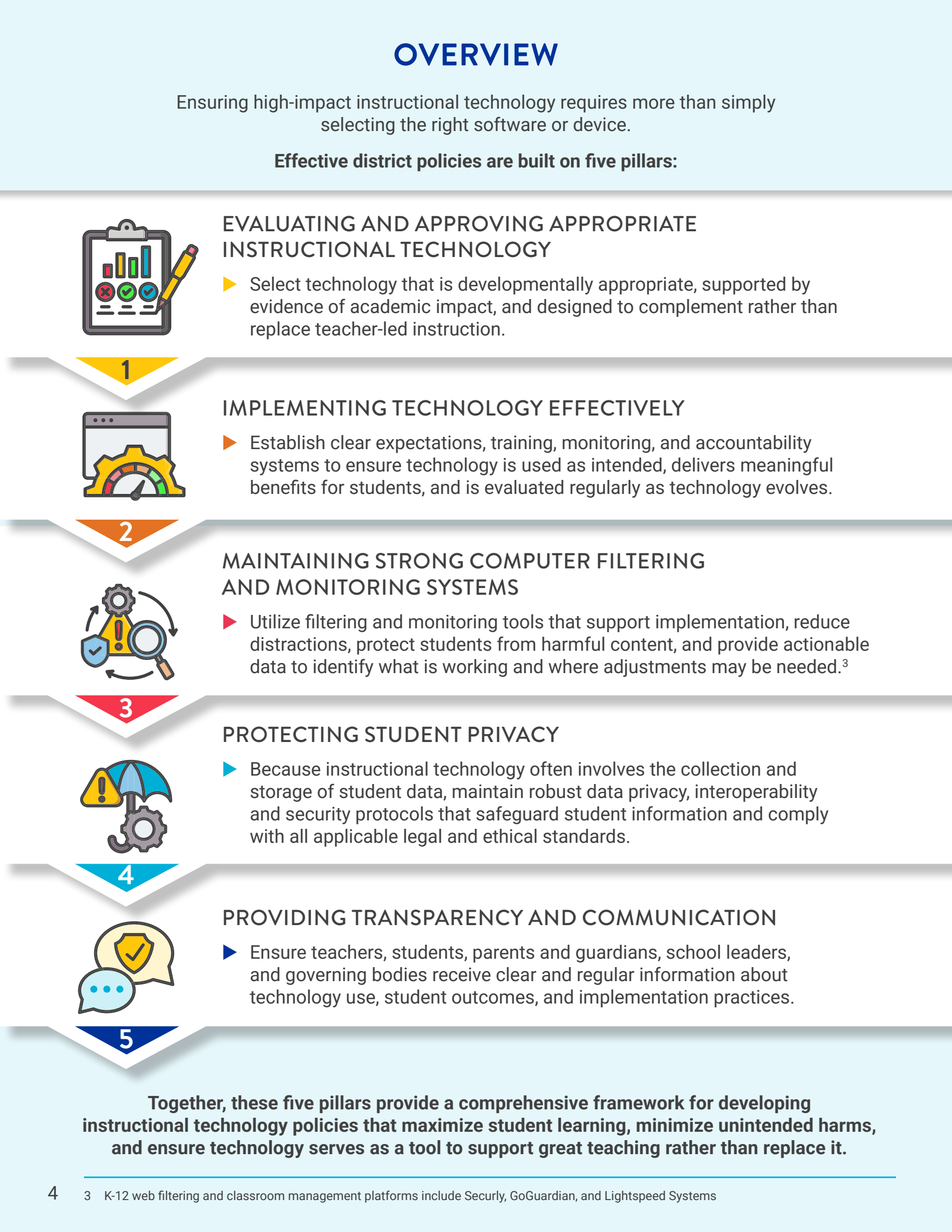
Instructional Technology and School-Issued Devices: District Policy Guidelines is a balanced, research-informed approach to determining how high-quality instructional technology, used in moderation and guided by educators, can accelerate learning.
Introduction
Across the country, school district leaders are under pressure to make decisions about instructional technology, school-issued devices, and internet filtering amid a polarized public debate. On one pole, instructional technology is treated as inherently beneficial and allowed to proliferate with few meaningful guardrails; on the other, it is treated as inherently harmful and something schools should ban entirely. Neither view is in the best interest of students.
Research shows that passive, non-educational screen time is harmful, while high-quality instructional technology, used in moderation and guided by educators, can accelerate learning. The central questions for district leaders to answer are when, where, and how instructional technology can improve educational outcomes.
To answer those questions effectively, districts should focus on screen value. Screen value is measured by the proven impact of instructional technology on student learning. Instructional technology that does not demonstrably improve learning has no place in the classroom, no matter how little time students spend on it. To add value, technology must serve clear learning objectives, align to students’ age, grade level, and state standards, and strengthen—not replace—teacher-led instruction and face-to-face learning.
In addition, districts must build guardrails that protect students while preparing them for the future. Students will live and work in a technology-rich world, so the goal should not be to keep technology out of schools but rather to ensure its productive use. Strong guardrails include both intentionality in what instructional technology is utilized as well as effective monitoring software, rigorous student data privacy protections, and transparency among schools, students, and parents about which tools are in-use, how they are used, and how student data is handled.
In Partnership With:



Download the District Policy Guide
Foreword by Jean-Claude Brizard, President and CEO, Digital Promise:
“At a moment when public pressure could push policy toward an extreme, these guidelines offer a different standard. Policymakers and educators should be selective, demand evidence, and minimize unnecessary use. At the end of the day, we must recognize that we have to judge technology by what matters most, and that’s whether it helps students learn.”
– Jean-Claude Brizard, President and CEO of Digital Promise