
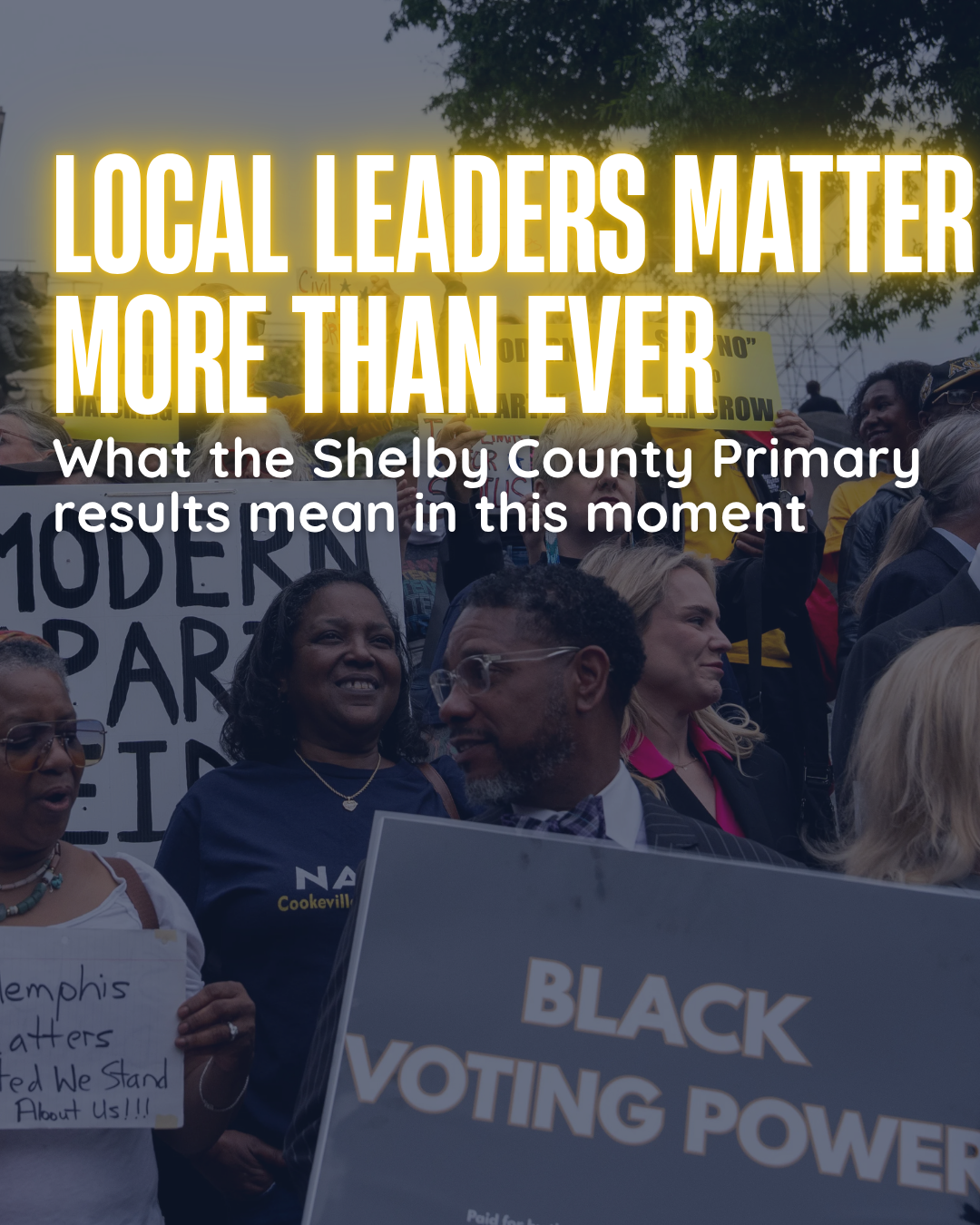
Now that the May 5 election is over, we are looking closely at the Shelby County primary results and want to congratulate the candidates who will move on to the general election.We also want to thank every candidate who stepped forward to serve our community during a moment when so much is at stake for Memphis and Shelby County.

This election happened in the shadow of major decisions that will shape our future for years to come.

While voters were casting ballots across Shelby County, Tennessee lawmakers passed the state takeover of Memphis-Shelby County Schools into law, stripping local communities of democratic control over our schools and placing enormous power into the hands of state-appointed officials. Days later, the Supreme Court’s decision in Louisiana v. Callais cleared the way for Tennessee Republicans to redraw congressional maps that carve Memphis into three separate districts stretching deep into rural, conservative Middle Tennessee – a blatant attack on Black voting power and fair representation. Check here to see how your district changed.

Taken together, these decisions remind us that we can’t afford to sit back and take our democracy for granted. They also remind us why local elections matter so deeply.

County government and school board leadership will continue to shape how public dollars are spent, what services families can rely on, how our justice system operates, and how we respond to the growing attacks on local control and community self-determination coming from the state and federal levels.

Congratulations to our endorsed candidates who advanced through the primary:

  • Sheriff: Anthony Buckner
  • County Commission:
    • Shante Avant, Henri E. Brooks, Amber Huett-Garcia, Will Richardson, Karen Streeter, Erika Sugarmon
  • School Board: Michelle McKissack

We also want to congratulate Mickell Lowery on his victory in the Democratic County Mayor primary. While we endorsed JB Smiley, Jr., we recognize the importance of this moment and look forward to working with Lowery and leaders across Shelby County to advance policies that strengthen our communities and improve the lives of everyday people.

And to our endorsed candidates who did not make it through, thank you for the campaigns you ran and the vision you brought to these races.

Thank you to J.B. Smiley, Jr. for a campaign grounded in bold ideas and a clear commitment to Shelby County’s future.

Thank you to John Bradley for stepping up to serve and for bringing important conversations and perspectives into the County Commission race.

And thank you to Ayleem Connolly, whose campaign inspired so many people across Shelby County. Ayleem represents the kind of thoughtful, values-driven leadership our community needs more of, and we’re confident this is only the beginning of her impact on Shelby County’s future.

Elections are important, but they’re only one part of building lasting change.

The real work continues after Election Day: staying engaged, organizing, holding elected officials accountable, and building relationships that allow communities to shape decisions long after campaigns end.

As Shelby County moves toward the general election and prepares to navigate the challenges ahead, we remain committed to working with elected officials, community partners, advocates, educators, parents, and residents across our county to build a brighter future rooted in opportunity, dignity, safety, and democratic participation.

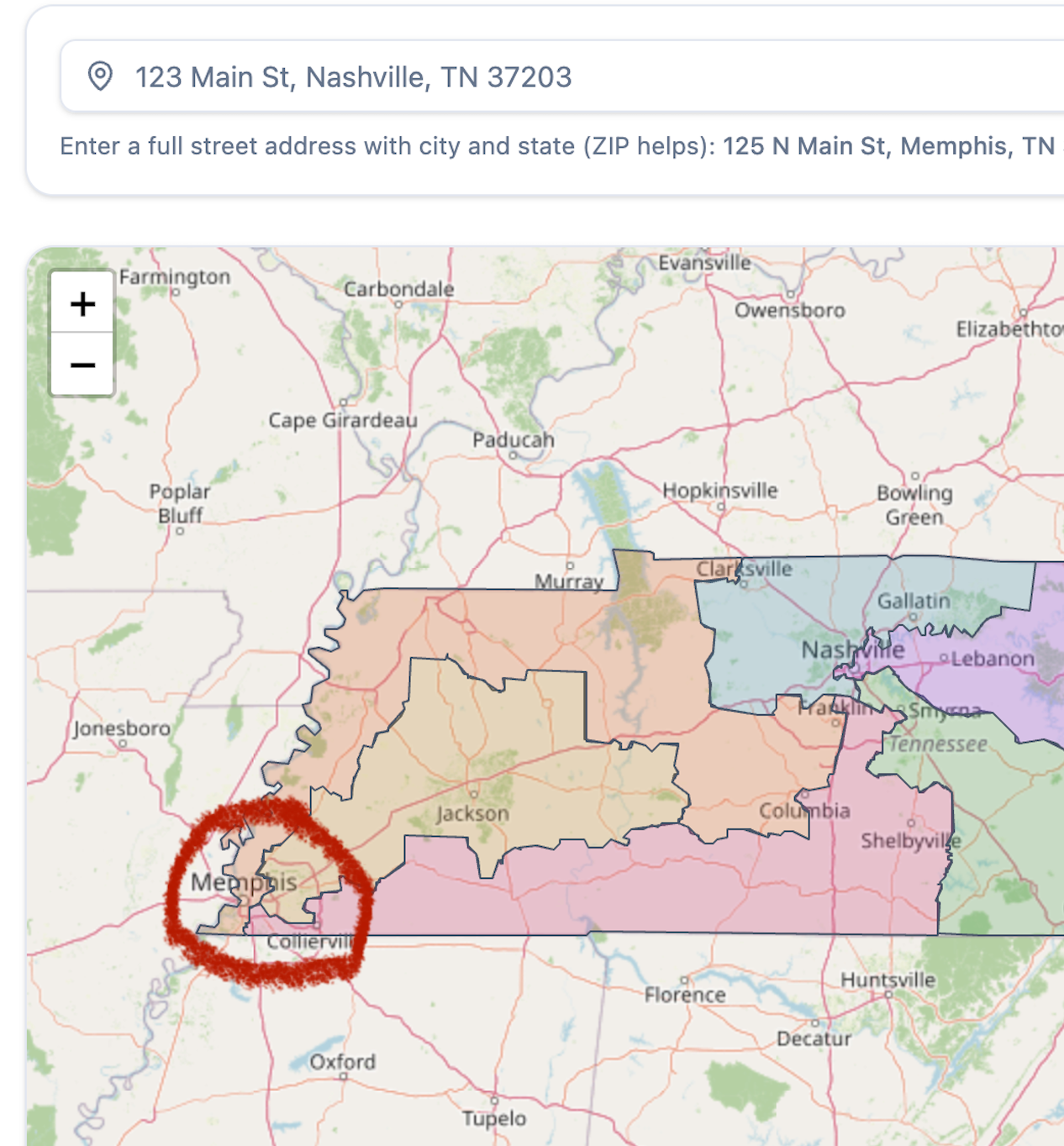
Tennessee’s Republican lawmakers officially passed a new Memphis congressional districts map that cracks the city into three separate districts, dismantling the state’s only majority-Black congressional district. But the fight’s not over.

Understanding your new district is critical to the ongoing fight for Memphis’ political power and representation. These maps were designed to divide our communities and dilute Black votes, but staying informed about where you live, who represents you, and how these districts are structured is a crucial step toward organizing strategically and continuing the fight for our city’s voice at the federal level.

Enter your address into the tool below to learn: your new congressional district and representative, how big your new district is, and which counties are now included. These new districts stretch into middle TN, meaning Memphians could now be “represented” by people who live hundreds of miles away from our city.

For generations, Memphis had a single congressional district that allowed our country’s largest majority-Black city to speak with a more unified voice at the federal level. By splitting Memphis into three separate districts that stretch deep into middle Tennessee, lawmakers diluted that collective power and tied Memphis neighborhoods to communities with very different political priorities and lived realities.

That has real consequences.

Our congressional representatives make decisions about federal funding, transportation, housing, healthcare, education, environmental protections, voting rights, disaster relief, and criminal justice policy. If we don’t know our district, we won’t know who represents us in Congress, which races we can vote in, or how these maps affect our community’s influence moving forward.

The changes also create confusion by design. Many longtime neighbors may now live in different congressional districts even though they share the same schools, infrastructure, and city services. Some Memphians could end up represented by elected officials who live hundreds of miles away and whose political base is centered outside of Shelby County altogether.

That distance matters because representation is not just about geography. It’s about relationships, accountability, and understanding the needs of the people you serve. Memphis has unique challenges and strengths tied to urban infrastructure, poverty, public transit, healthcare access, environmental justice, labor, and racial equity. When the city is fractured across districts dominated by other regions, there’s a real risk those priorities receive less attention at the federal level.

Knowing your district is the first step toward staying engaged and continuing to build political power even under maps designed to weaken it.

Within hours of the maps passing, the Tennessee NAACP filed an emergency court petition asking judges to block the map before it can be used. Additional legal challenges are expected from civil rights organizations and advocates across the state.

We can’t afford to give in to despair or apathy. We’re still here, and we’ll keep fighting. No map can erase the generations of Black organizing, leadership, and political power that have always existed in this city.

Take care of yourselves and your people, stay informed with the full Defend TN 9 website, and stay ready. We need all hands on deck in the fight ahead.

City redistricting determines which neighborhoods get resources and representation, and thanks to your emails and advocacy over the past year, the City Council answered our calls for a public redistricting process!

Earlier this year, we teamed up with the Shelby County Voter Alliance to gather support for including community voices in how our city’s maps are drawn, and we ramped up our efforts in September after the City Council voted to approve a new map drawn by unelected city attorney Allan Wade. We were told that the redistricting process would be an open one, redistricting meetings would appear clearly on the Council agenda, and that public input would be welcomed, but the new map was rushed through after meetings behind closed doors ahead of the special election in November to fill the District 4 seat vacancy.

In fact, this map was approved even though the August 23rd meeting was the first time the public–and even some of the Council members–had seen the proposed changes. Redrawing maps behind closed doors is undemocratic and shuts all of us out of important decisions that will affect our families, neighborhoods, and communities for the next decade. To get the word out and spur people to take action, we held a press conference and sent out a mailer to households around Memphis. We weren’t disappointed–Memphians flooded City Council members’ inboxes with emails calling for a fair process, and in October, City Council responded by passing a resolution sponsored by Councilwoman Michalyn Easter-Thomas to establish a public redistricting committee! 

The first public committee meeting was held on Tuesday, December 13, and we’re very much looking forward to the maps and community-centered insight they’ll bring forward in the new year ahead of the city elections.